

Ex-PM Khan's Pakistan Tehreek-e-Insaf party wins NA-245 Karachi by-election

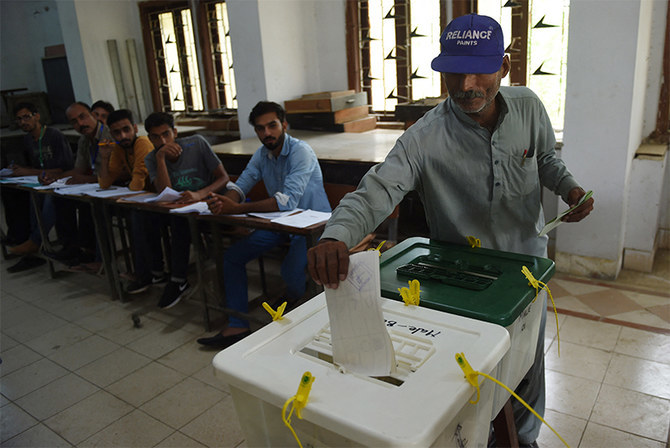
Pakistani man casts his vote at a polling station during general election in Karachi on July 25, 2018. (AFP/FILE)
Short Url
Updated 21 August 2022
Follow

Ex-PM Khan's Pakistan Tehreek-e-Insaf party wins NA-245 Karachi by-election

  • PTI candidate Mehmood Baqi Molvi bagged a total of 29,475 votes in Sunday's by-election
  • Molvi was trailed by Muttahida Qaumi Movement-Pakistan's Moid Anwer with 13,193 votes

ISLAMABAD: Former prime minister Imran Khan's Pakistan Tehreek-e-Insaf (PTI) party on Sunday won the by-election in the National Assembly constituency NA-245 in the southern Pakistani port city of Karachi, according to official preliminary results.  

PTI candidate Mehmood Baqi Molvi bagged 29,475 votes in Sunday's by-polls, according to preliminary results shared by the Election Commission of Pakistan. Muttahida Qaumi Movement-Pakistan's (MQM-P) Moid Anwer stood runner-up with 13,193 votes, while Muhammad Ahmed Raza of Tehreek-e-Labbaik Pakistan (TLP) finished third by securing 9,836 votes. 

The National Assembly seat fell vacant after PTI stalwart Dr. Aamir Liaquat Hussain, a controversial religious talk show host and legislator, passed away on June 9.  

"After the Punjab by-elections, Tehreek-e-Insaf also succeeded in Karachi today," PTI leader Asad Umar said on Twitter.  

"Whatever others decide, Pakistani nation has decided only [in favour of] Imran Khan." 


Polling for the by-election commenced at 8am and continued uninterrupted till 5pm, with the process remaining largely peaceful. The ECP on Sunday warned that it will not tolerate interference in the polling process as voting commenced for the NA-245 by-election in Pakistan’s southern port city of Karachi.   

In 2018 general elections, PTI’s Hussain won the NA-245 election after bagging 56,673 votes, followed by MQM-P's Sattar, who had secured 35,429 votes. TLP’s Muhammad Ahmed Raza bagged 20,737 votes.   

According to the election commission, the NA-245 constituency had a total of 515,003 registered voters, of which 274,987 were male while 240,016 were female voters. The by-election takes place exactly one week before political parties once again flex their muscles for local government elections in Sindh.   

On Saturday, Chief Election Commissioner Sikander Sultan Raja directed ECP officials to ensure the polling process was held in a transparent manner. “Under any circumstances, make sure the election is held in a peaceful and transparent manner,” the ECP quoted him as saying.   

“All law enforcement agencies should be alert; interference in polling will not be tolerated,” Raja said. “Strict action will be taken against those found violating the rules." 


Earlier this month, the Pakistan Peoples Party (PPP) and the Jamiat Ulema-e-Islam-Fazl (JUI-F) parties had withdrawn their candidates from the NA-245 constituency to support the MQM-P candidate.  

PPP representative Saeed Ghani said the decision to support MQM-P had been taken by parties that form the coalition government. 


Islamabad dismisses claims about paying up to 8 percent interest on foreign loans as ‘misleading’

Updated 22 February 2026
Follow

Islamabad dismisses claims about paying up to 8 percent interest on foreign loans as ‘misleading’

  • Pakistan has long relied on external loans to help bridge persistent gaps in public finances and foreign exchange reserves
  • Pakistan’s total external debt, liabilities stand at $138 billion at an overall average cost of around 4 percent, ministry says

KARACHI: Pakistan’s finance ministry on Sunday dismissed as “misleading” claims that the country is paying up to 8 percent interest on external loans, saying the overall average cost of external public debt is approximately 4 percent.

Pakistan has long relied on external loans to help bridge persistent gaps in public finances and foreign exchange reserves, driven largely by a narrow tax base, chronic trade deficits, rising debt-servicing costs and repeated balance-of-payments pressures.

Over the decades, successive governments have turned to multilateral and bilateral lenders, including the International Monetary Fund, the World Bank and the Asian Development Bank, to support budgetary needs and shore up foreign exchange reserves.

The finance ministry on Sunday issued a clarification in response to a “recent press commentary” regarding the country’s external debt position and associated interest payments, and said the figures required contextual explanation to ensure accurate understanding of Pakistan’s external debt profile.

“Pakistan’s total external debt and liabilities currently stand at $138 billion. This figure, however, encompasses a broad range of obligations, including public and publicly guaranteed debt, debt of Public Sector Enterprises (both guaranteed and non-guaranteed), bank borrowings, private-sector external debt, and intercompany liabilities to direct investors. It is therefore important to distinguish this aggregate figure from External Public (Government) Debt, which amounts to approximately $92 billion,” it said.

“Of the total External Public Debt, nearly 75 percent comprises concessional and long-term financing obtained from multilateral institutions (excluding the IMF) and bilateral development partners. Only about 7 percent of this debt consists of commercial loans, while another 7 percent relates to long-term Eurobonds. In light of this composition, the claim that Pakistan is paying interest on external loans ‘up to 8 percent’ is misleading.

The overall average cost of External Public Debt is approximately 4 percent, reflecting the predominantly concessional nature of the borrowing portfolio.”

With respect to interest payments, public external debt interest outflows increased from $1.99 billion in Fiscal Year (FY) 2022 to $3.59 billion in FY2025, representing an increase of 80.4 percent, not 84 percent as reported. In absolute terms, interest payments rose by $1.60 billion over this period, not $1.67 billion, it said.

According to the State Bank of Pakistan’s records, Pakistan’s total debt servicing payments to specific creditors during the period under reference were as follows: the IMF received $1.50 billion, of which $580 million constituted interest; Naya Pakistan Certificates payments totaled $1.56 billion, including $94 million in interest; the Asian Development Bank received $1.54 billion, including $615 million in interest; the World Bank received $1.25 billion, including $419 million in interest; and external commercial loans amounted to nearly $3 billion, of which $327 million represented interest payments.

“While interest payments have increased in absolute terms, this rise cannot be attributed solely to an expansion in the debt stock,” the ministry said. “Although the overall debt stock has increased slightly since FY2022, the additional inflows have primarily originated from concessional multilateral sources and the IMF’s Extended Fund Facility (EFF) under the ongoing IMF-supported program.”

Pakistan secured a $7 billion IMF bailout in Sept. 2024 as part of Prime Minister Shehbaz Sharif’s efforts to stabilize the South Asian economy that narrowly averted a default in 2023. The government has since been making efforts to boost trade and bring in foreign investment to consolidate recovery.

“It is also important to note that the increase in interest payments reflects prevailing global interest rate dynamics. In response to the inflation surge of 2021–22, the US Federal Reserve raised the federal funds rate from 0.75-1.00 percent in May 2022 to 5.25–5.50 percent by July 2023. Although rates have since moderated to around 3.75 percent, they remain significantly higher than 2022 levels,” the finance ministry said.

“The government remains committed to prudent debt management, transparency, and the continued strengthening of Pakistan’s macroeconomic stability,” it added.