RCU announces birth of Arabian leopard cubs, US embassy congratulates

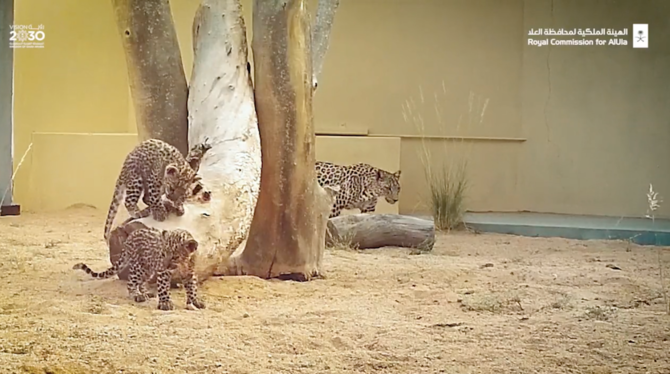
Two female Arabian leopard cubs were born in Prince Saud Al-Faisal Center for Wildlife Research last week. (Screenshot/RCU)
Short Url
Updated 21 August 2022
Follow

RCU announces birth of Arabian leopard cubs, US embassy congratulates

  • RCU tweeted video of newborn Arabian leopard cubs playing together at Prince Saud Al-Faisal Center for Wildlife Research

JEDDAH: The Royal Commission for AlUla (RCU) has announced the birth of two female Arabian leopard cubs, one of the world’s most endangered animals.

The RCU tweeted a video of the newborn Arabian leopard cubs playing together at the Prince Saud Al-Faisal Center for Wildlife Research, where they were born.

The US embassy in Riyadh praised the efforts of the RCU in preserving one of the most endangered species via a message on Twitter: “We congratulate Saudi Arabia on the birth of “two female” Arabian leopard cubs. RCU is doing a great job when it comes to preserving one of the most endangered animals.”


The news received thousands of positive reactions from many animal lovers from countries around the globe including Japan, India, Canada, Ukraine, the US and France.

The RCU’s strategy to preserve the Arabian leopard includes initiatives such as the expansion of a breeding program through the opening of the Arabian Leopard Breeding Center in the Sharaan Nature Reserve, and the establishment of a $25 million Global Fund for the Arabian Leopard. 

The Arabian Leopard’s habitat has historically been ecologically diverse. The RCU tweeted: “In #AlUla, we work to safeguard the Arabian Leopard from extinction, restore ecosystems and meet our #SaudiGreenInitiative & #SaudiVision2030 objectives.”

Only a handful of the magnificent animals are thought to survive in the whole Arabian Peninsula, holding out in the last refuge in Oman’s Dhofar mountains.

What makes Arabian leopards vulnerable is that they are solitary animals, they live alone and mate in the winter, their gestation period is 100 days, and the female Arabian leopard gives birth at an annual rate of one to two cubs only.

The Arabian leopard is classified on the International Union for Conservation of Nature’s Red List as “critically endangered.” It is all but extinct in the wild.

However, the commitment to preserving the Arabian leopard runs deep in Saudi Arabia, and in June 2016 Prince Badr bin Abdullah bin Farhan, Saudi Arabia’s minister of culture and the RCU, signed an agreement with Panthera, committing the commission to invest $20 million over 10 years to aid global conservation of the leopard and to revitalize the Arabian leopard population.

This year, the Kingdom celebrated its first Arabian Leopard Day in February. The occasion will take place annually on February 10 to raise awareness about the endangered big cat.

Rewilding Arabia
Return of the leopard is at the heart of plans to conserve and regenerate Saudi Arabia’s landscapes and wildlife

Enter


keywords

Threat to Kingdom’s security is ‘red line’ that will be ‘addressed and neutralized,’ Saudi envoy says

Updated 14 January 2026
Follow

Threat to Kingdom’s security is ‘red line’ that will be ‘addressed and neutralized,’ Saudi envoy says

  • Abdulaziz Alwasil tells UN Security Council the situation in southern Yemen is ‘a just cause with social and historic dimensions’ that can only be resolved through dialogue
  • Recent military activity in the south was unilateral, resulting in an escalation that harms the interests of Yemeni people and undermines efforts to address issues in the south, he said

NEW YORK CITY: Any attempt to threaten Saudi Arabia’s national security is a “red line” and will be met with decisive action, the Kingdom’s ambassador to the UN told the Security Council on Wednesday.

Speaking during a meeting of the council to discuss Yemen, Abdulaziz Alwasil said the situation in the south of the country is “a just cause with social and historic dimensions” that can only be resolved through dialogue.

“We stress that any attempt to threaten our national security is a red line, and we will not hesitate to take the necessary actions and steps to address it and neutralize it,” he added.

Alwasil reaffirmed Saudi Arabia’s support for Yemeni President Rashad Al-Alimi, the Presidential Leadership Council, and the Yemeni government in their efforts to achieve security, stability, development and peace while preserving national unity.

He said military activity by Southern Transitional Council forces in Hadramout and Al-Mahra on Dec. 2, 2025, was unilateral, did not have the approval of the Presidential Leadership Council, and was not carried out in coordination with the Coalition to Restore Legitimacy in Yemen.

It had resulted in an unjustified escalation that harmed the interests of the Yemeni people, undermined efforts to address the issues in the south, and ran counter to the coalition’s objectives, Alwasil added.

The Kingdom, working with its coalition partners, the Presidential Leadership Council and the Yemeni government, had moved to contain the situation by dispatching a military force to coordinate arrangements with the Southern Transitional Council in Aden, he said.

The aim was to ensure the return of the southern council’s forces to their previous positions outside of Hadramout and Al-Mahra, and the handover of camps to legitimate government forces and local authorities in line with agreed procedures, Alwasil added.

He expressed regret over the military operations that took place in Hadramout and Al-Mahra, close to Saudi Arabia’s southern border, which he said posed a direct threat to the Kingdom’s national security, as well as the security of Yemen and regional stability. Such steps were extremely dangerous, he added, and contradicted the principles on which the Coalition to Restore Legitimacy in Yemen had been founded.

Alwasil welcomed a prisoner and detainee exchange agreement signed in Muscat on Dec. 23, which he described as an important humanitarian measure to alleviate suffering and build confidence.

He praised Oman for hosting and sponsoring the consultations and supporting negotiations, and commended the efforts of UN’s special envoy for Yemen, Hans Grundberg, the International Committee of the Red Cross and all others that has played a part.

Regarding the political efforts to resolve the crisis, Alwasil said Saudi Arabia welcomed President Al-Alimi’s call for an inclusive conference in Riyadh to bring together all stakeholders to discuss just solutions to the situation in southern Yemen.

Preparations for the conference have begun, he added, in cooperation with the Yemeni government and southern representatives, reflecting the close ties between the two countries and their shared interests in stabilizing Yemen.

He urged all southern stakeholders to participate actively and constructively in the talks, to help find comprehensive and just solutions that meet the legitimate aspirations of the people of southern Yemen.

Alwasil called on all Yemeni forces and stakeholders to cooperate and intensify their efforts to reach a lasting political settlement that would ensure security and stability.

He described the southern issue as “a just cause with social and historic dimensions,” adding that “the only way to address it is through dialogue that leads to a comprehensive political solution” based on nationally and internationally agreed terms of reference.