

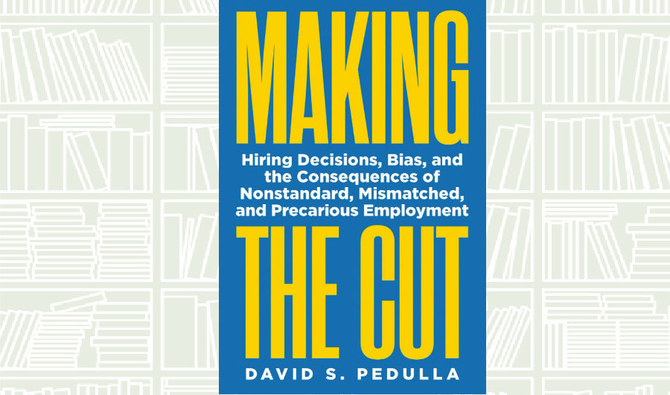
What We Are Reading Today: Making the Cut

Photo/Supplied
Short Url
Updated 20 August 2022
Follow

What We Are Reading Today: Making the Cut

  • Making the Cut explores how key gatekeepers—HR managers, recruiters, and talent acquisition specialists—evaluate workers with nonstandard, mismatched, or precarious employment experience

Author: David Pedulla

Millions of workers today labor in nontraditional situations involving part-time work, temporary agency employment, and skills underutilization or face the precariousness of long-term unemployment. To date, research has largely focused on how these experiences shape workers’ well-being, rather than how hiring agents perceive and treat job applicants who have moved through these positions. Shifting the focus from workers to hiring agents, Making the Cut explores how key gatekeepers—HR managers, recruiters, and talent acquisition specialists—evaluate workers with nonstandard, mismatched, or precarious employment experience. Factoring in the social groups to which workers belong—such as their race and gender—David Pedulla shows how workers get jobs, how the hiring process unfolds, who makes the cut, and who does not.
Drawing on a field experiment examining hiring decisions in four occupational groups and in-depth interviews with hiring agents in the US, Pedulla documents and unpacks three important discoveries.


What We Are Reading Today: Can College Level the Playing Field? 

Updated 13 March 2026
Follow

What We Are Reading Today: Can College Level the Playing Field? 

Authors: Sandy Baum and Michael McPherson

We often think that a college degree will open doors to opportunity regardless of one’s background or upbringing. In this eye-opening book, two of today’s leading economists argue that higher education alone cannot overcome the lasting effects of inequality that continue to plague us, and offer sensible solutions for building a more just and equitable society.

Sandy Baum and Michael McPherson document the starkly different educational and social environments in which children of different races and economic backgrounds grow up, and explain why social equity requires sustained efforts to provide the broadest possible access to high-quality early childhood and K–12 education. 

They dismiss panaceas like eliminating college tuition and replacing the classroom experience with online education.