

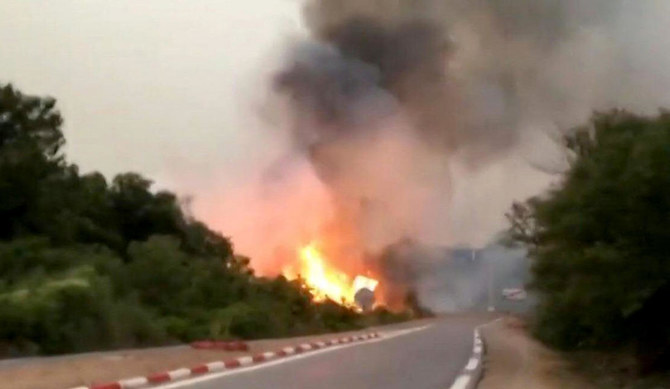
Deadly wildfires contained in Algeria after homes, livelihoods lost

Deadly fires have become an annual scourge in Algeria. (AFP)
Short Url
Updated 19 August 2022
Follow

Deadly wildfires contained in Algeria after homes, livelihoods lost

  • Justice Ministry launches inquiry after interior minister suggests some of this year’s blazes were started deliberately

ALGIERS: Wildfires which killed at least 38 people across northern Algeria have been contained, firefighters said Friday, as volunteers mobilized to help those who lost homes and livelihoods in the tragedy.

“All of the fires have been completely brought under control,” said fire brigade Col. Farouk Achour, of the civil defense department.
Fierce fires have become an annual fixture in Algeria’s parched forests where climate change exacerbates a long-running drought.
Since the beginning of August, almost 150 blazes have devastated hundreds of hectares.

BACKGROUND

Experts have called for a major effort to bolster the firefighting capacity of Algeria, which has more than four million hectares of forest.

In the badly hit region of El Tarf, farmers examined the charred remains of their animals killed when flames swept through the area.
The fire “didn’t spare anything,” said one farmer, Hamdi Gemidi, 40, who walked in rubber sandals on the ash-covered earth where the carcasses of what appeared to be sheep lay.
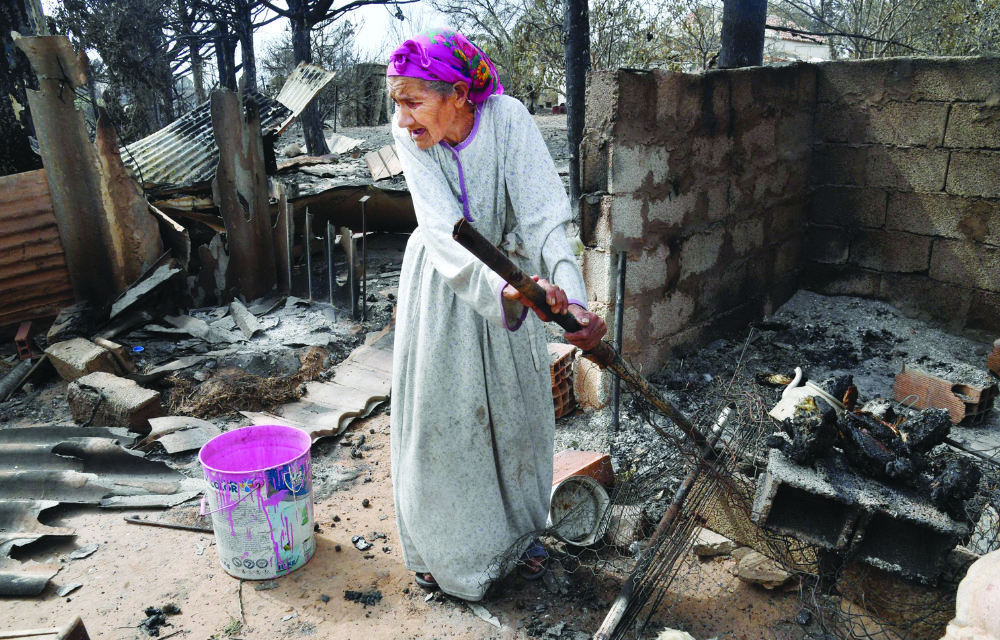


An elderly Algerian woman reacts inside the ruins of her home. (AFP)

“This is our livelihood ... We have nowhere to go and nothing to make a living from.”
Ghazala, 81, said she had been rescued along with a few animals after flames came dangerously close to her house.
“I don’t know where to go now. Should I stay in the fields, forests or mountains?” she asked, on the verge of tears.
“I really don’t know where I should go.”
The Justice Ministry launched an inquiry after Interior Minister Kamel Beldjoud suggested some of this year’s blazes were started deliberately, and authorities on Thursday announced four arrests of suspected arsonists.
But officials have also been accused of a lack of preparation, with few firefighting aircraft available despite record casualties in last year’s blazes and a cash windfall from gas exports with global energy prices soaring.
Authorities said they deployed more than 1,700 firefighters over Wednesday and Thursday.
The dead included more than 10 children and a similar number of firefighters, according to multiple sources including local journalists and the fire service.
Most were in the El Tarf region near Algeria’s eastern border with Tunisia, an area which was sweltering earlier this week in 48 degree Celsius heat.
Algerians both at home and in the diaspora have mobilized to collect clothing, medicines and food to help those affected.
Late on Thursday, dozens of trucks carrying humanitarian aid from various cities arrived in El Tarf, regional authorities said.
European Union foreign policy chief Josep Borrell also offered support to Algerians “hard-hit by the terrible fires.”
Writing on Twitter, he said: “The EU stands by your side in these difficult times.”
Twelve people burned to death in their bus as they tried to escape when fire ripped through an animal park, a witness who asked not to be named said.
When “nobody came to help us, neither the fire service nor anyone else,” park staff assisted families with young children to escape as flames encroached on the area, Takeddine, a worker at the park, said.
Fires last year killed at least 90 people and seared 100,000 hectares of forest and farmland in the country’s north.
Experts have called for a major effort to bolster the firefighting capacity of Algeria, which has more than 4 million hectares of forest.
Algeria had agreed to buy seven firefighting aircraft from Spanish firm Plysa, but canceled the contract following a diplomatic row over the Western Sahara in late June, according to specialist website Mena Defense.
Spain, too, has this year battled hundreds of wildfires following punishing heat waves and long dry spells.
On Thursday, Algeria’s Prime Minister Aimene Benabderrahmane defended the government’s response.
He said his country had ordered four new firefighting aircraft but they would not be available until December.
The prime minister added that strong winds had exacerbated the fires and authorities deployed “all their means” to extinguish them.


Aoun slams ‘systematic policy of aggression’ as Israeli strikes kill 2, wound journalists in south Lebanon escalation

Updated 4 sec ago
Follow

Aoun slams ‘systematic policy of aggression’ as Israeli strikes kill 2, wound journalists in south Lebanon escalation

  • Lebanese Army: Attacks terrorize civilians and hinder weapons control plan
  • Israeli army spokesperson said military eliminated Abu Ali Salameh, who served as a Hezbollah liaison officer in the area
  • Israeli drones targeted sites with heavy airstrikes, wounding journalists in Qanarit and destroying their equipment, cameras and vehicles

BEIRUT: Two people were killed and several journalists wounded in a series of Israeli attacks on Wednesday targeting southern areas, most of which lie north of the Litani River.

The Lebanese Army Command described the escalation as “impeding the army’s efforts and hindering the completion of its plan to confine weapons to Lebanese territory.” It said that the strikes terrorized civilians, caused deaths and injuries, displaced dozens of families and undermined regional stability.

The day’s security situation was dominated by hours of Israeli escalation, including airstrikes and evacuation warnings targeting villages and populated areas ahead of further bombardment.

The Israeli army said that warplanes carried out precision strikes on civilian vehicles in Bazouriyeh, killing a Hezbollah member. A separate drone strike hit a civilian vehicle on the Zahrani-Mseileh road, killing one person, with Israel claiming the target was another Hezbollah operative.

Israeli army spokesman Avichai Adraee said that the military “eliminated Abu Ali Salameh, who served as a Hezbollah liaison officer” in the village of Yanouh, in southern Lebanon. He accused Salameh of managing Hezbollah activities to “enable the group to operate within civilian areas and on private property, and to establish terrorist infrastructure in the heart of populated civilian areas, through the deliberate and cynical exploitation of the residents to serve Hezbollah’s objectives.”

Adraee claimed that on Dec. 13, Israel alerted Lebanon’s enforcement mechanism about a Hezbollah weapons depot in Yanouh. Salameh allegedly relayed the notification to other Hezbollah members, who then blocked Lebanese army access by staging a gathering while removing weapons from the site.

He said that Salameh also coordinated with the Lebanese army to falsely document the property as weapons-free, even as “suspicious boxes” were removed via a back entrance. Adraee called these actions a violation of Israel-Lebanon understandings, adding that “the Israeli army will continue to take measures to eliminate all threats.”

Israeli artillery also shelled the Harmoun area in the Bint Jbeil district, south of the Litani River, prompting Israeli army warnings — complete with maps — for residents of Qanarit, Kfour in Nabatieh and Jarjouh to evacuate immediately.

Israeli drones then hammered the sites with heavy airstrikes, wounding journalists in Qanarit and destroying their equipment, cameras and vehicles.

The Press Photographers Syndicate said: “Israeli claims of maintaining safe distances offer no protection, just as the warnings issued by the enemy to civilians offer no protection. It seems that cameras are not a red line.”

The statement urged photojournalists “to exercise caution and avoid turning their professional commitment into a reckless gamble.” 

Civilians in the targeted areas reported receiving phone calls from Israel ordering them to clear squares, residential neighborhoods and a mosque.

The Lebanese Army Command confirmed that “Israeli attacks and violations targeted civilian buildings and homes in several areas, most recently in villages in the south, in a blatant violation of Lebanon’s sovereignty and security, the cessation of hostilities agreement, and UN Security Council Resolution 1701.”

Lebanese President Joseph Aoun issued a statement on Wednesday evening condemning the strikes and accused Tel Aviv of “pursuing a systematic policy of aggression” that targeted civilians and violated international humanitarian law, and constituted “a dangerous escalation.”

“This repeated aggressive behavior proves Israel’s refusal to abide by its commitments under the cessation of hostilities agreement and reflects a deliberate disregard for the efforts exerted by the Lebanese state to control the situation on the ground, maintain stability, and prevent the escalation of the confrontation,” he said.

He called on the international community — particularly the agreement’s sponsors — “to assume their legal and political responsibilities and take clear and effective measures to stop these violations and put an end to the policy of impunity.”

The escalation also came as Aoun reaffirmed his commitment to “monopolizing weapons in the hands of the state throughout all Lebanese territory.”

At a meeting of the Higher Supervisory Committee for Lebanon’s border protection program — attended by the US and Canadian ambassadors — Army Commander Gen. Rudolph Haykal stressed the army’s “absolute commitment” to securing borders but called for “qualitative military support” to tackle challenges on the northern and eastern fronts.

The army said that the ambassadors praised “its professionalism and success,” stressing the need to bolster the military institution to enhance its ability to maintain security nationwide. Lebanese military units are currently securing the northern and eastern borders with Syria to combat smuggling, weapons transfers and illegal infiltration.