

Anger of Muslims at Salman Rushdie understandable, attack ‘terrible’ — ex-PM Khan

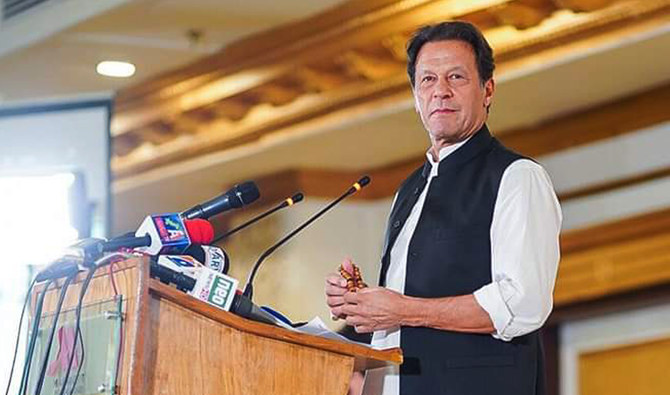
Pakistan Tehreek-e-Insaf chairperson Imran Khan addresses a seminar on freedom of expression in Islamabad on August 18, 2022. (Twitter/WaqasAliJafri)
Short Url
Updated 19 August 2022
Follow

Anger of Muslims at Salman Rushdie understandable, attack ‘terrible’ — ex-PM Khan

  • Ten years ago, Khan pulled out of event in India because Rushdie would also be appearing, the two men exchanged insults
  • When asked for his response to knife attack that left Rushdie badly wounded, Khan told the Guardian: “It’s terrible, sad“

ISLAMABAD: Pakistan’s former prime minister Imran Khan has condemned the attack on novelist Salman Rushdie, describing it as “terrible” and “sad,” and saying while the anger of the Muslim world over Rushdie’s book The Satanic Verses was understandable, it did not justify the assault.

Ten years ago, Khan pulled out of an event in India because Rushdie would also be appearing and the two men exchanged insults. But in a wide-ranging interview with the Guardian published on Friday, when asked for his response to the knife attack in New York state that left Rushdie badly wounded, Khan said: “I think it’s terrible, sad.”

“Rushdie understood [why his book was offesnive], because he came from a Muslim family. He knows the love, respect, reverence of a prophet that lives in our hearts. He knew that,” Khan said. “So the anger I understood, but you can’t justify what happened.”

The man accused of stabbing Rushdie last week in western New York pleaded not guilty to second-degree attempted murder and assault charges on Thursday and was held without bail.

Hadi Matar, 24, is accused of wounding Rushdie, 75, on Friday just before the author was to deliver a lecture on stage at an educational retreat near Lake Erie. Rushdie was hospitalized with serious injuries in what writers and politicians around the world decried as an attack on the freedom of expression.

The attack came 33 years after Ayatollah Ruhollah Khomeini, then Iran’s supreme leader, issued a fatwa, or religious edict, calling on Muslims to assassinate Rushdie a few months after “The Satanic Verses” was published. Many Muslims saw passages in the book about the Prophet Muhammad as blasphemous.

Rushdie, who was born in India to a Muslim Kashmiri family, has lived with a bounty on his head, and spent nine years in hiding under British police protection.

In 1998, Iran President Mohammad Khatami government distanced itself from the fatwa, saying the threat against Rushdie was over.

But the multimillion-dollar bounty has since grown and the fatwa was never lifted: Khomeini’s successor, Supreme Leader Ayatollah Ali Khamenei, was suspended from Twitter in 2019 for saying the fatwa against Rushdie was “irrevocable.”


Pakistan urges pilgrims to complete Saudi biometrics as Hajj preparations gain pace

Updated 30 January 2026
Follow

Pakistan urges pilgrims to complete Saudi biometrics as Hajj preparations gain pace

  • Government warns pilgrims biometric verification is required for Hajj visas
  • Step follows tighter oversight after last year’s Hajj travel disruptions

ISLAMABAD: Pakistan’s government on Friday urged aspiring pilgrims to complete mandatory Saudi biometric verification for Hajj visas, as preparations for the 2026 pilgrimage gather pace following stricter oversight of the Hajj process.

The announcement comes only a day after Pakistan’s Religious Affairs Minister Sardar Muhammad Yousuf said regulations for private Hajj operators had been tightened, reducing their quota following widespread complaints last year, when tens of thousands of pilgrims were unable to travel under the private Hajj scheme.

“Saudi biometric verification is mandatory for the issuance of Hajj visas,” the Ministry of Religious Affairs said in a statement, urging pilgrims to complete the process promptly to avoid delays.

“Hajj pilgrims should complete their biometric verification at home using the ‘Saudi Visa Bio’ app as soon as possible,” it added.

The statement said the pilgrims who were unable to complete biometric verification through the mobile application should visit designated Saudi Tasheer centers before Feb. 8, adding that details of the centers were available on Pakistan’s official Hajj mobile application.

Pakistan has been steadily implementing digital and procedural requirements for pilgrims ahead of Hajj 2026, including mandatory training sessions, biometric checks and greater use of mobile applications, as part of efforts to reduce mismanagement.

Saudi Arabia has allocated Pakistan a quota of 179,210 pilgrims for Hajj 2026, with the majority of seats reserved under the government scheme and the remainder allocated to private tour operators.