Russian ship carrying ‘plundered’ Ukraine grain reaches Syria: embassy

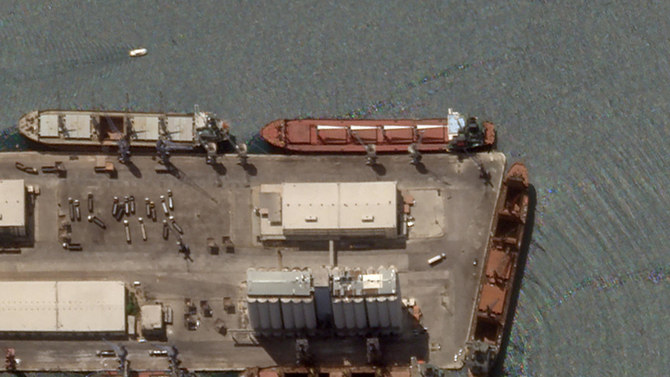
A ship carrying first Ukraine grain cargo docks at the Tartus port in Syria on August 15, 2022. (Reuters)
Short Url
Updated 18 August 2022
Follow

Russian ship carrying ‘plundered’ Ukraine grain reaches Syria: embassy

  • "According to our information, SV KONSTANTIN has docked in Syria," the embassy said
  • It said the ship was carrying "grains that were plundered and illegally transported by the Russian occupation authorities"

BEIRUT: A Russian cargo ship allegedly carrying stolen Ukrainian grain has reached Syria, Kyiv’s embassy in Beirut said Thursday, the latest in a series of contested shipments arriving in the war-torn country.
“According to our information, SV KONSTANTIN has docked in Syria,” the embassy said in a statement to AFP.
It said the ship was carrying “grains that were plundered and illegally transported by the Russian occupation authorities,” adding that the vessel was initially destined for the Lebanese port of Tripoli.
Ukraine has repeatedly accused Russian forces of ransacking its grain warehouses since they invaded the country in late February.
The embassy’s statement came as another cargo ship carrying the first shipment of grain allowed to leave Ukraine under a UN-backed deal reportedly unloaded its cargo at the Syrian port of Tartus, which is managed by a Russian firm.
The Sierra Leone-flagged vessel Razoni was expected to arrive in Lebanon, but the shipment’s five-month delay prompted the Lebanese buyer to cancel the deal once the ship was already at sea, Ukrainian officials had said.
According to Samir Madani, co-founder of oil shipping monitoring website TankerTrackers.com, the vessel docked in Tartus earlier this week.
Satellite imagery appeared to show that the ship — which was carrying 26,000 tons of corn — was unloading its cargo, Madani tweeted on Thursday.
Earlier this month, a Syrian-flagged ship was briefly seized by Lebanese authorities following similar claims by the Ukrainian embassy that it was laden with stolen cargo.
Lebanon later released the Laodicea vessel after investigations failed to prove it carried stolen goods, drawing criticism from Kyiv’s embassy.
The Laodicea started unloading its cargo at Tartus on August 8, according to Syrian state media.
Syria is a staunch ally of Russia, which intervened in the country’s civil war in 2015 to support President Bashar Assad’s government.
Moscow has lent Damascus very limited amounts of financial aid, but it has supplied Syria with wheat as a form of assistance.
The Syrian government relies on Moscow for the bulk of its wheat imports.


Israel operating beyond ceasefire line in Gaza, satellite images suggest

Updated 6 sec ago
Follow

Israel operating beyond ceasefire line in Gaza, satellite images suggest

  • BBC probe identifies Yellow Line markers hundreds of meters further into Hamas-controlled land than agreed in US-backed deal
  • Security expert: Moving of markers, accompanying destruction would reduce swath of Gaza to ‘sterilized belt’

LONDON: Israel has moved the so-called Yellow Line marking the boundary of its area of control within Gaza, satellite images show.

A report by the BBC suggests that Israeli personnel have moved blocks denoting the line of control further inside territory ostensibly controlled by Hamas in at least three areas of Gaza.

The move endangers Palestinians living nearby who have been left unclear where they can move freely, after Israeli Defense Minister Israel Katz warned in October that the military would open fire on anyone crossing the Yellow Line.

The line’s markers have been moved further inside Hamas-controlled territory at Beit Lahia, Jabalia and Al-Tuffah, images seen by BBC Verify suggest.

In total, 16 markers were moved in the three areas, at an average of 295 meters beyond their original positions.

The BBC mapped another 205 Yellow Line markers across Gaza, with more than half of them found to have been placed further inside Hamas territory than previously agreed under the US-backed ceasefire plan.

It added that some areas of the Yellow Line — amounting to nearly 10 km in total — remain unmarked almost three months after the ceasefire came into effect, despite Katz’s warning to civilians.

A Palestinian told the BBC that in December Israeli troops moved markers around where he lives, leaving him “trapped” on the Israeli side.

“We are now living inside the Yellow Line, (but) behind the yellow blocks, with no idea what our fate will be,” said the man, whom the BBC did not name for his safety.

“The atmosphere at night is terrifying. We hear shells exploding, soldiers advancing, gunfire, and drones buzzing overhead without pause. We are also being shot at directly.”

The BBC said satellite images showed that Israeli vehicles and personnel frequently crossed the Yellow Line despite the ceasefire agreement prohibiting them from doing so.

It added that armored vehicles had been spotted at Bani Suhaila roundabout in Khan Younis, 400 meters west of the line, in verified footage, and that tanks and heavy machinery had been identified 260 meters beyond the line in Beit Lahia.

The forays into Hamas territory have often been accompanied by demolitions of buildings and infrastructure.

At least 69 incidents have been identified by the BBC since the ceasefire came into effect of Israeli troops shooting at Palestinian civilians in the vicinity of the Yellow Line.

They include an airstrike on a school building on Dec. 19 in Al-Tuffah, which was 330 meters inside the Yellow Line on the Hamas side, but which was close to a marker denoting the line that had been moved from where it should have been. The strike killed five people, local authorities said. 

In Jabalia on Dec. 10, 17-year-old Zaher Nasser Shamiya was shot and run over by an Israeli tank on the Hamas side of the Yellow Line, his father said.

“The tank turned his body into pieces … It came into the safe area (west of the Yellow Line) and ran over him,” he told the BBC.

In November, two children were reportedly killed west of the line while out gathering firewood for their family.

Middle East security expert Prof. Andreas Krieg told the BBC: “By keeping the legal line on the map and the physical blocks hundreds of meters apart, Israel preserves the ability to shift where Gazans may live, move and farm without ever formally announcing a change of border.”

On Wednesday, Israel is due to begin withdrawing from more parts of Gaza under the terms of the US plan, but no timeline has been put in place as yet.

Krieg warned that Israel’s continued moving of the Yellow Line markers and the accompanying destruction would reduce a swath of Gaza to a “sterilized belt.”

He told the BBC: “In practice, that means the status of land is less about what the ceasefire map says and more about where concrete blocks sit on a given day.”