

Dubai sees air travel surge, expects World Cup boost

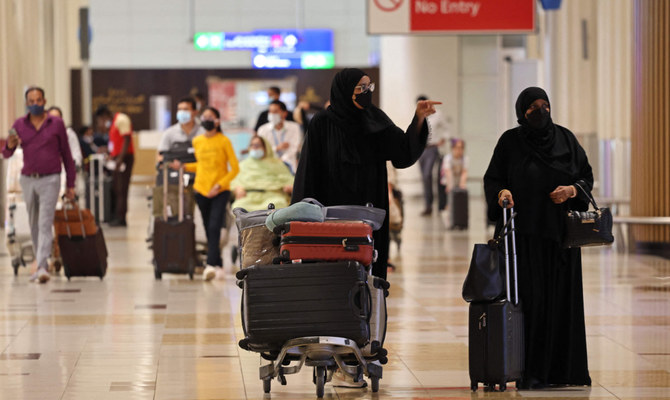
Travellers walk at Dubai Airport terminal 3, in the Gulf emirate of Dubai, on August 16, 2022. (AFP)
Short Url
Updated 17 August 2022
Follow

Dubai sees air travel surge, expects World Cup boost

  • The airport handled 160 percent more traffic over the past six months compared to the same period last year

DUBAI: Dubai International Airport saw a surge in passengers over the first half of 2022 as pandemic restrictions eased and the upcoming FIFA World Cup in Qatar will further boost traffic to the city-state’s second airfield, its chief executive said Wednesday.

Paul Griffiths, who oversees the world’s busiest airport for international travel, told The Associated Press that the airport handled 160 percent more traffic over the past six months compared to the same period last year, part of an air travel rebound around the world.

The nearly 28 million people who traveled through the airport over the past six months represent some 70 percent of the airport’s pre-pandemic levels, even as Dubai’s key source market of China remains closed due to severe pandemic restrictions. Griffiths said he expects the airport’s traffic to return to pre-pandemic levels by the end of next year.

“It’s a very, very welcome surge of traffic,” Griffiths said.

The first World Cup in the Middle East, he added, will send foreign soccer fans flocking to Al-Maktoum International Airport at Dubai World Central, or DWC. From there, they will travel daily to Qatar, a tiny neighbor that faces a hotel squeeze.

“We’ve actually seen a huge demand at DWC for slot filings for airlines wanting to operate a shuttle service,” he said. “I think the city has a lot to offer and a lot to gain from the World Cup.”

Among the airlines buying extra slots to shuttle soccer fans to the tournament from DWC are Qatar Airways, low-cost carrier FlyDubai and budget airline Wizz Air Abu Dhabi, he said.

During the first half of 2022, Dubai International Airport dealt with nearly 56 percent more flights than the same period in 2021, when contagious coronavirus variants clobbered the industry.

Now, in a sign of the health of the industry, Emirates said on Wednesday that it would pour billions of dollars into retrofitting much of its Airbus A380 and Boeing 777 fleet. At the height of the pandemic, the airline received a $4 billion government bailout.


Saudi POS spending jumps 28% in final week of Jan: SAMA

Updated 06 February 2026
Follow

Saudi POS spending jumps 28% in final week of Jan: SAMA

RIYADH: Saudi Arabia’s point-of-sale spending climbed sharply in the final week of January, rising nearly 28 percent from the previous week as consumer outlays increased across almost all sectors. 

POS transactions reached SR16 billion ($4.27 billion) in the week ending Jan. 31, up 27.8 percent week on week, according to the Saudi Central Bank. Transaction volumes rose 16.5 percent to 248.8 million, reflecting stronger retail and service activity. 

Spending on jewelry saw the biggest uptick at 55.5 percent to SR613.69 million, followed by laundry services which saw a 44.4 percent increase to SR62.83 million. 

Expenditure on personal care rose 29.1 percent, while outlays on books and stationery increased 5.1 percent. Hotel spending climbed 7.4 percent to SR377.1 million. 

Further gains were recorded across other categories. Spending in pharmacies and medical supplies rose 33.4 percent to SR259.19 million, while medical services increased 13.7 percent to SR515.44 million. 

Food and beverage spending surged 38.6 percent to SR2.6 billion, accounting for the largest share of total POS value. Restaurants and cafes followed with a 20.4 percent increase to SR1.81 billion. Apparel and clothing spending rose 35.4 percent to SR1.33 billion, representing the third-largest share during the week. 

The Kingdom’s key urban centers mirrored the national surge. Riyadh, which accounted for the largest share of total POS spending, saw a 22 percent rise to SR5.44 billion from SR4.46 billion the previous week. The number of transactions in the capital reached 78.6 million, up 13.8 percent week on week. 

In Jeddah, transaction values increased 23.7 percent to SR2.16 billion, while Dammam reported a 22.2 percent rise to SR783.06 million. 

POS data, tracked weekly by SAMA, provides an indicator of consumer spending trends and the ongoing growth of digital payments in Saudi Arabia.  

The data also highlights the expanding reach of POS infrastructure, extending beyond major retail hubs to smaller cities and service sectors, supporting broader digital inclusion initiatives.  

The growth of digital payment technologies aligns with Saudi Arabia’s Vision 2030 objectives, promoting electronic transactions and contributing to the Kingdom’s broader digital economy.