

REVIEW: ‘Five Days at Memorial’ replicates the horrors of Hurricane Katrina

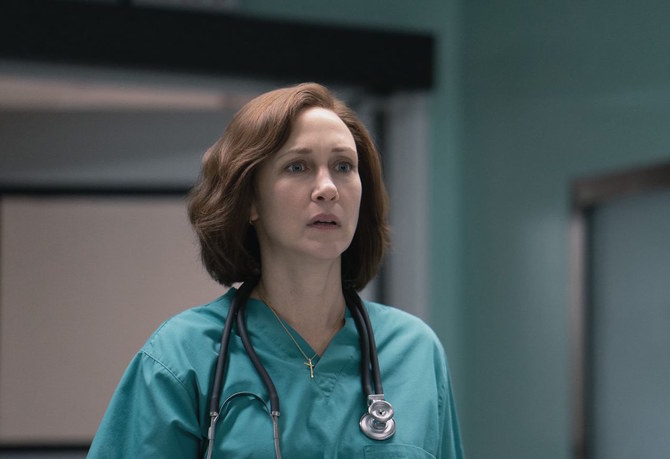
Vera Farmiga in ‘Five Days at Memorial.’ (Supplied)
Short Url
Updated 17 August 2022
Follow

REVIEW: ‘Five Days at Memorial’ replicates the horrors of Hurricane Katrina

CHENNAI: Apple+ TV’s limited series “Five Days at Memorial” sets out to capture a natural calamity in its stark reality. Adapted from Sheri Fink’s “Five Days at Memorial: Life and Death in a Storm-Ravaged Hospital,” a retelling of Hurricane Katrina, which devastated New Orleans in late 2005, the TV version is a brutal but compelling watch. It is brought out most poignantly in a scene where we see an elderly patient watching the raging storm from a window at the Memorial Medical Centre.

Created by John Ridley, writer of “12 Years a Slave,” and “Lost” showrunner Carlton Cuse, the series brings drama without overly exaggerating, along with a near-perfect recreation of the hospital that becomes a character in itself. Real footage is seamlessly woven into scenes, with the first five chapters devoted to the first five days of the catastrophic event that left 45 patients dead.

Dr Anna Pou is portrayed by the excellent Vera Farmiga, who puts in a powerful performance standing watching the hurricane batter the bridge between two segments of the facility. Then there is the nerve-wracking dilemma as a daughter (Raven Dauda) is forced to abandon her critically ill mother, nurse Diane Robichaux (Julie Ann Emery). A deep sense of heartrending misery and utter helplessness pervades just about every frame.

As “Five Days at Memorial” begins, we see local residents trooping inside the facility to join patients and staff — standard procedure, as the building had withstood many storms in its 80 years. But in this case, the hurricane smashed glass panes and wrenched chunks of iron, leaving little respite. The hurricane passes, but levees then collapse, flooding the city. With the problems mounting, the hospital’s incident commander, Susan Mulderick (Cherry Jones), discovers that the building’s bulky manual says nothing about evacuation protocols in case of floods. With elevators out of operation, doctors and others carry patients to the rooftop helipad.


A post shared by Apple TV+ (@appletvplus)

The last few episodes focus on the investigation into the controversial decision to euthanize terminally-ill patients, and explore the meaning of care and compassion. But what stands out is the failure of the administration, the Federal Management Agency, and all those who had the power to intervene to avoid the disaster.


Review: ‘Sorry, Baby’ by Eva Victor

Eva Victor appears in Sorry, Baby by Eva Victor, an official selection of the 2025 Sundance Film Festival. (Supplied)
Updated 27 December 2025
Follow

Review: ‘Sorry, Baby’ by Eva Victor

  • Victor makes a deliberate narrative choice; we never witness the violence of what happens to her character

There is a bravery in “Sorry, Baby” that comes not from what the film shows, but from what it withholds. 

Written, directed by, and starring Eva Victor, it is one of the most talked-about indie films of the year, winning the Waldo Salt Screenwriting Award at Sundance and gathering momentum with nominations, including nods at the Golden Globes and Gotham Awards. 

The film is both incisive and tender in its exploration of trauma, friendship, and the long, winding road toward healing. It follows Agnes, a young professor of literature trying to pick up the pieces after a disturbing incident in grad school. 

Victor makes a deliberate narrative choice; we never witness the violence of what happens to her character. The story centers on Agnes’ perspective in her own words, even as she struggles to name it at various points in the film. 

There is a generosity to Victor’s storytelling and a refusal to reduce the narrative to trauma alone. Instead we witness the breadth of human experience, from heartbreak and loneliness to joy and the sustaining power of friendship. These themes are supported by dialogue and camerawork that incorporates silences and stillness as much as the power of words and movement. 

The film captures the messy, beautiful ways people care for one another. Supporting performances — particularly by “Mickey 17” actor Naomi Ackie who plays the best friend Lydia — and encounters with strangers and a kitten, reinforce the story’s celebration of solidarity and community. 

“Sorry, Baby” reminds us that human resilience is rarely entirely solitary; it is nurtured through acts of care, intimacy and tenderness.

A pivotal scene between Agnes and her friend’s newborn inspires the film’s title. A single, reassuring line gently speaks a pure and simple truth: “I know you’re scared … but you’re OK.” 

It is a reminder that in the end, no matter how dark life gets, it goes on, and so does the human capacity to love.