

Kenyan opposition leader says he’ll challenge his close election loss

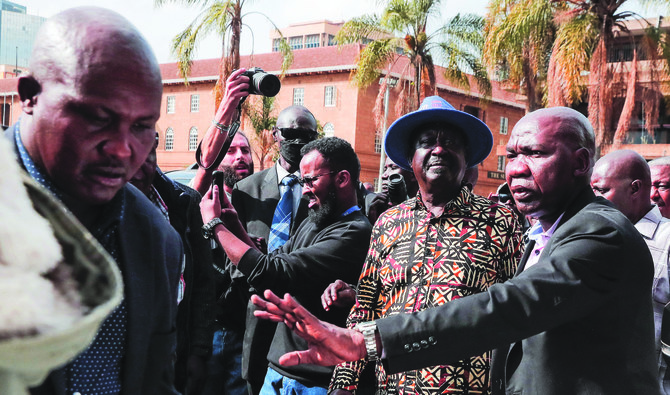
Odinga is renowned as a fighter, detained for years in the 1980s over his push for multiparty democracy, and a supporter of Kenya’s groundbreaking 2010 constitution. (Reuters)
Short Url
Updated 16 August 2022
Follow

Kenyan opposition leader says he’ll challenge his close election loss

  • Religious and other leaders have pleaded for calm in a country with a history of deadly post-election violence

NAIROBI: Kenyan opposition figure Raila Odinga said Tuesday he’ll challenge the results of the close presidential election with “all constitutional and legal options” after Deputy President William Ruto was declared the winner, bringing new uncertainty to a country where the vote was widely considered to be its most peaceful.

Now East Africa’s most stable democracy faces weeks of disputes and the possibility that the Supreme Court will order a fresh election. Religious and other leaders have pleaded for calm in a country with a history of deadly post-election violence.

“Let no one take the law into their own hands,” Odinga said to his often passionate supporters. In Kisumu, a city in his western Kenya stronghold, some residents said they were tired of going into the street and being tear-gassed.

This was Odinga’s first appearance since Kenya’s electoral commission chairman on Monday declared Ruto the winner with almost 50.5 percent of the votes. Four of the seven commissioners abruptly announced they couldn’t support the results, and Odinga supporters scuffled with the remaining commissioners at the declaration venue.

Shortly before Odinga spoke, the four commissioners asserted to journalists that the chairman’s final math added up to 100.01 percent and the excess votes would have made a “significant difference.” They also said he didn’t give them a chance to discuss the results before his declaration.

“What we saw yesterday was a travesty and blatant disregard of the constitution,” Odinga said, calling the election results “null and void.”

The 77-year-old Odinga has pursued the presidency for a quarter-century. His campaign has seven days after Monday’s declaration to file a petition with the Supreme Court, which would then have 14 days to make a ruling.

Odinga is renowned as a fighter, detained for years in the 1980s over his push for multiparty democracy, and a supporter of Kenya’s groundbreaking 2010 constitution. His claim that the deeply troubled 2007 election was stolen from him led to violence that left more than 1,000 dead. Though he boycotted the fresh 2017 vote, his court challenge led to election reforms.

The electoral commission had been widely seen as improving its transparency in this election, practically inviting Kenyans to do the tallying themselves by posting online the more than 46,000 results forms from around the country.

On Tuesday, the local Elections Observation Group announced that its highly regarded parallel voting tally “corroborates the official results” in an important check on the process.

But Odinga asserted that only the electoral commission chairman could see the final results before the declaration. “The law does not vest in the chairperson the powers of a dictator,” he said, and insisted that decisions by the commission must be taken by consensus.

There was no immediate statement from the electoral commission or its chairman. A screen at its tallying center that had been showing cumulative presidential election results stopped being updated Saturday and was later turned off. The official form showing final results could not be accessed on the commission’s website Tuesday.

Odinga’s campaign had expected victory after outgoing President Uhuru Kenyatta in a political twist backed his former rival Odinga instead of his own deputy president, with whom he fell out years ago. Some Kenyans have noted that Kenyatta appointed the four dissenting commissioners last year.

The 55-year-old president-elect, Ruto, appealed to Kenyans by making the election about economic differences and not the ethnic ones that have long marked the country’s politics with sometimes deadly results. He portrayed himself as an outsider from humble beginnings defying the political dynasties of Kenyatta and Odinga, whose fathers were Kenya’s first president and vice president.


Nigerian police deny church attacks as residents insist 168 people are held by armed groups

Updated 11 sec ago
Follow

Nigerian police deny church attacks as residents insist 168 people are held by armed groups

Kaduna State Police Commissioner Muhammad Rabiu described news reports of the attacks as rumors
It is common for police and locals to have contradicting accounts of attacks in Nigeria’s hard-hit villages

KADUNA, Nigeria: Nigerian police denied reports of simultaneous church attacks in northwestern Kaduna state over the weekend, even as residents shared accounts of kidnappings at the churches in interviews Tuesday.
A state lawmaker, Usman Danlami Stingo, told The Associated Press on Monday that 177 people were abducted by an armed group Sunday. Eleven escaped and 168 are still missing, according to the lawmaker and residents interviewed by AP.
Kaduna State Police Commissioner Muhammad Rabiu described news reports of the attacks as rumors, saying the police visited one of the three churches in the district of Kajuru and “there was no evidence of the attack.”
It is common for police and locals to have contradicting accounts of attacks in Nigeria’s hard-hit villages.
“I am one of the people who escaped from the bandits. We all saw it happen, and anyone who says it didn’t happen is lying,” said Ishaku Dan’azumi, the village head of Kurmin Wali.
Nigeria is struggling with several armed groups that launch attacks across the country, including Boko Haram and Daesh-WAP, which are religiously motivated, and other amorphous groups commonly called “bandits.”
Rights group Amnesty International condemned the “desperate denial” of the attack by the police and government.
“The latest mass abduction clearly shows President Bola Tinubu and his government have no effective plan for ending years of atrocities by armed groups and gunmen that killed thousands of people,” the group said in a statement.
A Kaduna-based Christian group, the Christian Solidarity Worldwide Nigeria, said in a press release that security operatives did not allow its members to visit the sites of the attacks.
“The military officer who stopped the CSWN car said there was a standing order not to allow us in,” Reuben Buhari, the group’s spokesperson, said.
The Chikun/Kajuru Active Citizens Congress, a local advocacy group, published a list of the hostages. The list could not be independently verified by the AP. Police did not respond to a request for questions on the list.
The Christian Association of Nigeria also verified the attacks and has a list of the hostages, according to a senior Christian leader in the state who spoke on condition of anonymity for fear of his safety.
“This happened, and our job is to help them. These people came, attacked and picked people from churches,” he said. “But I think they prefer to play the politics of denying, and I don’t think that’s what we want.”
Attacks against religious worship centers are common in Nigeria’s conflict-battered north. They are a part of the country’s complex security crisis that also affects schools, such as in November when hundreds of schoolchildren and their teachers were abducted in another part of Kaduna.
In the past few months, the West African nation has been in the crosshairs of the US government, which has accused the Nigerian government of not protecting Christians in the country, leading to a diplomatic rift. The USlaunched an attack against an alleged Daesh group members on Nigerian territory on Dec. 25, an operation the Nigerian government said it was aware of.