

Pakistani Hajj pilgrims under government scheme to receive Rs150,000 in subsidy from August 17

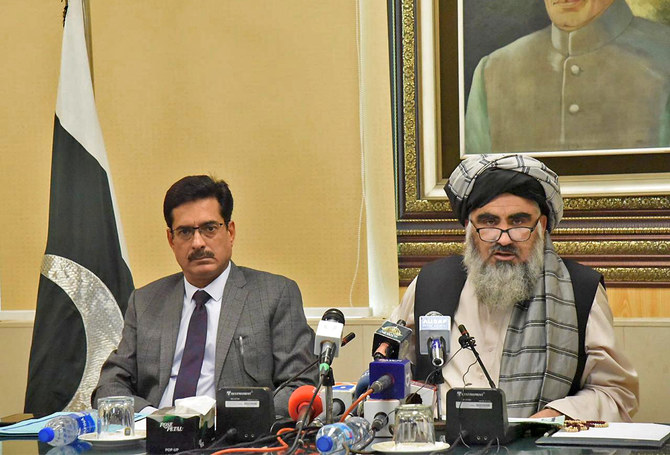
Federal Minister for Religious Affairs, Mufti Abdul Shakoor (right), address a press conference in Islamabad, Pakistan, on August 15, 2022. (Federal Minister for Religious Affairs)
Short Url
Updated 15 August 2022
Follow

Pakistani Hajj pilgrims under government scheme to receive Rs150,000 in subsidy from August 17

  • The government will inform Hajj pilgrims about the disbursement by sending them text messages
  • Pakistani minister says the country saved substantial amount during Hajj due to Saudi assistance

ISLAMABAD: Federal Minister for Religious Affairs Mufti Abdul Shakoor said on Monday Pakistani pilgrims performing Hajj under the government scheme would start receiving a subsidy of Rs150,000 from August 17 as the country said it had completed of its Hajj operation this year.

The government announced a subsidy of Rs4.88 billion which would be disbursed among pilgrims who returned from the kingdom after performing the pilgrimage.

The total Hajj expenditure under the government scheme exceeded Rs860,000, though people will now be getting some financial relaxation after the announcement of the subsidy.

“Our Hajj operation has completed successfully and without any untoward incident,” the minister told Arab News on the sidelines of a post-Hajj news conference in the federal capital. “All people who performed their pilgrimage under the government scheme will start getting Rs150,000 back from August 17 and this disbursement process will complete by August 31.”

He said the pilgrims would be informed about the disbursement through text messages.

“They will get the amount by showing that message along with their national identity card and passport to the bank,” the minister continued. “The bank will transfer the amount into the pilgrim’s account after that.”

Saudi Arabia allowed about a million people to perform Hajj this year after lifting strict coronavirus restrictions which were imposed after the emergence of the pandemic.

Pakistan’s religious affairs minister said the kingdom supported his country’s Hajj mission in every possible way, adding it even increased the South Asian nation’s quota by adding 2,000 more people.

“Due to the hard work of our team and cooperation of Saudis, we succeeded in reducing the expenses by nearly 1,500 Riyal per pilgrim than we had initially anticipated,” he said.

The minister also informed that over 15,000 Pakistani pilgrims under the government scheme had also benefitted from the Makkah Route Initiative.

“The pilgrims were provided residences near the Grand Mosque [in Makkah] and four- and five-star hotels in Madinah,” he said. “Apart from that, they were given the best transportation and food services as well.”

The minister informed it was the first time pilgrims under the government scheme got their boarding passes 24 hours before their return to the country.
He added their luggage was also booked much ahead of their return flight, which saved them time at the airport.


Pakistan reports first wild polio case of 2026 despite vaccination campaigns

Updated 4 sec ago
Follow

Pakistan reports first wild polio case of 2026 despite vaccination campaigns

  • Four-year-old girl infected in Sindh’s Sujawal district as virus persists in high-risk areas
  • Pakistan conducted last nationwide campaign in January, vaccinating over 45 million children

ISLAMABAD: Pakistan reported its first wild poliovirus case of the year, health authorities said on Thursday, underscoring the persistence of the disease in high-risk areas despite ongoing vaccination campaigns.

The latest infection was confirmed in a four-year-old girl in Sujawal district of the southern Sindh province, according to the Regional Reference Laboratory for Polio Eradication at the National Institute of Health in Islamabad.

Polio is a highly contagious viral disease that can cause permanent paralysis, mainly in children under the age of five. Pakistan and neighboring Afghanistan are the only two countries in the world where the disease remains endemic.

“The case was reported through the polio surveillance network and confirmed by the Regional Reference Laboratory for Polio Eradication at the National Institute of Health, Islamabad,” the statement said.

“The Polio Eradication Initiative is already analyzing the best response to tackle and prevent further transmission.”

In 2026, Pakistan conducted a nationwide polio campaign in January that vaccinated more than 45 million children, while the next national campaign is planned for April.

Since 1994, Pakistan has cut polio cases by 99.8 percent through vaccination efforts, reducing infections from an estimated 20,000 in the early 1990s to 31 in 2025.

Pakistan reported 31 polio cases in 2025. Southern Khyber Pakhtunkhwa accounted for more than half of the country’s polio cases in 2025, with 17 of the 31 infections reported from the region.

According to health authorities, 74 cases were reported in 2024.

More than 200 polio workers and police officers assigned to protect polio teams have been killed in Pakistan since the 1990s, according to health and security officials.

Militants often falsely claim the vaccination campaigns are part of a Western plot to sterilize Muslim children.

The vaccination campaigns are also undermined by parental refusals in remote regions.