



LAHORE: When you take a left turn on Lower Mall Road in Lahore and go down Rattigan Road toward the ancient city’s district courts, you pass by an imposing red-brick building, a picture of neglect with its peeling paint and raggedy doors.
A plaque outside the desolate structure reads: “This building was called Bradlaugh Hall.”
Indeed, though the structure that was once Bradlaugh Hall is still there, the buildings’ grandeur and stature as a host to the veritable “who’s who” of the movement for the independence of India is a thing of the past. The resplendence of a great political history is today only a memory.
“For almost half a century, this hall would play host to Indians of all cast, creeds and religions and their political sessions, receptions, literary sittings and even mushairas (poetry conference),” Wajahat Masood, a veteran journalist and historian, told Arab News.
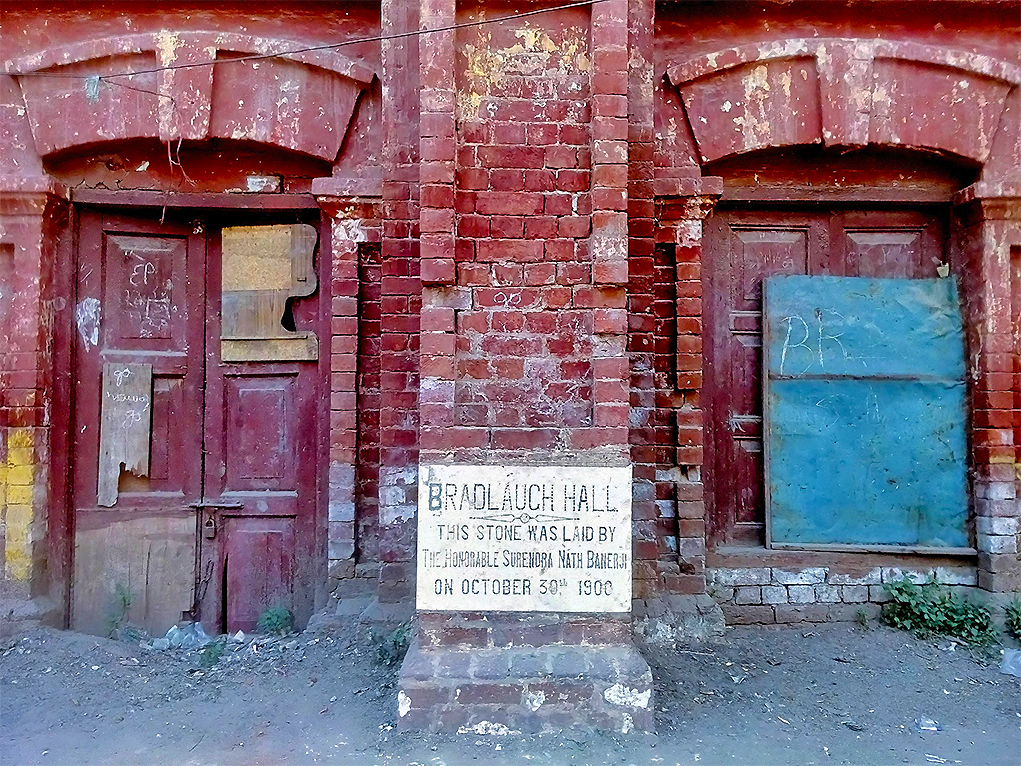
The pictue shows an inscription on a plaque made of stone in Bradlaugh Hall in Lahore, Pakistan, August 15, 2020. (Muhammad Imran Saeed/Facebook)
Seed money of Rs10,000 for Bradlaugh Hall was collected by Indian banker and activist Dayal Singh Majithia through a fundraiser at the Indian National Congress party’s annual session in Lahore in 1983, according to noted historian Dr. Tahir Kamran. The Congress party was the first modern nationalist movement to emerge in the British Empire in Asia and Africa.
“At the time, there were only two halls in Lahore, the Town Hall of the municipal office and Montgomery Hall in Lawrence Garden, which were owned by the government and not available for political events,” Kamran said.
Bradlaugh Hall, built at the tail end of the 19th century, was named after British MP Charles Bradlaugh (1833-1891), a notable freethinker of his era and a staunch supporter of the Indian struggle for independence from British rule. Bradlaugh wished for political activists of the time to have an administrative center where they could gather and discuss their political future.
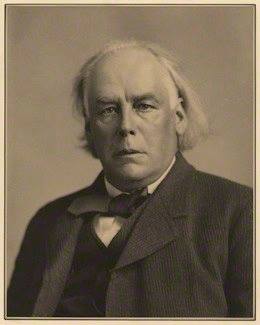
The undated photo shows British MP Charles Bradlaugh. (Save Bradlaugh Hall, Lahore)
“Bradlaugh was a radical liberal of his time who vehemently advocated women voting rights, birth control laws and independence for Indians,” Kamran said. “Bradlaugh’s daughter wrote her father’s biography, in which she recalls him as an Indian.”
The Hall, which comprises several rooms, a pavilion and a vast area for public gatherings, was completed in 1900, nine years after Bradlaugh passed away in 1891. It was inaugurated by Congress President Surendranath Bannerji.
“PROMINENT POLITICAL HUB”
In its early years, the Hall “helped facilitate the labor and peasants’ movement, especially the influential movement of the peasants (known as “Pagri Sambhal Jatta”) of Lyallpur (Faisalabad), in 1905,” reporter Aown Ali wrote in 2015 in daily Dawn.
“Later, in 1915, the ‘Ghadar Party’ also had its base in Bradlaugh Hall. By the 1920s, it had become well-known across India as a prominent political hub.”
Among those who visited and delivered speeches at the Hall are Allama Muhammad Iqbal, one of the subcontinent’s most celebrated poets, Maulana Zafar Ali Khan, a key member of the Pakistan Movement and widely considered ‘the father of Urdu journalism,’ and Jawaharlal Nehru, who would go on to become the first prime minister of India.
Muhammad Ali Jinnah, the founder of Pakistan and the leader for the movement for an independent homeland for the Muslims of India, also delivered at least one speech at Bradlaugh, on May 24, 1924, during the Khilafat Movement, a pro-Islamic campaign in the subcontinent to salvage the Ottoman Empire and its ruler after World War 1.
According to Haroon Khalid, author of the book ‘Imagining Lahore,’ Bradlaugh Hall was home to the National College, set up by Indian author and politician Lala Lajpat Rai “to prepare ‘intellectual revolutionaries’” such as Bhagat Singh, the famed hero of India’s freedom struggle. It also hosted the Indian National Congress’s historic 1929 Lahore session that culminated in the declaration of Purna Swaraj, or full independence, on December 31, which the party would celebrate as India’s symbolic Independence Day until 1947.”
In March 1926, young proponents of freedom from all over India, especially Punjab, formed the “Naujawan Bharat Sabha” with the objective of transforming their ideology into action. The left-wing association chose Bradlaugh Hall as its headquarter.
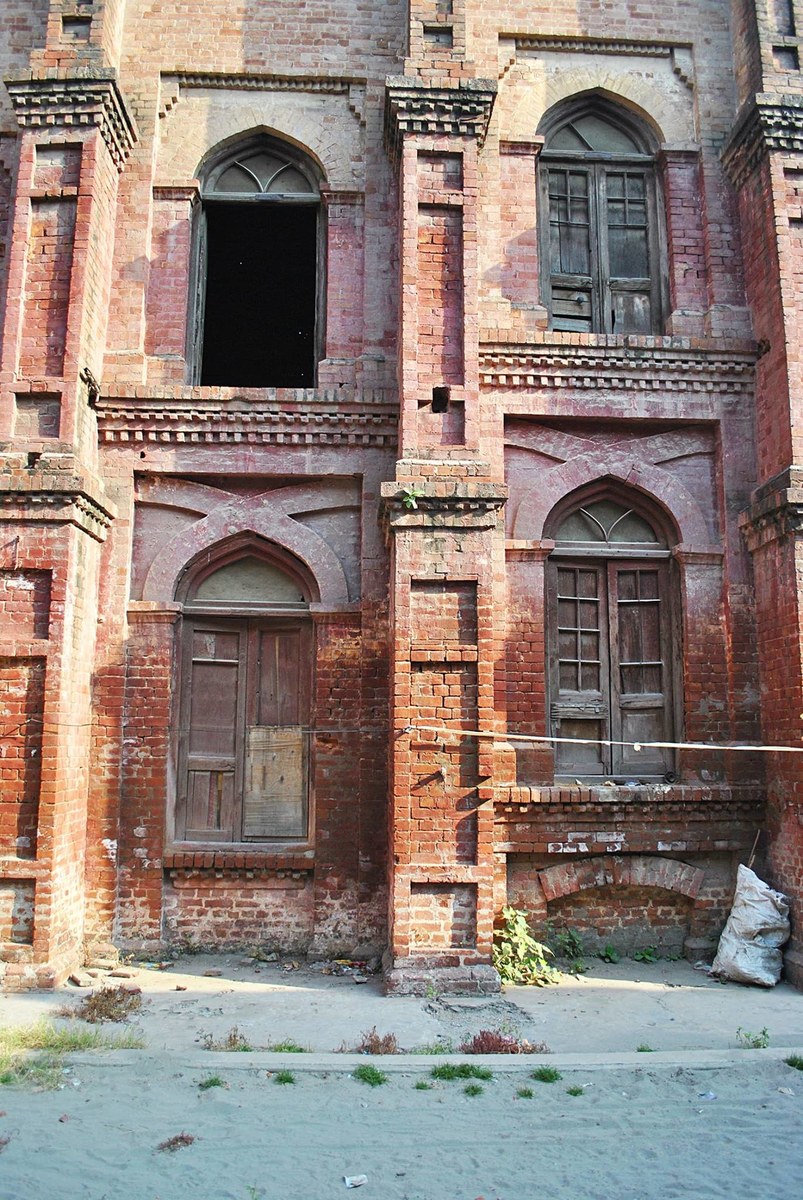
The pictue shows exterior view of Bradlaugh Hall in Lahore, Pakistan, August 15, 2020. (Muhammad Imran Saeed/Facebook)
On October 7, 1930, when freedom fighters Singh and two others were sentenced to death, the Sabha party was declared illegal. However, it was revived as a legal defense team for Singh and others under the name of the “Bhagat Singh Appeal Committees,” with sessions carried out at Sabha’s office in Bradlaugh Hall.
The building also served as a center of cultural activity.
“Apart from being the center of political activities, this historic hall also served as a center for activities related to literature, culture and arts,” historian Masood said.
To commemorate their victory in World War 1, the British organized a mushaira at the Hall in 1919 where Iqbal recited his famous poem Shoa’a-e-Aftab. It is also at Bradlaugh that during the first session of the Lahore Students Union, the poet Josh Malih Abadi recited his famous revolutionary poem: “Suno ay Bastgaan e Zulf Gaiti, Nida Ye Aa Rahi hai Aasman Se/ Kay Aazadi ka ik Lamha hai Behter, Ghulaami ki Hayaat e Jawidaan Se” (Listen! You slaves of the times, such is the order of the day coming down from skies/ A moment of independence is far better than the eternal life in slavery).
The Parsi Theatrical Companies of Cowasjee and Habib Seth were very popular, and both used to perform at Bradlaugh Hall. In 1903, Narayan Prasad Betab’s drama Kasauti was played here. Legendary singer and dancer Gauhar Jaan Kalkattewali performed to a sold-out Hall in 1912.
But the building’s golden years came to an end in 1946 when the All-India Muslim League, formed out of the need for the political representation of Muslims in British India, won majority in the 1946 provincial elections, which is believed to have laid the path for Pakistan. After that, the rival Indian National Congress stopped meeting at Bradlaugh.
“NEGLECT AN INSULT TO REVOLUTIONARIES”
The Hall was managed by the Bradlaugh Hall administrative committee till the 1947 Partition of India, and for a decade after independence was used to provide shelter to migrants from Amritsar, as a warehouse for iron merchants and as a grain silo for the food department.
“The Government of Pakistan handed over the hall to the food department and it was converted into a wheat storage center,” Wasif Naqi, a historian and journalist who grew up in a neighborhood located behind the Hall, told Arab News.
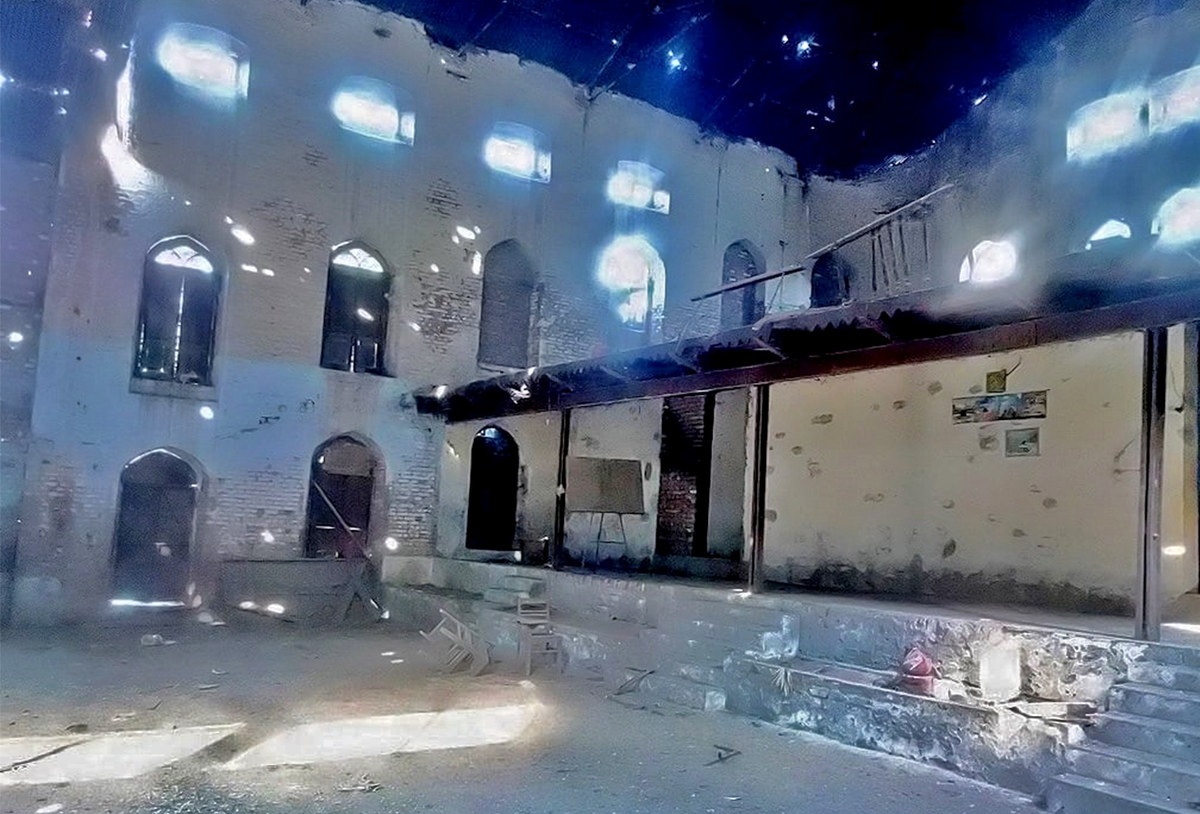
The pictue shows Bradlaugh Hall in Lahore, Pakistan, August 15, 2020. (Muhammad Imran Saeed/Facebook)
“For a long time, the hall also served as a car workshop. We would hear the din of hammers used by mechanics all day,” Naqi said.
Flooded in a rain storm in 1956, Bradlaugh Hall could no longer be used for food storage and was turned into the National Technical Institute in 1957. The Institute had the building until the 90s, which writer Aown Ali described “as the worst period for this historic building, as it was in this period that all the land grabbing and illegal interventions took place … the area was being exploited all for personal and monetary interests.”
Since 1997, the building has been sealed.
This April, however, the Walled City of Lahore Authority (WCLA) and the Evacuee Trust Property Board (ETPB) said they would join hands to restore the original façade and the internal and external portions of the structure to return Bradlaugh Hall to its former glory.
“Ideally, a library should be built within Bradlaugh Hall, including a space for political activity,” Kamran the historian said. “But what we have done to our other libraries is no less shameful to what we’ve done to this historical building which once helped bring revolution and thus independence.”
“More important is to return to the ethos this building once embodied, though restoring the structure is also vital,” journalist Masood said. “This act [of neglect] is an insult to the efforts and sacrifices of the revolutionaries who broke the chains of slavery for us.”


