TOKYO: Japan’s Prime Minister Fumio Kishida renewed Japan’s no-war pledge at a somber ceremony Monday as his country marked the 77th anniversary of its World War II defeat, but he did not mention Japanese wartime aggression.
In his first address as prime minister since taking office in October, Kishida said Japan will “stick to our resolve to never repeat the tragedy of the war.”
Kishida did not mention Japanese aggression across Asia in the first half of the 20th century or the victims in the region. The omission was a precedent set by the assassinated former leader Shinzo Abe, who had pushed to whitewash Japan’s wartime brutality.
Kishida largely focused on the damages Japan suffered on its turf — the US atomic bombings on Hiroshima and Nagasaki, massive firebombings across Japan and the bloody ground battle on Okinawa. He said the peace and prosperity that the country enjoys today is built on the suffering and sacrifices of those who died in the war.
Beginning in 2013, Abe stopped acknowledging Japan’s wartime hostilities or apologizing in his Aug. 15 speeches, scrapping the tradition that began in 1995.
Emperor Naruhito repeated his “deep remorse” over Japan’s wartime actions in a nuanced phrase in his speech, like his father, Emperor Emeritus Akihito, who devoted his career to making amends for a war fought in the name of the wartime emperor, Hirohito, the current emperor’s grandfather.
Some 900 participants observed a minute of silence at noon during the ceremony held at the Budokan arena. The crowd was reduced from about 5,000 before the pandemic, participants were asked to wear masks, and there was no singing of the national anthem.
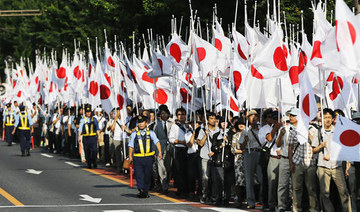
While Kishida on Monday stayed away from praying at the Yasukuni Shrine and sent a religious ornament instead, three of his Cabinet members visited — Economic Security Minister Sanae Takaichi and Disaster Reconstruction Minister Kenya Akiba earlier Monday and Trade and Industry Minister Yasutoshi Nishimura on Saturday.
“I paid respects to the spirits of those who sacrificed their lives for the national policy,” Takaichi told reporters, adding that she also prayed so that there will be no more war dead in Ukraine.
Chief Cabinet Secretary Hirokazu Matsuno defended their Yasukuni visits by saying that “In any country, it is natural to pay respects to those who sacrificed their lives to their nation,” but that they decided to pray as “private citizens.”
“There is no change to Japan’s policy of strengthening its ties with its neighbors China and South Korea,” Matsuno said.
Victims of Japanese actions during the first half of the 20th century, especially China and the Koreas, see the shrine as a symbol of Japanese militarism because it honors convicted war criminals among about 2.5 million war dead.
The visits sparked criticisms from China and South Korea.
South Korea’s Foreign Ministry expressed “deep disappointment and regret” over the Yasukuni visits which it said beautifies Japan’s past invasions. The ministry urged Japanese officials to “look squarely” at history and demonstrate their “sincere” remorse with action.
China’s Foreign Ministry spokesperson Wang Wenbin, on Sunday after Nishimura’s visit, criticized it as “Japanese government’s erroneous attitude toward historical issues.” Wang also urged Japan to “deeply reflect” on its wartime aggression and act responsibly to gain trust of its Asian neighbors and the larger international community.


![]()

Fumio Kishida: Japan vows ‘never to repeat tragedy of war’

Short Url
https://arab.news/n5x9c
Fumio Kishida: Japan vows ‘never to repeat tragedy of war’
- Country marks the 77th anniversary of its World War II defeat

Latest updates


© 2026 SAUDI RESEARCH & PUBLISHING COMPANY, All Rights Reserved And subject to Terms of Use Agreement.