

Prototype of Pakistan’s first indigenous electric vehicle launched on country’s Independence Day

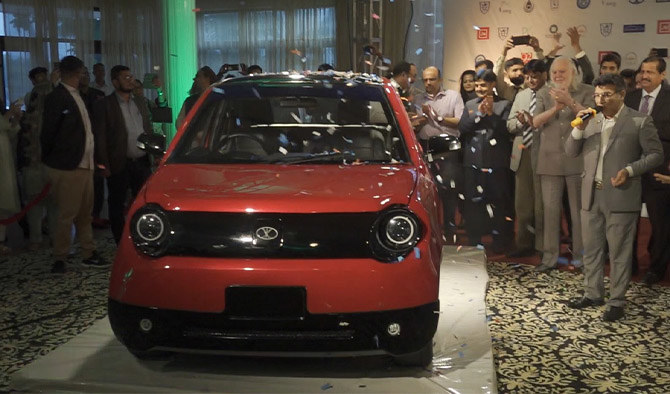
A prototype of Pakistan’s first ingenious electric vehicle, Nur-E 75, which was launched in Karachi, Pakistan, on August 14, 2022. (AN Photo)
Short Url
Updated 15 August 2022
Follow

Prototype of Pakistan’s first indigenous electric vehicle launched on country’s Independence Day

  • Nur-E 75 is designed by Pakistani motor engineers based in different corners of the world
  • Developed in collaboration with local students, vehicle will hit the road by the end of 2024

KARACHI: A foundation of Pakistani-American motor engineers on Sunday launched the prototype of the country’s first indigenous electric vehicle developed in collaboration with local university students and expected to hit the road by the end of 2024.
The manufacturers of Nur-E 75 launched the vehicle on Pakistan’s diamond jubilee, hoping it would contribute to the national economy and help improve the country’s environment.
Pakistan approved the National Electric Vehicle Policy in November 2019 to reduce its oil import bill and address the issue of air pollution. The policy also intended to convert 100,000 cars and 500,000 two- and three-wheelers into electric vehicles within a span of four years.
DICE Foundation, a US-based non-profit organization, started working on the country’s first electric car in the same year with the help of local universities and industry to meet the country’s transportation needs by utilizing less energy.
“Today, on the 75th birthday of Pakistan, Alhamdulillah [praise be to God], we are able to launch five-seater hatchback electric car,” Dr. Khurshid Qureshi, the foundation’s chairman, told Arab News while unveiling the prototype.
“The actual car will be produced and will be in the hands of consumers at the end of 2024,” he said, adding the prototype was made by Pakistani expatriates based in different parts of the world, many of whom were academics and industry experts.
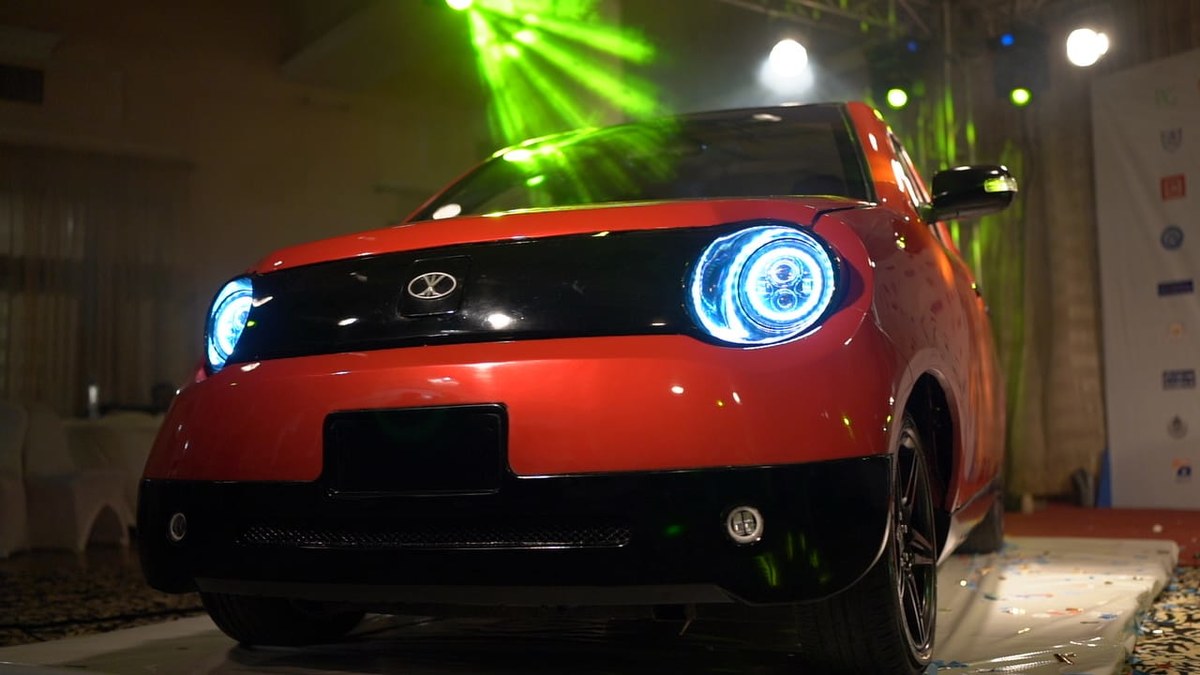


A prototype of Pakistan’s first ingenious electric vehicle, Nur-E 75, which was launched in Karachi, Pakistan, on August 14, 2022. (DICE Foundation)


“We have very thoroughly tested [it] so far,” he continued. “We drove it at about 130 kph [kilometer per hour]. It works very fine, it has a 35-kilowatt-hour battery, 108 HP [horsepower] motor and gives about 210 kilometers in one charge [which costs Rs900].”
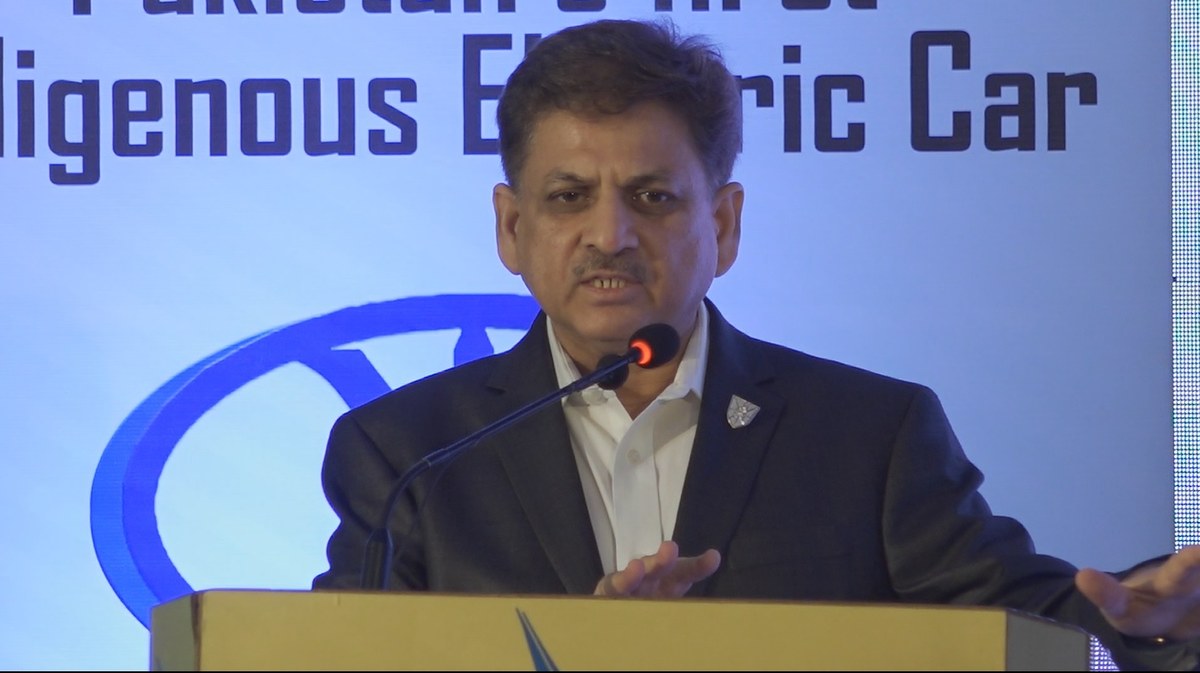


Dr. Khurshid Qureshi, chairman of the US-based DICE Foundation, addresses the ceremony to launch Nur-E 75, the prototype of Pakistan’s first ingenious electric vehicle, in Karachi, Pakistan, on August 14, 2022. (AN Photo)

“Pakistan has tried a couple of times to make its own car but was not successful,” Qureshi added. “This is the first indigenous electric car of Pakistan ... We have designed it, we have developed it, and we are proud of it.”
The car has been named Nur-E 75, with the first word referring to light and the number implying the 75th independence anniversary of Pakistan. The company, which will manufacture and sell the car, has been named after the 12th century Muslim scientist Ismail Al-Jazari.
According to an estimate, the global market for batteries will be around $120 billion in the next five to six years which is likely to have a huge impact on Pakistan’s economy since the plan is to manufacture the car for both domestic and international markets.
The top official of DICE Foundation said battery was one of the most important components of the car which would be developed by students of NED University in Karachi under the supervision of his team of experts.
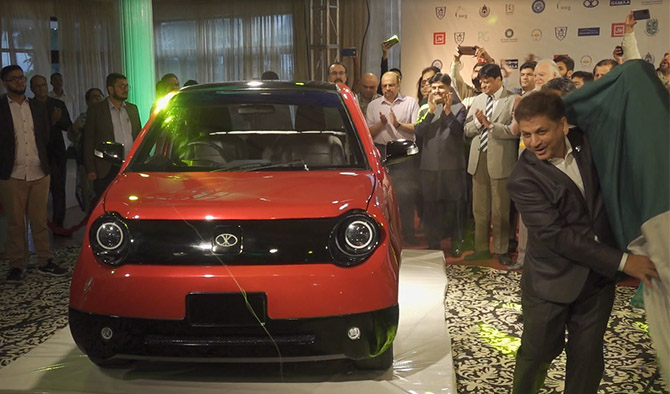


A prototype of Pakistan’s first ingenious electric vehicle, Nur-E 75, which was launched in Karachi, Pakistan, on August 14, 2022. (AN Photo)

“That’s how we actually work with the students in universities and provide the expertise in many projects,” he said.
Qureshi said funds would be required in the next stage for the mass commercial generation of the car, which would cost customers about $19,000.
“This is a very big project of $60 to $80 million,” he added. “And we will be looking for financers and investors who will be willing to invest in this venture.”
Qureshi said Pakistan had never produced its own car in the last 75 years.
“It is extremely important for any nation,” he said. “Car is a pride of any nation. It is important for the people to save money also.”
He added if Pakistan did not pay attention to this area, it would not be able to pay back its loans.
“It is very, very important for Pakistan from economic prosperity perspective,” Qureshi said.


Karachi mall inferno came after ignored warnings, delayed response

Updated 4 sec ago
Follow

Karachi mall inferno came after ignored warnings, delayed response

  • Documents show Gul Plaza violated building regulatory standards ‌for over a decade
  • Authorities warned the situation was dire in the last review happened two years ago

KARACHI: Muhammad Imran did not take the fire seriously at first, thinking it was another small spark at the Karachi mall that would be quickly extinguished by fellow shop owners.

But smoke seeped through ducts and blackened the air in seconds. The lights went out soon after and phone flashlights turned useless, people could no longer see their own hands, he said.

Imran, who has diabetes and has undergone heart surgery, managed only a few steps before nearly giving up. “It felt like doomsday,” he said. “You couldn’t see ​the person next to you.”

The blaze would rage for nearly two days and reduce Gul Plaza, a multi-story complex of 1,200 family-run shops selling children’s clothes, toys, crockery and household goods, to ash.

At least 67 people were killed, with 15 still missing and feared dead, police official Asad Ali Raza said, in the January 17 blaze, the Pakistani port city’s largest in over a decade.

Imran’s escape from the inferno, along with more than a dozen others who spoke to Reuters, was hampered by locked doors, poor ventilation, and crowded corridors. When they eventually got out, the survivors watched Gul Plaza crumble as rescue efforts faced delays and poor resources.

Police said the fire appeared to have started at an artificial flower shop and may have been caused by children playing with matches. They added that all but three of the 16 exits were locked, which was routine practice after 10 p.m.

Documents reviewed by Reuters showed Gul Plaza, located on a major artery in Karachi’s historic city center and built in the early 1980s, ‌had violated building regulatory standards ‌for over a decade, with authorities warning the situation was dire in the last review two years ago.

Gul Plaza’s ‌management ⁠did ​not respond to ‌repeated requests for comment.

LONG PAPER TRAIL

Records from the provincial Sindh Building Control Authority showed court cases filed over Gul Plaza’s lack of safety compliance in 1992, 2015 and 2021, as well as records of unauthorized construction.

The files reviewed by Reuters do not detail the outcomes of those cases, including whether fines were imposed or whether violations were fully remedied. SBCA did not respond to queries on enforcement action taken.

A Nov. 27, 2023, survey by the fire department, covering more than 40 commercial buildings in the area, cited inadequate firefighting equipment, blocked escape routes, faulty alarms, poor emergency lighting and a lack of fire safety training for occupants and staff.

A follow-up audit by the fire department in January 2024 placed Gul Plaza among buildings that failed to meet regulations, with inspectors marking key safety categories, including access to firefighting equipment, alarm systems and electrical wiring conditions, as “unsatisfactory.”

Separately, documents describing inspections by Karachi’s Urban Search and Rescue teams in ⁠late 2023 and early 2024 that were reviewed by Reuters also showed Gul Plaza was among several markets and commercial buildings flagged for deficiencies in one or more fire safety categories.

‘PEOPLE WERE PANICKING’

“Young boys were crying. People were panicking,” ‌Imran said, when they were confronted by locked exits.

Others smashed doors and locks as they moved through ‍the darkness, holding hands and forming human chains to avoid getting lost.

With no way ‍down, they ran to the roof, where 70 people, including families and children, were trapped for nearly an hour, survivors said. The smoke was even worse there, ‍funnelled upward by the building’s design, making it impossible to see even the neighboring buildings.

Then the wind changed.

A sudden gust pushed the smoke aside, revealing Rimpa Plaza next door. Young men crossed first, found a broken ladder and began ferrying people across one by one.

“I was the last to leave. I wanted to make sure everyone was safe,” Imran said. An ambulance from the Edhi Foundation charity was waiting on the other side.

WATCHED IT BURN

Many survivors said the response by the fire brigade was delayed and inadequate. Imran and other shop owners said they had escaped ​from the building and watched Gul Plaza turn into a molten inferno as the first firefighters arrived.

The first emergency call came at 10:26 p.m. from a teenager, with two fire vehicles reaching the site within 10 minutes and classifying the blaze as a Grade 3 fire, “the ⁠highest category for an urban area,” said a provincial government spokesperson Sukhdev Assardas Hemnani.

A citywide emergency was declared by 10:45 p.m., triggering the mobilization of resources from across Karachi, he said.

Shopkeepers said the first engine soon ran out of water and left to refill but Hemnani said those allegations were inaccurate.

Firefighters used “water, foam, chemicals and sand,” he said, adding the blaze was difficult to control because the building contained more than 50 gas cylinders and flammable material such as perfumes, generator fuel and car batteries.

Many of the shops were stocked to the brim because of the holy month of Ramadan in February-March, Pakistan’s biggest shopping season.

The first fire truck was not delayed, Hemnani said, but later arrivals were slowed by heavy traffic on a busy Saturday night and a crowd of over 3,000 people that had gathered outside the mall.

The fire department did not respond to requests for comment.

‘NO LONGER AMONG US’

Survivors said many of the missing were shop employees and traders who tried to help others escape — or went back inside looking for family members.

Abdul Ghaffar, a toy store employee who had worked in Gul Plaza for two decades, said one of his cousins was among those still unaccounted for after helping others flee.

His cousin’s mobile phone voice message, in which he can be heard apologizing to his family, was circulated widely on social media.

“He was helping people escape,” Ghaffar said. “That’s how he died.” Three other relatives remain missing, he said, with the family still waiting ‌for identification through DNA testing.

Several shopkeepers said the losses have scarred the market’s tightly knit community.

“All of this keeps replaying in front of my eyes. People we saw daily are no longer among us. God was kind to us — our lives were saved — but I still cannot understand what kind of fire this was,” said Imran.