Iraq judiciary dismisses Al-Sadr’s demand to dissolve parliament

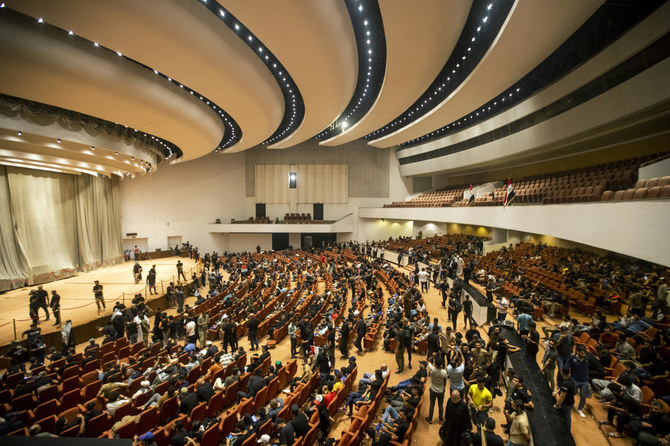
Followers of Shiite cleric Muqtada Al-Sadr fill the parliament building during a sit-in protest, in Baghdad, Iraq, Thursday, Aug. 4, 2022. (AP)
Short Url
Updated 14 August 2022
Follow

Iraq judiciary dismisses Al-Sadr’s demand to dissolve parliament

  • Followers of Sadr, in defiance of his Shiite rivals of the pro-Iran Coordination Framework, have been staging a sit-in protest at Iraq’s parliament

BAGHDAD: Iraq’s judiciary said Sunday it lacks the authority to dissolve parliament as demanded by populist Shiite Muslim cleric Moqtada Sadr, who is engaged in an escalating standoff with political rivals.
Followers of Sadr, in defiance of his Shiite rivals of the pro-Iran Coordination Framework, have been staging a sit-in protest at Iraq’s parliament.
In the latest twist to the political turmoil, the firebrand cleric has urged the judiciary to dissolve parliament by the end of this week to pave the way for new legislative elections.
But the judiciary replied that “the Supreme Judicial Council has no jurisdiction to dissolve parliament,” citing “the principle of a separation of powers.”
Under the constitution, parliament can only be dissolved by an absolute majority vote in the house, following a request by one-third of deputies or by the prime minister with the approval of the president.
Nearly 10 months on from the last elections, Iraq still has no government, new prime minister or new president, due to disagreement between factions over forming a coalition.
In the latest turmoil to strike the oil-rich but war-scarred nation, Sadr has called for “early democratic elections after a dissolution of parliament.”
Although it did not endorse the dissolution of parliament, the Supreme Judicial Council said it agreed with Sadr’s criticism of the system’s “failure to elect a president of the republic, a prime minister and the absence of a government formed within the constitutional timeframe.”
“This is an unacceptable situation that must be remedied,” it said.
The Coordination Framework opponents of Sadr launched their own Baghdad sit-in on Friday, nearly two weeks after the cleric’s supporters stormed parliament and began an open-ended protest, first inside, then outside the legislature.
The opposing encampments are the latest turn in a standoff which has so far remained peaceful.
On Twitter, a close associate of Sadr, Saleh Mohamed Al-Iraqi, said it was time to show “which of the two sides has the most support” among the Iraqi people.
He called on Sadr’s supporters across the country to rally in Baghdad for a “million-man demonstration.”
The demonstration would take place at 5:00 p.m. (1400 GMT) on Saturday, he said, calling for it to be “unprecedented in terms of numbers.”
Sadr’s camp launched the sit-in two weeks ago after the Coordination Framework nominated a candidate they saw as unacceptable for prime minister.
The cleric’s bloc emerged from the October elections as parliament’s biggest, but still far short of a majority.
In June, 73 of his lawmakers quit in an aborted bid to break the months-long political logjam.


Israel demolishes residential building in east Jerusalem

Updated 2 sec ago
Follow

Israel demolishes residential building in east Jerusalem

  • Israeli bulldozers tore through a four-story residential building displacing scores of Palestinians
JERUSALEM: Israeli bulldozers tore through a four-story residential building in east Jerusalem on Monday, displacing scores of Palestinians in what activists said was the largest such demolition in the area this year.
The building, located in the Silwan neighborhood near the Old City, comprised a dozen apartments housing approximately 100 people, many of them women, children and elderly residents.
It was the latest in a series of buildings to be torn down as Israeli officials target what they describe as unauthorized structures in annexed east Jerusalem.
“The demolition is a tragedy for all residents,” Eid Shawar, who lives in the building, told AFP.
“They broke down the door while we were asleep and told us we could only change our clothes and take essential papers and documents,” said the father of five.
With nowhere else to go, Shawar said his seven-member family would have to sleep in his car.
Three bulldozers began ripping into the structure early on Monday as residents looked on, their clothes and belongings scattered across nearby streets, an AFP journalist saw.
Israeli police cordoned off surrounding roads, with security forces deployed across the area and positioned on rooftops of neighboring houses.
Built on privately owned Palestinian land, the building had been slated for demolition for lacking a permit, activists said.
Palestinians face severe obstacles in obtaining building permits due to Israel’s restrictive planning policies, according to activists, an issue that has fueled tensions in east Jerusalem and across the occupied West Bank for years.
- ‘Ongoing policy’ -
The building’s destruction “is part of a systematic policy aimed at forcibly displacing Palestinian residents and emptying the city of its original inhabitants,” the Jerusalem governorate, affiliated with the Ramallah-based Palestinian Authority, said in a statement.
“Any demolition that expels residents from their homes constitutes a clear occupation plan to replace the land’s owners with settlers.”
The Jerusalem municipality, which administers both west and east Jerusalem, has previously said demolitions are carried out to address illegal construction and to enable the development of infrastructure or green spaces.
In a statement, the municipality said the demolition of the building was based on a 2014 court order, and “the land on which the structure stood is zoned for leisure and sports uses and construction, and not for residential purposes.”
Activists, however, accuse Israeli authorities of frequently designating areas in east Jerusalem as national parks or open spaces to advance Israeli settlement interests.
The demolition was “carried out without prior notice, despite the fact that a meeting was scheduled” on Monday to discuss steps to legalize the structure, the Israeli human rights groups Ir Amin and Bimkom said in a statement, calling it the largest demolition of 2025.
“This is part of an ongoing policy. This year alone, around 100 east Jerusalem families have lost their homes,” they added.
The status of Jerusalem remains one of the most contentious issues in the Israeli-Palestinian conflict.
Israel occupied east Jerusalem, including the Old City, in the 1967 Arab-Israeli war, and swiftly annexed the area.
Silwan begins at the foot of the Old City, where hundreds of Israeli settlers live among nearly 50,000 Palestinians.