

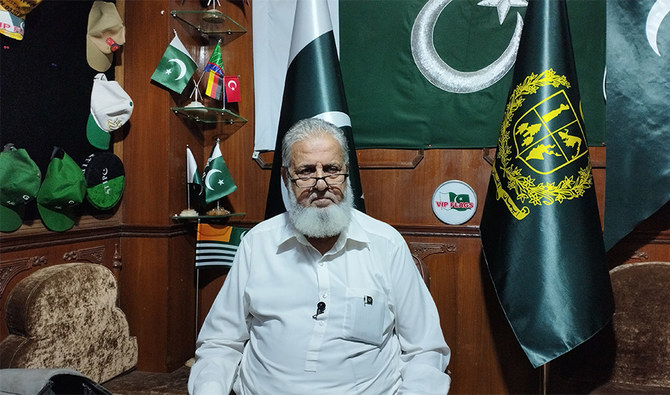

KARACHI: It was in 1985 that Sheikh Nisar Ahmed Perchamwala decided to go into the business of commercially producing Pakistan’s national flag, feeling personally offended that the patriotic symbol was being “desecrated” by manufacturers who paid little attention to government specifications about the flag’s correct size and color.
Perchamwala thus launched VIP Flags Pakistan with the aim of using modern machines that would get the colors and proportions of the national flag just right. Today, the company has many accolades to its name, including a Guinness world record in 2004 for making the world’s largest flag, after which the company’s CEO formally added to his name the honorific Perchamwala, which translates as flag maker.
And this August is particularly special for Perchamwala: as Pakistan turns 75, so too will he.
“I will also turn 75 on August 30,” Perchamwala told Arab News at the company’s manufacturing unit in Karachi, smiling. “August is not just the month of our freedom but also the month of my birth. It is the month of my Pakistan’s birth.”
Perchamwala was born in New Delhi on August 30, 1947, two weeks after the end of British colonial rule and the creation of Pakistan. His family had been in the clothing business for generations when in the early 1980s, Perchamwala became increasingly perturbed by Pakistani flag manufacturers who did not care “about the proportion of the crescent and the star.”
“These flags also came in different shades [of green], it was almost like people didn’t know how to make the Pakistani flag,” he said.
The casualness made him wonder: “What kind of a nation are we?”
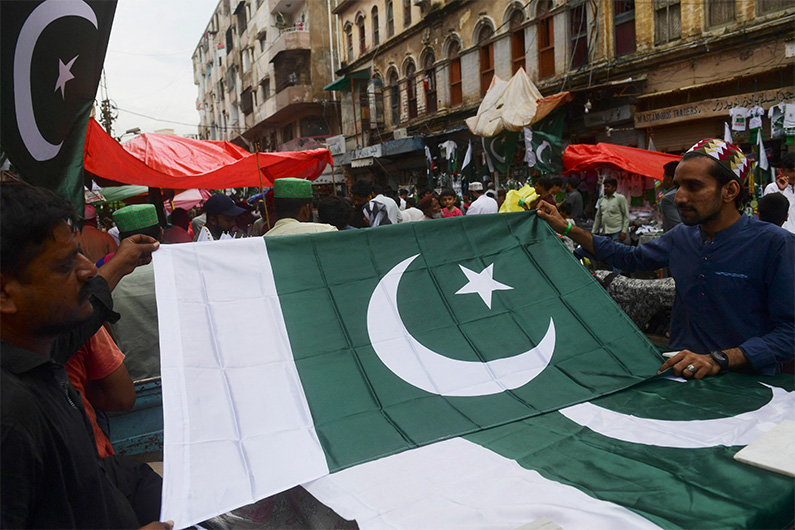
People buy national flags of Pakistan at a market ahead of Pakistan's 75th Independence Day in Karachi on August 12, 2022. (AFP)
“Then I did some research and started manufacturing the flag along modern lines for the first time,” the businessman said. “Now, handmade flag manufacturing has stopped and only printed and standard flags are produced with right proportions.”
Perchemwala said he started off by making small flags, following government specifications, but then went on to increase the sizes and finally made the world’s largest flag, at 173,400 square feet, in 2004, for which he was recognized in the Guinness Book of World Records.
“When my name appeared in the record book, I felt I had accomplished something significant and started writing ‘Perchamwala’ with my name,” he said.
Since then, Perchamwala has used the cloth from his record-breaking flag to make quilt covers for the victims of a devastating earthquake that hit Kashmir in October 2005. He has also been receiving orders for large flags from other countries, including Saudi Arabia and Afghanistan.
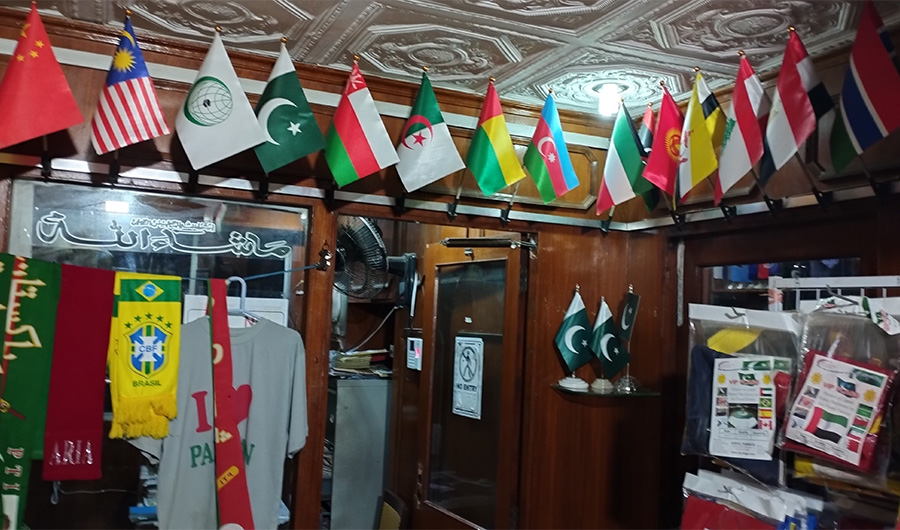
Flags of various countries made by Sheikh Nisar Ahmed Perchamwala are displayed at his manufacturing facility in Karachi on August 02, 2022. (AN photo).
In 2006, he made the biggest Saudi flag ever, measuring 6,000 square feet, which was also the tallest, installed on a 100-meter-tall pole in Diriyah, near Riyadh.
“They [Saudis] approached us after we made the [2004] record. We were honored to make the kingdom’s flag, though it was also quite difficult due to the inscription and the sword,” the flag maker said.
In 2008, Perchamwala made another large flag, which measured 250,000 square feet, for neighboring Afghanistan. He also gets regular orders for flags from embassies, consulates and hotels in Pakistan.
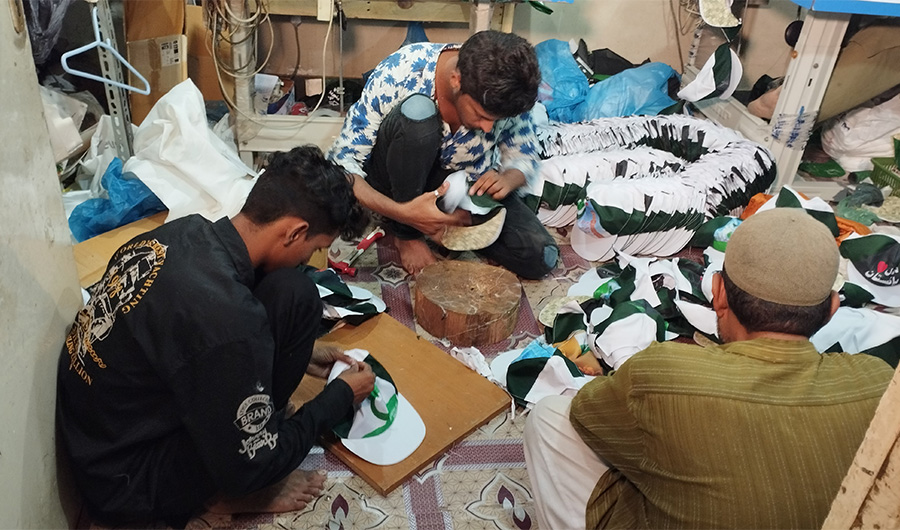
Workers at VIP Flags are making green and white caps representing Pakistan's national flag on August 02, 2022. (AN photo)
Now, at the diamond jubilee of Pakistan, Perchamwala’s business is managed by the family’s third generation, for whom he had an important message:
“The new generation should not forget the importance of freedom which was earned through struggle. They must take care of Pakistan’s pride and greatness.”


