

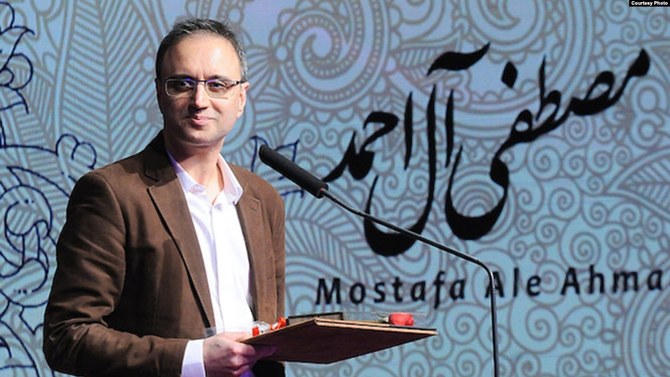
One of three jailed Iranian filmmakers released on bail 

The 52-year-old was arrested along with filmmakers Mohammad Rasoulof and Jafar Panahi in June. (Radio Farda)
Short Url
Updated 12 August 2022
Follow

One of three jailed Iranian filmmakers released on bail 

  • The 52-year-old was arrested along with filmmakers Mohammad Rasoulof and Jafar Panahi in June
  • The filmmakers’ arrest sparked international criticism from European film and arts festivals, including the Cannes Film Festival

Mostafa Al-Ahmad, one of the three prominent Iranian filmmakers arrested during Iran’s latest crackdown on dissent, has been released on bail, according to Radio Farda. 

The 52-year-old was arrested along with filmmakers Mohammad Rasoulof and Jafar Panahi in June, days after signing an open letter calling on security forces in the country to “lay down their arms” during widespread demonstrations over “corruption, theft, inefficiency, and repression,” Radio Farda reported. 

Al-Ahmad and Panahi had reportedly contracted COVID-19 in Tehran’s notorious Evin prison and were denied hospital care outside the detention facility, the report said. 

Outrage erupted across the country after more than 40 people were killed in May when a 10-storey building collapsed in the southwestern city of Abadan. At the time, public outcry called for corrupted authorities to be held accountable. 

The filmmakers’ arrest sparked international criticism from European film and arts festivals, including the Cannes Film Festival. 

“The Festival de Cannes strongly condemns these arrests as well as the wave of repression obviously in progress in Iran against its artists,” festival organizers said. “The festival calls for the immediate release of Mohammad Rasoulof, Mostafa [Al-Ahmad] and Jafar Panahi.”

“The Festival de Cannes also wishes to reassert its support to all those who, throughout the world, are subjected to violence and repression. The festival remains and will always remain a haven for artists from all over the world and it will relentlessly be at their service in order to convey their voices loud and clear, in the defense of freedom of creation and freedom of speech.”


Paris exhibition marks 200 years of Le Figaro and the enduring power of the press

Updated 17 January 2026
Follow

Paris exhibition marks 200 years of Le Figaro and the enduring power of the press

  • The exhibition celebrated the bicentennial of Le Figaro, offering visitors a rare opportunity to step inside the newspaper’s vast historical archive

PARIS: One of France’s most influential newspapers marked a major milestone this month with a landmark exhibition beneath the soaring glass nave of the Grand Palais, tracing two centuries of journalism, literature and political debate.
Titled 1826–2026: 200 years of freedom, the exhibition celebrated the bicentennial of Le Figaro, offering visitors a rare opportunity to step inside the newspaper’s vast historical archive. Held over three days in mid-January, the free exhibition drew large crowds eager to explore how the title has both chronicled and shaped modern French history.
More than 300 original items were displayed, including historic front pages, photographs, illustrations and handwritten manuscripts. Together, they charted Le Figaro’s evolution from a 19th-century satirical publication into a leading national daily, reflecting eras of revolution, war, cultural change and technological disruption.
The exhibition unfolded across a series of thematic spaces, guiding visitors through defining moments in the paper’s past — from its literary golden age to its role in political debate and its transition into the digital era. Particular attention was paid to the newspaper’s long association with prominent writers and intellectuals, underscoring the close relationship between journalism and cultural life in France.
Beyond the displays, the program extended into live journalism. Public editorial meetings, panel discussions and film screenings invited audiences to engage directly with editors, writers and media figures, turning the exhibition into a forum for debate about the future of the press and freedom of expression.
Hosted at the Grand Palais, the setting itself reinforced the exhibition’s ambition: to place journalism firmly within the country’s cultural heritage. While the exhibition has now concluded, the bicentennial celebrations continue through special publications and broadcasts, reaffirming Le Figaro’s place in France’s public life — and the enduring relevance of a free and questioning press in an age of rapid change.