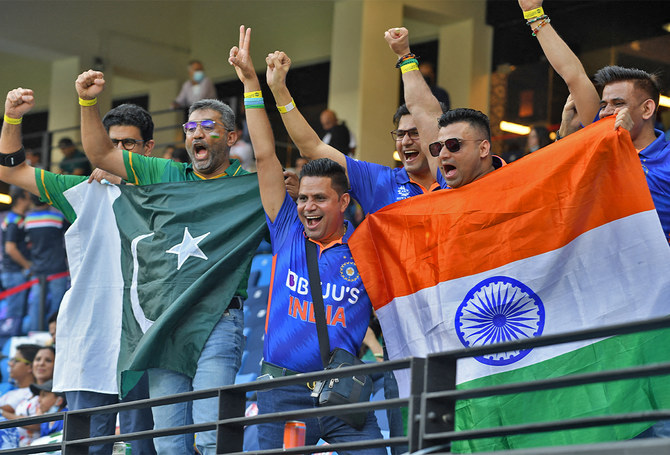

KARACHI: When India and Pakistan were forged out of violent partition 75 years ago, the split also created one of sport's greatest rivalries.
Today, any cricket match between the two nations is one of the most watched events on the global sporting calendar -- and victory used to promote their respective nationalism.
So strong is the rivalry between the countries that they can't even share the date of the partition which gave them independence, with Pakistan celebrating it on August 14 and India a day later.
"India playing Pakistan involves the sentiments of millions," said Wasim Akram, one of cricket's all-time greats and now a commentator.
"You become a hero if you perform well... you are portrayed as a villain if your team loses," said the former Pakistan skipper.
Matches ignite great fervour but they have also defused military tensions between the two nations, which have fought four wars since independence from Britain in 1947.
During one period of sabre rattling in 1987, as troops massed along their frontier, Pakistan's military ruler General Muhammad Zia-ul-Haq showed up unannounced in New Delhi -- ostensibly to watch a match between the two.
The move, as crafty as any a cricket captain could conjure up on the field, led to a meeting with Indian Prime Minister Rajiv Gandhi, and tensions eased.\
Still, the on-field rivalry has spilled off the cricket pitch for now.
The neighbours have not played a Test since 2007, instead meeting only in the shorter versions of the game and at multi-team competitions on foreign soil, rather than head-to-head series at home.
When they do play -- as they will at the Asia Cup later this month in the United Arab Emirates -- cricket fans around the world are glued to their TV screens, a multibillion-dollar bonanza for broadcasters.
The 2019 50-over World Cup clash between India and Pakistan drew 273 million viewers, while 167 million watched them in last year's Twenty20 World Cup.
"Nothing can match an Indo-Pakistan bilateral series because it is played in a different league," former prime minister and cricket captain Imran Khan, who led Pakistan to World Cup glory in 1992, said in a Sky Sports documentary.
"The atmosphere is filled with tension, pressure and enjoyment."
Pakistan Cricket Board chief executive Faisal Hasnain called games against India the "mother of all cricket matches".
"Fans want these two countries to play each other on a regular basis but resumption is only likely when there is a thaw in relations," he told AFP.
"We can only wait and hope that happens."
Introduced to the sub-continent in the 18th century, cricket was played mostly by its white colonial rulers, but locals learned the game by being used as bowling or batting fodder in the practice nets.
India won Test status in 1932, but after partition most Muslim players -- including three who had played for the national team -- migrated to Pakistan, who had to build from scratch.
Pakistan's first Test, appropriately, was against India, in 1952 -- and they were led by Abdul Hafeez Kardar, one of the three double internationals.
Since then Pakistan and India have played 59 Tests, with Pakistan winning 12, India nine, and the rest drawn.
In ODIs Pakistan also have the edge, but India have won seven of their nine T20 encounters.
In the women's game, India have won all 11 of their ODIs and 10 of their 12 Twenty20s since first meeting in 2005.
The advent of one-day cricket has only boosted the rivalry with one commentator calling their clashes "war minus shooting".
In 1991, Aaqib Javed's seven-wicket haul, including a hat-trick, helped Pakistan win the Wills Trophy in Sharjah in a match that ended in near-darkness, sparking outrage from the losing Indian side and fans.
"They whinged about it for months," Aaqib said drily.
But Pakistan fans have also shown their bile, sending death threats to Wasim Akram after he withdrew from a key final against India because of injury.
"At times the fans' reaction is intolerable," Akram said.
Former Indian batsman Sanjay Manjrekar said he misses regular clashes against Pakistan.
"It was my favourite opposition for all the entertainment they provided on the field with their banter," he told AFP.
"Plus the fact that they were a damn good side."