

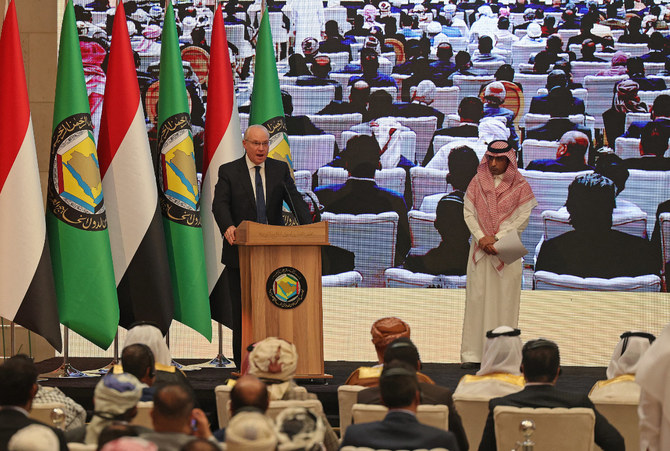
US envoy to Yemen visiting Saudi Arabia, other Gulf nations, amid Houthi escalation in Shabwa

In this March 30, 2022, photo, US Special Envoy for Yemen Tim Lenderking speaks during a conference on Yemen's devastating war hosted by the six-nation Gulf Cooperation Council in Riyadh. (AFP file)
Short Url
Updated 12 August 2022
Follow

US envoy to Yemen visiting Saudi Arabia, other Gulf nations, amid Houthi escalation in Shabwa

  • Tim Lenderking’s regional tour is part of the intense diplomatic efforts to extend a UN-mediated truce in Yemen and bolster the peace process
  • He is also expected to rally support and funding for UN efforts to tackle the threat posed by the derelict Safer oil tanker, amid fears of an ecological disaster in the Red Sea

LONDON: The US special envoy for Yemen, Tim Lenderking, began a tour of Saudi Arabia, the UAE and Oman on Thursday, and members of his team have traveled to Jordan, as part of intense diplomatic efforts to extend an UN-mediated truce in Yemen and bolster peace efforts, the State Department said on Friday.

“The special envoy and his team will focus on helping to meaningfully expand benefits of the truce to all Yemenis and pave the way for a permanent ceasefire and an inclusive, durable Yemeni-led resolution to the conflict,” the State Department said.

Lenderking will also discuss recent instability in Shabwa and the need for a return to calm after fighting intensified in the oil-rich, eastern province, and highlight the need for additional financial assistance for the Yemeni people.

“The United States has already provided over $1 billion in humanitarian aid this year alone, bringing our total contribution to the humanitarian response in Yemen to nearly $5 billion since the crisis began eight years ago,” the State Department said.

“We urge donors both to give generously and to make previous pledges immediately available for the sake of the people of Yemen.”

The head of the Yemeni Presidential Leadership Council, Rashad Al-Alimi, on Wednesday announced moves designed to quickly end sedition in Shabwa and hold to account those responsible.

He added that “the strife that occurred in Shabwa confirms the importance of rallying around the state,” according to a report by the official Yemeni news agency, Saba.

Lenderking is also expected to continue to rally support for UN efforts to raise awareness of the threat posed by the Safer oil tanker, and funding to address it. The vessel, which is moored in the Red Sea off the coast of Yemen, holds more than 1.1 million barrels of oil and has had little or no maintenance carried out since the civil war began in late 2014. As a result, its condition has deteriorated to the point where there are fears of a major ecological disaster.

“With about $14 million unfunded and an UN-Houthi agreement to offload the oil to a temporary vessel, we are the closest we have ever been to addressing the threat posed by this derelict tanker,” Lenderking said.

“An oil spill would exacerbate the world’s worst humanitarian crisis, cause severe environmental damage, and impact global shipping and other economic activity.”

Meanwhile, the EU said it is very concerned about the recent violence in Shabwa and the reported loss of lives.

“The EU welcomes the efforts of President Rashad Al-Alimi and the PLC to deescalate the situation (in) Yemen,” it said.


Deal with Iran ‘Unimaginable,’ Pompeo tells WGS in Dubai

Updated 4 sec ago
Follow

Deal with Iran ‘Unimaginable,’ Pompeo tells WGS in Dubai

  • UAE’s Gargash says he would like to see direct US negotiations with Tehran

DUBAI: Former US secretary of State, Mike Pompeo, told the World Government Summit in Dubai on Monday that he believed a deal between Iran and the United States was “unimaginable” under the current Ayatollah regime believing US strikes on the nation were still a possibility despite the apparent deescalation of the last few days.

“It's unimaginable that there could be a deal. To me, we've had a deal with Iranians multiple times,” he told a panel in Dubai on Tuesday.

“They have cheated and lied and avoided compliance with every deal they've signed.”

Pompeo was central to the US decision to leave the Joint Comprehensive Plan of Action (JCPOA) nuclear deal when he served as secretary during Donald Trumps first term. According to the US department of Justice, the Islamic Republic subsequently placed a $1 million bounty on his head.

Trump has in previous days said the US was seeking to srike a deal with Iran whilst simultanously ordering a large scale militray build up in the region. Pompeo said that he believed the US president could use military strikes – or at least the threat of them – to increase leverage on the regime to give up its enrichment and missiles fully, although he remained cynical of anything being achieved without regime change. 

“To think that there's a long-term solution that actually provides stability and peace to this region while the Ayatollah was still in power, is something I pray for, but find unimaginable,” Pompeo said.

On Syria, Pompeo expressed cautious optimism that the interim president Ahmed Hussein al-Sharaa will succeed in rebuilding his country with a lasting peace.

Al-Sharaa has previously said he was focused on consolidating power, rebuilding state institutions, integrating military factions, and restoring Syria's international relations, including with the United States, Russia, and regional powers.

Pompeo said he maintained a level of mistrust in the Syrian president – most notably due to his involvement with Al-Qaeda - but added that he hoped Al-Sharaa would do well.

 “I have known of Mr. Sharaa for a long time, when I was a CIA director… we had a $10m bounty on his head. He was an Al Qaeda terrorist,” he said.

“It is important for the region to get stability in Syria and so I am rooting for him…. I hope we all do our part to help him be more successful at bringing a very fractured nation back together so that.”

He said he hoped the up to seven million people who had fled the country as refugees could one day return to their homes.

“But it is a very difficult task for anyone and someone with the history that he has, I think it makes it even more complicated for him to be successful. But he’s the leader today and we all should hope that he is able to pull off what It is he has stated his intentions are.”

Pompeo was joined on stage by former UAE Minister of State for Foreign Affairs, Anwar Gargash, who was more hopeful of a diplomatic solution to the Iranian crisis; saying the region stood firm against escalation and further prolonged military conflict.

Gargash believed that it was in the best interest of Iran to strike a deal with the US that would open the pathway to it resolving its multitude of crises.

“I think that the region has gone through various various calamitous confrontations. I don't think we need another one,” he told the summit.

“I would like to see direct Iranian American negotiations leading to understandings so that we don't have these issues every other day.”

Speaking more broadly on regional security, Gargash said resolving the Palestinian issue was still of utmost importance if the middle east was to secure a prosperous future. He said that the UAE was commiitted to seeing through the Trumps plan but ruled out rumours that the emirates was poised to take over governance of the territory.

“We have to work with the Palestinians. We have to work with the Egyptians, the Israelis, the Jordanians, and of course, American leadership is key, really, for achieving a sort of, I won't say, sustainable solution at this time, but moving on with with the part two of President Trump's plan,” he said.

On the international stage, Gargash said he bvelived the health of the China-US relationship was the biggest hinderence to peace – warning that if not managed properly it would likely lead to increasing comflict around the world. He said it was paramount that the two countries maintained a mature relationship based on competition.