


BEIRUT: Doubts were cast over the upcoming presidential election in Lebanon later this year, after Hezbollah’s Secretary-General Hassan Nasrallah called on Lebanese officials “to form a government that enjoys its full powers to assume its responsibilities, whether or not a new president is elected,” on Tuesday.
It was the first time Nasrallah mentioned publicly the possibility of not holding the presidential elections, raising fears of a political vacuum in the crisis-stricken country, similar to that which preceded President Michel Aoun’s election in 2016, and which lasted over two years.
Prime Minister Najib Mikati was tasked on June 23 with forming a new Cabinet, which he presented to Aoun after parliamentary elections last May.
However, Mikati’s lineup did not satisfy Aoun, who said the prime minister’s choices undermined him. Communication between the two has been fraught since then, and all attempts to revive forming a government have stalled.
Parliamentary Speaker Nabih Berri said in a statement he thought a resolution to the impasse at this stage would require “a miracle.”
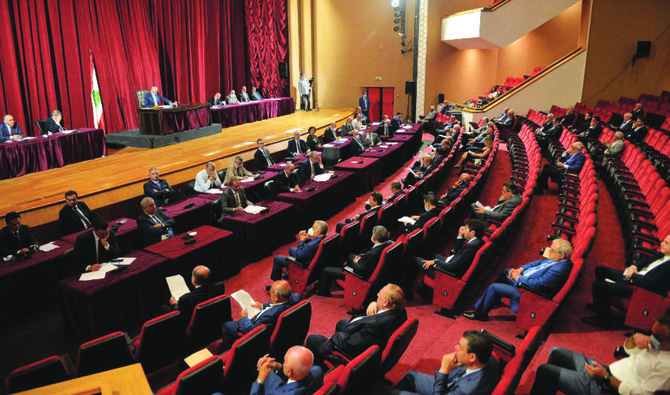
As things stand, on Sept. 1, Parliament will turn into the elective body of the office of the president, with several rounds of voting set to take place to appoint a new head of state.
Ali Darwish, a member of Lebanon’s Parliament, told Arab News: “Each party has the right to express its opinion on the next political phase the way it deems convenient. Certainly, a government enjoying its full powers is better than a caretaker government. It is a sound demand because a government enjoying its full powers can take decisions.
“We want these elections to take place, just like other events — electing a new Parliament, and tasking the prime minister with the formation of a new government — to be carried out on time. Electing a new president for the country provides stability.”
On Monday, a meeting was held between 16 MPs from the Force of Change bloc, along with a number of other independent and opposition MPs.
The stated objective of the meeting was to “hold discussions in order to agree on a legislative agenda and coordinate on future duties, such as approving the general budget, the financial reform plan and the legislations necessary for the country.”
However, political observers believe the meeting was an early move to identify a candidate to replace Aoun.
If these MPs were able to attract other moderate colleagues, they could form a significant force in Parliament opposing Hezbollah and its allies, potentially preventing a candidate aligned with Hezbollah from being elected president.
Darwish said: “What happened in Parliament last Monday serves the democratic game and the country’s interest, and we approve of it. We do not favor confrontational diversity, as we are in a crucial phase of the economic crisis we are facing and we need everyone’s solidarity.
“Every political party in Lebanon has its own agenda. I hope the presidential elections will be held on time and the democratic game will be fully reflected.”
He added: “Complex files are awaiting the next president, such as the negotiations with the International Monetary Fund, the approval of an economic recovery plan, the restructuring of the public sector, and the maritime border demarcation, which requires a complete ruling system.”
Lebanese Forces MP Fadi Karam told Arab News: “Through his speech, Nasrallah insists on keeping the state incapacitated and paralyzed, so Hezbollah can impose its conditions on everyone.”
Karam said the meeting was “a positive event, and an attempt to unify the opposition in the face of Hezbollah, so we can have a majority that represents the people and faces (down) Hezbollah’s plan.”
Hadi Abou El-Hassan of the Progressive Socialist Party said: “The parliamentary elections didn’t limit decision-making to one party. This allows settlement and agreement on broad topics.”
He added: “As a patriotic Lebanese, I can’t link the fate of a country to the fate of Iran, but everyone knows that Lebanon isn’t independent in its decision-making.”


