India’s Neeraj Chopra wishes Arshad Nadeem ‘all the best’ after new record, gold at Commonwealth Games

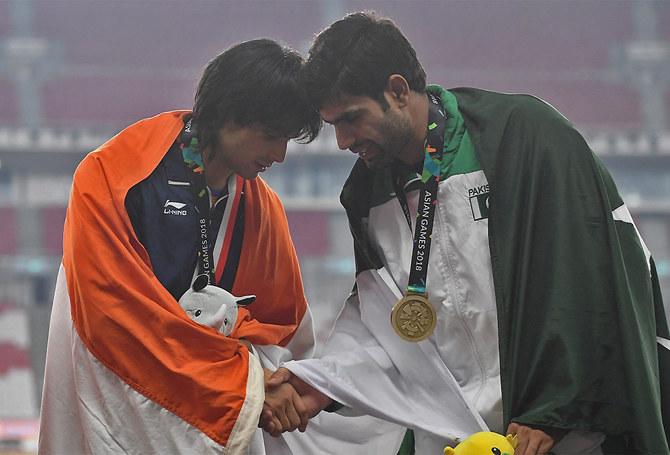
Gold medallist India's Neeraj Chopra (L) shakes hands with bronze medallist Pakistan's Arshad Nadeem during the victory ceremony for the men's javelin throw athletics event during the 2018 Asian Games in Jakarta on August 27, 2018. (AFP/File)
Short Url
Updated 09 August 2022
Follow

India’s Neeraj Chopra wishes Arshad Nadeem ‘all the best’ after new record, gold at Commonwealth Games

  • The two South Asian athletes first met in India in 2016 when they were still in their teenage
  • Nadeem is the first South Asian athlete who has breached the 90-meter barrier in an international contest

ISLAMABAD: A leading Indian athlete, Neeraj Chopra, congratulated his Pakistani rival and friend, Arshad Nadeem, after the latter shared the video of his record-breaking, 90-meter javelin throw at the Commonwealth Game on Instagram that helped him earn a gold for his country.

The two sportsmen first met in 2016 as teenagers when Nadeem visited India to participate in an international competition. Ever since, they have competed with each other in several international contests, including the Olympic Games held last year where Chopra secured the top position for his country.

Nadeem made history in the early hours of Monday while participating in the Men’s Javelin Throw Final, setting the new record at the games and snatching the title in a fifth-round throw of 90.18 meters.

His performance not only made him the first Pakistani, but also the only South Asian, to breach the 90-meter barrier in the sport.

“Congratulations Arshad bhai [brother] for gold medal and crossing 90mtr with new games record,” Chopra said while commenting on Nadeem’s social media post.

The Indian athlete, who could not represent his country at the Commonwealth Games due to a groin injury, also wished him luck for future competitions.
Asked about Chopra’s absence from the competition, Nadeem said he “missed” him at the games.

“May God grant him good health,” he added. “It would have been more fun if he were here.”


Pakistan plans 3,000 EV charging stations as green mobility push gathers pace

Updated 14 January 2026
Follow

Pakistan plans 3,000 EV charging stations as green mobility push gathers pace

  • Roadmap unveiled by energy efficiency regulator and a private conglomerate amid early-stage EV rollout
  • New EV Policy and related plans aim to install 3,000 EV stations by 2030, including 240 stations in current fiscal year

ISLAMABAD: Pakistan’s energy efficiency regulator and a private conglomerate have unveiled an approved roadmap to establish 3,000 electric vehicle (EV) charging stations across the country, state-run Associated Press of Pakistan (APP) reported on Tuesday.

The announcement comes as Pakistan looks to build out basic EV charging infrastructure, which remains limited and unevenly distributed, largely concentrated in major cities. Despite policy commitments to promote electric mobility as part of climate and energy-efficiency goals, the absence of a nationwide charging network has slowed broader EV adoption.

Pakistan’s EV ecosystem is still at a formative stage, with progress constrained by regulatory approvals, grid connectivity issues and coordination challenges among utilities, regulators and fuel retailers. Expanding charging infrastructure is widely seen as a prerequisite for scaling electric transport for both private and commercial use.

According to APP, the roadmap was presented during a meeting between Malik Group Chief Executive Officer Malik Khuda Baksh and National Energy Efficiency and Conservation Authority Managing Director and Additional Secretary Humayon Khan.

“Baksh ... in a meeting with Khan, unveiled the approved roadmap for establishing 3,000 electric vehicle charging stations across Pakistan,” APP reported. “Khan reaffirmed the authority’s full institutional backing and pledged to expand the initiative to 6,000 EV charging stations nationwide.”

The discussion reviewed hurdles delaying the rollout, including EV charger imports, customs duties, regulatory documentation and inter-agency coordination.

APP said Khan welcomed the proposal and sought recommendations for “internationally compliant EV charger brands,” while asking for a detailed “issue-and-solutions report within three days” to facilitate timely implementation of the national green mobility initiative.

Despite the issuance of 13 licenses by NEECA and the arrival of five EV charging units at designated sites, progress has been slowed by procedural bottlenecks, officials said. These include delays in electricity connections, prolonged installation of separate meters and pending no-objection certificates from power distribution companies and oil marketing firms, which continue to stall operational readiness.

Pakistan’s electric vehicle ecosystem is still in its early stages, with charging infrastructure far behind levels seen in more advanced markets. The government’s New Energy Vehicle Policy and related plans aim to install 3,000 EV charging stations by 2030, including 240 stations planned in the current fiscal year, but actual deployment remains limited and uneven, mostly clustered in major cities and along key urban corridors.

Despite regulatory backing, including the 2024 Electric Vehicles Charging Infrastructure and Battery Swapping Stations framework, progress has been slow. Many proposed stations have yet to become operational due to delays in grid connections and approvals, and public maps of nationwide charging coverage are not yet available.

Private players are beginning to install more chargers, and there are over 20 public EV charging points reported in urban centers, offering both slower AC chargers and faster DC options. However, such infrastructure is still sparse compared with the growing number of electric vehicles and the government’s long-term targets.