



ISLAMABAD: A Pakistani expatriate living in Saudi Arabia has helped pave the way for the release of 155 Pakistani prisoners from jails in Saudi Arabia by arranging payments for their fines worth 2.75 million riyals over the past two years.
Saudi Arabia serves as the largest source of remittances to Pakistan, where 2.5 million Pakistani expatriates live and work. Nasar Iqbal, 39, came to Saudi Arabia around 20 years ago from Pakistan’s Gujrat city and has been working as a project manager at a contracting company named Modon Al Bina in Jeddah.
“I began this project in September 2020 and as of today, with the help of the entire community, we were successful in the release of 155 Pakistani prisoners and have paid off fines totalling 2.75 million Saudi Riyals,” Iqbal told Arab News over the phone.
Iqbal disclosed that a distressed phone call from the mother of a Pakistani inmate in Saudi Arabia convinced him to undertake the initiative.
“I received a phone call from an old lady who was in a miserable condition due to the imprisonment of her son for the past six years [in Saudi Arabia] who was charged with minor offenses with a fine (claim from Saudi Sponsor) of 6,500 Saudi Riyals,” he said.
He said the family was unable to pay off the fine due to financial constraints.
“I immediately made inquiries regarding this matter and came to know that there was a list of 107 imprisoned individuals who were not financially secure enough to pay their fines and go back to their families in Pakistan,” Iqbal added.
Iqbal confirmed details of each case from the Pakistani consulate in Jeddah and the prisoners’ families and then tried to reach a settlement agreement with the Saudi sponsor.
“I collected all the relevant details and approached the Pakistani Consul General in Jeddah, Khalid Majeed, in this regard,” he said, adding that Majeed “took a keen interest in every single case and assisted me in all legal matters.”
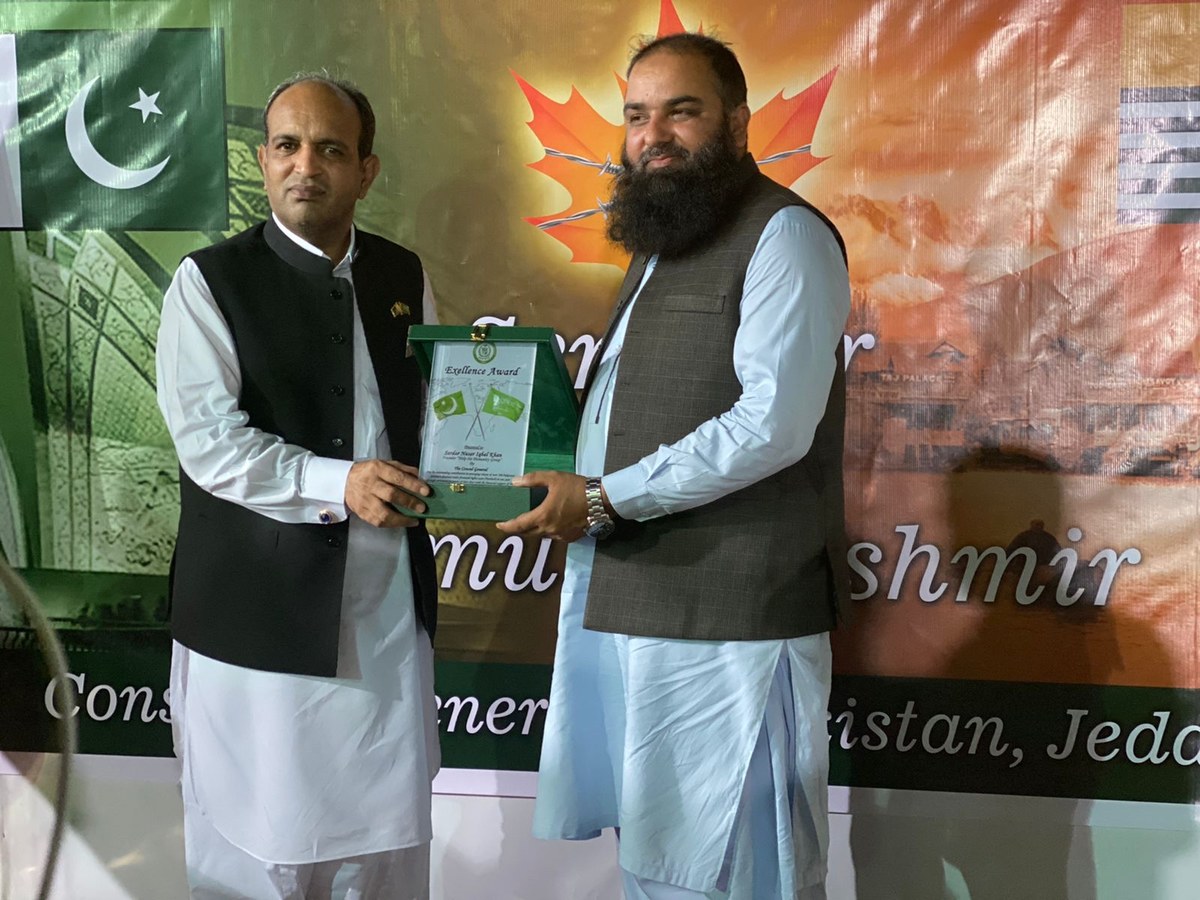
Pakistani Consul General in Jeddah Khalid Majeed (Left) hands a shield to Nasar Iqbal (Right) on securing the release of 100 prisoners In Jeddah, Saudi Arabia on October 27, 2021. (Courtesy: Nasar Iqbal)
Explaining the process, he said after confirming details of each case from the consulate and the prisoners’ families in Pakistan, he tried to reach a settlement agreement with the Saudi sponsor or company.
“Once it is finalized, the Saudi Government generates a Tanfeez/Sadad (an electronic payment code) which I share in different social media groups, with the case details, and the donors start paying directly to the Saudi government payment system (Sadad),” Iqbal explained.
Sadad is a central system of electronic payments in Saudi Arabia, launched to accelerate payment of invoices and other payments electronically across banking channels in the kingdom.
“We do not collect cash directly or indirectly for these payments as donors pay directly to the Saudi government’s payment system, whatever amount they can,” he added.
Iqbal shares the payment documents with the Pakistani consulate in Jeddah after they are received in full. The consulate then starts processing the documents in coordination with the prison.
Once all the paperwork is completed, the inmate is released from prison. Iqbal said the Saudi government pays for the tickets of all prisoners it deports to Pakistan.
Hamza Gillani, a spokesperson of the Pakistani consulate in Jeddah, confirmed that Iqbal worked in close coordination with the Pakistani mission in Saudi Arabia.
“He is doing excellent work and the consulate always provided assistance wherever required,” Gillani told Arab News.
Gillani said Iqbal arranged all the amount for fines and other legal expenses through donors which are directly paid to the Saudi government through Sadad. He added the consulate provided him with the relevant information.
“Once fines are paid, consulate teams would also assist in arranging necessary documents required for the release of the prisoner,” he confirmed.


