Continued Israeli targeting of Al-Aqsa and holy sites sparks condemnation

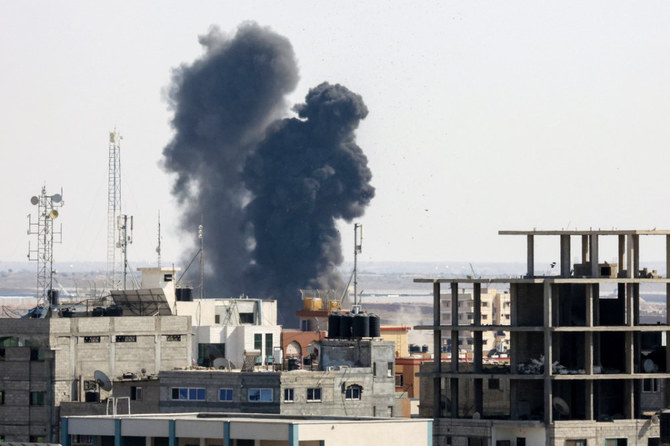
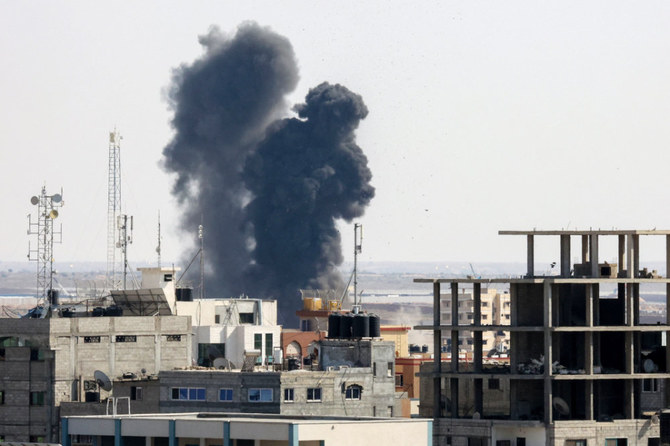
Smoke billows from a building struck during an Israeli air strike in Rafah in the southern Gaza Strip, on August 7, 2022. (AFP)
Short Url
Updated 07 August 2022
Follow

Continued Israeli targeting of Al-Aqsa and holy sites sparks condemnation

  • Settlers prostrate themselves in mosque's courtyards

RAMALLAH: Tensions rose in the West Bank and East Jerusalem on Sunday after more than 2,000 settlers stormed Al-Aqsa Mosque amid tight Israeli police protection throughout the Old City and at the gates leading to the mosque.

Hundreds of settlers will participate in the incursion to revive the so-called “destruction of the temple.”

They had gathered since Saturday evening in the Old City and its surroundings before reaching the Western Wall/Al-Buraq, ahead of their overnight preparation for the incursions, with the participation of far-right Knesset member Itamar Ben Gvir.

At dawn on Sunday, Israeli police stopped people under 50 from entering Al-Aqsa to prevent them from confronting the settlers. An arrest campaign was launched on Saturday night, with at least six young men targeted.

The settlers began storming the courtyards of Al-Aqsa in successive groups, with the first group of 50 provided by extremist Yehuda Glick.

Israeli police deployed members of its special units in the courtyards to provide guards for the intruders, keep Palestinians away from the path of the incursions, and prevent their movement during the tours.

Settlers raised the Israeli flag while storming the courtyards.

They organized dancing and singing sessions near the Al-Silsila Gate from the outside. There were also tours and prayers at all the gates of Al-Aqsa from the outside.

Several settlers prostrated themselves in the courtyards of Al-Aqsa, as Muslim worshippers confronted the intruders and their provocations.

A statement from the Islamic Awqaf, which is affiliated with Jordan and in charge of Al-Aqsa, was signed by other Islamic commissions in Jerusalem and obtained by Arab News.

It said: “In an attempt to change the religious, legal, and historical status of the blessed Al-Aqsa Mosque/Al-Haram Al-Sharif, the occupation authorities and their police and intelligence forces turned this morning, Sunday, the blessed Al-Aqsa Mosque into a military barracks to secure the storming of groups of Jewish extremists to the premises of the blessed Al-Aqsa Mosque, after their calls to mobilize large numbers to storm the mosque in remembrance of the so-called ‘Destruction of the Temple.’”

According to the Islamic Awqaf, about 2,176 Jewish extremists stormed the courtyards under the protection of the Israeli police and intelligence forces who secured their tours, dances, singing, and laying down as part of their rituals in an apparent provocation to the feelings of Muslims, in return for emptying the mosque of worshippers, pursuing several young men and women, forcibly expelling them outside the mosque, arresting a number of them, and preventing the entry of a large number of worshippers.

The Palestinian Foreign Ministry said it held the Israeli government fully and directly responsible for its ongoing aggression against Christian and Islamic holy sites, the foremost of which was Al-Aqsa, and for its repercussions and dangers on the conflict and the entire region.


Aleppo Citadel is a witness to the city’s great history and legacy

This aerial view shows the Citadel of Aleppo overlooking the northern Syrian city on December 11, 2024. (AFP)
Updated 11 sec ago
Follow

Aleppo Citadel is a witness to the city’s great history and legacy

  • Parts of military fortress date back nearly 2 millennia
  • Historian Abdullah Hajjar provides an extensive study

DAMASCUS: Towering above the old city, the Aleppo Citadel has stood for centuries as both a military stronghold and symbol of the location’s layered history.

After years of closure, neglect, and damage during the war, the Aleppo Citadel reopened to visitors on Sept. 27 following months of restoration.

The site has been listed as a UNESCO World Heritage landmark since 1986.

Rising around 38 meters above its surroundings, the fortress has played a central role in Aleppo’s political, military, and urban development.

Surrounded by a deep defensive moat, the citadel reflects advanced military engineering.

According to historian Abdullah Hajjar in his book “Archaeological Landmarks of Aleppo,” first published in 2010, the moat was excavated and reinforced during the reign of Ayyubid ruler Al-Zahir Ghazi.

At times it was 22 meters deep and about 30 meters wide, and filled with water to strengthen defenses.
Parts of the citadel date back nearly two millennia.

The lower section of its main entrance originates from the third century A.D., while the upper additions were made in the 15th century. Most of the towers and walls were built or expanded between the 13th and 16th centuries.

The citadel has repeatedly been damaged and rebuilt over the centuries. It was destroyed by the Sassanids in 540 A.D., but later restored.

Inside its walls, the citadel contains mosques, military structures, and residential buildings, offering a rare glimpse into daily life within a medieval fortress.

Among its landmarks are the Ibrahim Al-Khalil Mosque, the Great Mosque, defensive towers, barracks, and several historic houses.

Archaeological excavations have uncovered remains from multiple eras. This includes a ninth-century B.C. temple, Roman and Byzantine sarcophagi, and water cisterns dating to the reign of Byzantine Emperor Justinian, who rebuilt Aleppo’s fortifications in the sixth century against Persian invaders.

The citadel flourished during the Mamluk period, when it was restored by Sultan Baybars after the 1260 Battle of Ain Jalut.

Later inscriptions document victories by Mamluk rulers over Crusader and Mongol forces.

Under Ottoman rule, following the Battle of Marj Dabiq in 1516, the fortress gradually lost its military role and became an administrative and residential site.

The book outlines the various stages of restoration of the Aleppo Citadel over the centuries.

It highlights that Al-Zahir Ghazi, son of Saladdine Ayyubi, excavated the moat, reinforced the entrance with three wrought-iron gates, and built a large mosque within the fortress.

Later, Al-Zahir Baybars restored the citadel after the Mongol invasion, and in 1417, Sultan Al-Mu’ayyad Shaykh repaired its walls following their destruction by Timur in 1401.

The Aleppo Citadel has also survived powerful earthquakes, including a devastating quake in 1138 and another in 1822, each followed by major restoration efforts led by regional rulers of the time.

Beyond the citadel itself, Hajjar’s research documents Aleppo’s wider architectural heritage, including historic bathhouses and caravanserais that once supported the city’s role as a major trade center.