

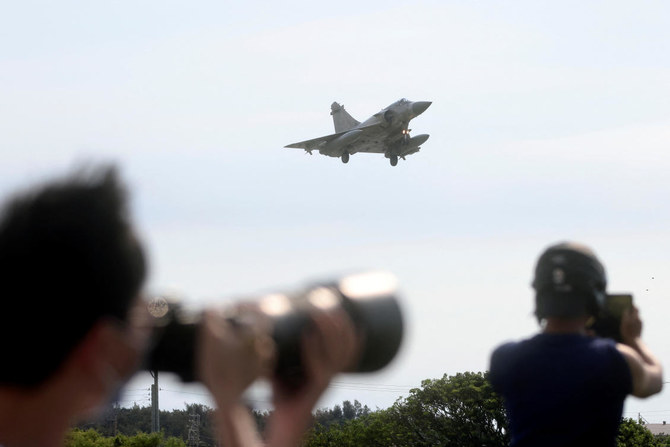

BEIJING: The Chinese military will from now on conduct “regular” drills on the eastern side of the median line of the Taiwan Strait, Chinese state television reported on Sunday, citing a commentator.
The median line in the narrow strait between the island of Taiwan and mainland China is an unofficial line of control that military aircraft and battleships from either side normally do not cross.
The median line has never been legally recognized, and is an “imaginary” line drawn up by the US military for their combat requirements in the previous century, according to the state television commentator.
Earlier, China’s largest-ever military exercises surrounding Taiwan drew to a close on Sunday following a controversial visit last week to the self-ruled island by US House Speaker Nancy Pelosi.
Beijing has raged at the trip by Pelosi — the second in the line of succession to the US presidency — ripping up a series of talks and cooperation agreements with Washington, most notably on climate change and defense.
It has also deployed fighter jets, warships and ballistic missiles around Taiwan in what analysts have described as practice for a blockade and ultimate invasion of the island.
Those exercises were set to end Sunday, though Beijing has announced fresh drills in the Yellow Sea — located between China and the Korean peninsula — to take place until August 15.
Taiwan’s transport ministry said six of the seven “temporary danger zones” China warned airlines to avoid ceased to be in effect as of noon on Sunday, signalling a drawdown of the drills.
It said the seventh zone, in waters east of Taiwan, would remain in effect until 10:00 am (0300 GMT) local time on Monday.
“Relevant flights and sailings can gradually resume,” the ministry said in a statement.
Taipei said some routes were still being affected in the seventh area, and authorities would continue to monitor ship movements there.
Earlier on Sunday, Beijing conducted “practical joint exercises in the sea and airspace surrounding Taiwan Island as planned,” the Chinese military’s Eastern Command said.
The drills were focused “on testing the joint firepower on the ground and long-range air strike capabilities,” it added.
Taipei’s defense ministry also confirmed that China had dispatched “planes, vessels and drones” around the Taiwan Strait, “simulating attacks on Taiwan’s main island and on ships in our waters.”
Beijing also sent drones over Taiwan’s outlying islands, it added.
In response, the democratic island said it mobilized a “joint intelligence surveillance and reconnaissance system to closely monitor the enemy situation” as well as sending planes and vessels.
China’s defense ministry did not respond to a request for comment about the expected conclusion of the drills on Sunday.
To show how close China’s forces have been getting to Taiwan’s shores, Beijing’s military released a video of an air force pilot filming the island’s coastline and mountains from his cockpit.
And the Eastern Command of the Chinese army shared a photo it said was taken of a warship patrolling seas near Taiwan with the island’s shoreline visible in the background.
The drills have also seen Beijing fire ballistic missiles over Taiwan’s capital, according to Chinese state media.
Taipei has remained defiant throughout China’s sabre-rattling, insisting it will not be cowed by its “evil neighbor.”
Taiwan’s foreign ministry urged Beijing on Saturday to “immediately stop raising tensions and taking provocative actions to intimidate the Taiwanese people.”
But experts have warned the drills reveal an increasingly emboldened Chinese military capable of carrying out a gruelling blockade of the self-ruled island as well as obstructing US forces from coming to its aid.
“In some areas, the PLA might even surpass US capabilities,” Grant Newsham, a researcher at the Japan Forum for Strategic Studies and former US Navy officer, told AFP, referring to China’s military by its official name.
“If the battle is confined to the area right around Taiwan, today’s Chinese navy is a dangerous opponent — and if the Americans and Japanese do not intervene for some reason, things would be difficult for Taiwan.”
The scale and intensity of China’s drills — as well as Beijing’s withdrawal from key talks on climate and defense — have triggered outrage in the United States and other democracies.
US Secretary of State Antony Blinken, meeting with his Philippine counterpart on Saturday, said Washington was “determined to act responsibly” to avoid a major global crisis.
China should not hold talks on issues of global concern such as climate change “hostage,” Blinken said, as it “doesn’t punish the United States, it punishes the world.”
The United Nations has also urged the two superpowers to continue to work together.
“For the secretary-general, there is no way to solve the most pressing problems of all the world without an effective dialogue and cooperation between the two countries,” his spokesman Stephane Dujarric said.


