UAE president, Saudi top general condole with Pakistan army chief over helicopter crash deaths 

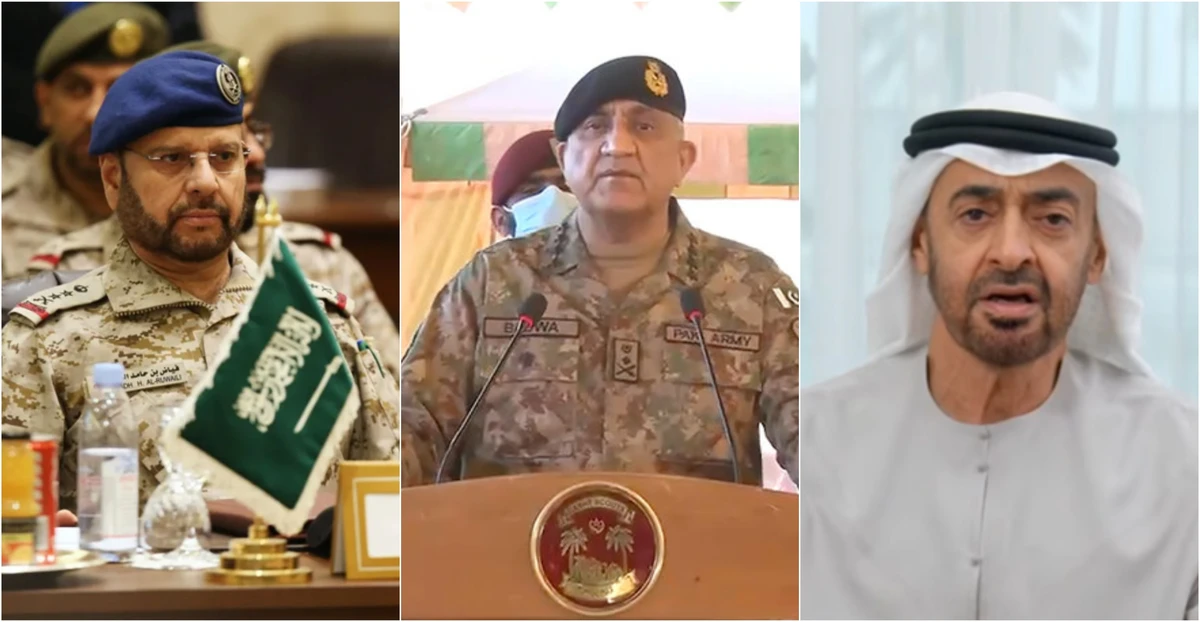
This combination of photos shows Saudi Army Chief General Fayyadh bin Hamed Al Ruwaili (L) Pakistan’s army chief General Qamar Javed Bajwa (C), and UAE President Sheikh Mohamed bin Zayed Al Nahyan. (AFP/ISPR/WAM)
Short Url
Updated 06 August 2022
Follow

UAE president, Saudi top general condole with Pakistan army chief over helicopter crash deaths 

  • Saudi Armed Forces chief of general staff expresses deepest condolences over loss of “precious lives’ in helicopter 
  • A top military commander, Lt. Gen. Sarfaraz Ali, was among six who were onboard and killed in this week’s crash 

ISLAMABAD: UAE President Sheikh Mohamed bin Zayed Al Nahyan and Saudi Army Chief General Fayyadh bin Hamed Al Ruwaili called on Pakistan’s army chief this week to offer condolences over a recent helicopter crash in which a top military commander was killed.

An army aviation helicopter reviewing flood relief operations went missing on Monday with Commander XII Corps, Lt. Gen. Sarfaraz Ali, and five other army officials, onboard. On Tuesday, wreckage was found, and the army said all passengers had died.

“His Highness [President Al Nahyan] expressed deepest condolences over the tragic loss of precious lives due to the helicopter crash in Lasbela,” a statement from the military’s media wing said on Friday.

Separately Saudi Arabia’s Armed Forces chief of the general staff, General Al Ruwaili, spoke to Gen Bajwa and offered condolences, the military said on Saturday.

“Chief of General Staff KSA expressed deepest condolences over tragic loss of precious lives due to helicopter crash in Lasbela,” ISPR said.

Pakistan has deep-rooted fraternal ties with Saudi Arabia and the UAE.

Nearly 2.5 million Pakistani expats live in the kingdom and more than 1.6 million in the UAE.

OIC’s COMSTECH stresses academic collaborations across Muslim world in Islamabad meeting

Updated 4 sec ago
Follow

OIC’s COMSTECH stresses academic collaborations across Muslim world in Islamabad meeting

  • COMSTECH holds annual meeting in Islamabad featuring 30 delegates from Iran, Somalia, Palestine, Indonesia and other OIC states
  • Limited pool of skilled professionals one of the foremost challenges facing Muslim world, notes COMSTECH secretary general 

ISLAMABAD: The OIC Standing Committee on Scientific and Technological Cooperation (COMSTECH) called for stronger academic collaboration across Islamic states to secure the future of higher education in the Muslim world, state-run media reported on Saturday. 

COMSTECH’s Coordinator General Prof. Dr. Muhammad Iqbal Choudhary was speaking at the Annual Meeting of the COMSTECH Consortium of Excellence at the organization’s Secretariat in Islamabad. The event brought together vice chancellors, rectors, and senior representatives from leading universities across OIC member and observer states. 

Nearly 30 international delegates representing universities from Iran, Somalia, Palestine, Indonesia, Malaysia, Thailand, Uganda, Bangladesh, Benin, Cameroon, Gabon, Côte d’Ivoire, and Senegal joined their counterparts from several Pakistani institutions at the meeting. Participants attempted to chart a collective path forward for tertiary education in OIC countries.

“Collaborations, knowledge sharing, best practices, exchange of scholars, technology transfer and joint academic programs are vital for overcoming the educational challenges faced across the OIC region,” Choudhary said, according to the state-run Associated Press of Pakistan (APP).

The COMSTECH secretary general noted that one of the foremost developmental challenges facing OIC nations remains the limited pool of skilled professionals and workforce. 

He said this gap can only be bridged through strengthened tertiary education systems and expanded opportunities for knowledge transfer.

Discussions at the event highlighted the urgent need for competency-driven education, modern pedagogical tools, university–industry partnerships and collaborative training programs designed to equip graduates with the skills necessary to address emerging global challenges.

“The Annual Meeting served as a vital platform for reviewing progress achieved over the past year, identifying future priorities, and deepening academic cooperation to promote scientific excellence and sustainable development across the OIC region,” the APP said.