NEW DELHI: According to Forrest Gump, life is like a box of chocolates because “you never know what you’re going to get.” Now, an Indian remake of the movie has been hit by boycott calls over years-old comments by its Muslim star Aamir Khan.
It is the latest example of how Bollywood actors, particularly minority Muslims like Khan, are feeling increased pressure under Hindu nationalist Prime Minister Modi.
“Laal Singh Chaddha,” an Indian spin on the 1994 Hollywood hit with Tom Hanks, is expected to be one of India’s biggest films of 2022.
This is due in large part to its main star, 57-year-old Khan, one of the Indian industry’s most bankable actors with past blockbusters like “3 Idiots” (2009) and “Dangal” (2016).
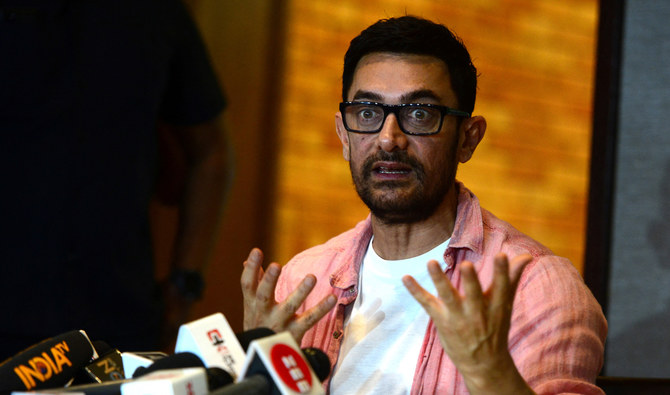
But ahead of the August 11 release, the Internet is awash with clips from a 2015 interview when Khan expressed a growing “sense of fear” and that he and his then-wife discussed leaving India.
“She fears for her child. She fears about what the atmosphere around us will be. She feels scared to open the newspapers every day,” he said.
More than 200,000 tweets, many from supporters of Modi’s BJP party, have been shared since last month calling for people to spurn the movie with the hashtag #BoycottLaalSinghChaddha.
“Aamir Khan married two Hindu Women, yet named his kids Junaid, Azad & Ira. (Hindu co-star) Kareena (Kapoor) married a Muslim & promptly named her kids Taimur & Jehangir,” said one tweet, referring to the children’s typical Muslim names.
“That’s enough reasons to boycott Lal Singh Chaddha, basically a production from Bollywood’s Love Jihad club. #BoycottLaalSinghChaddha,” it added, using a derogatory term coined by Hindu nationalists who accuse Muslim men of marrying Hindu women and forcing them to convert.
Nicknamed “Mr Perfectionist,” Khan has been credited with pushing films beyond Bollywood’s traditional fare of song and dance into social and cultural issues.
He also hosted a TV chat show — “Satyamev Jayate” — that discussed touchy themes like rape, domestic violence and corruption.
The furor over his new film — which adapts Hanks’ famous line to say that “life is like a golgappa,” an Indian snack — is such that this week Khan stressed his patriotism, a key tenet of the Modi government.
“I feel sad that some of the people... believe that I am someone who doesn’t like India,” he told local media.
“That’s not the case. Please don’t boycott my film. Please watch my film.”
Films have long sparked controversy — as well as violence — in the movie-mad country of 1.4 billion people.
But the heat being felt by Khan, one of a clutch of Muslim megastars in the industry along with Shah Rukh Khan and Salman Khan, mirrors growing intolerance, marginalization and vilification of the minority, commentators say.
“There is no doubt that Aamir is being targeted by those spreading hatred toward Muslims,” one commentator, who wished to remain anonymous for fear of becoming a target himself, told AFP.
Modi’s Bharatiya Janata Party (BJP) owes its origins to Rashtriya Swayamsevak Sangh (RSS), a militaristic group espousing “Hindutva,” or making India an exclusively Hindu state.
Lynchings of Muslims by Hindu mobs over so-called cow protection — a sacred animal for many Hindus — and other hate crimes have sown fear in the 200- million-strong Muslim population.
Social media is full of misinformation claiming that Muslims will soon outnumber Hindus — due to inter-religious marriages — or that the minority is a treasonous fifth column backed by Pakistan.
Critics say that the world’s most prolific film industry and its stars have been gradually changing their output to fit the government narrative since Modi came to power in 2014.
In 2019, the hagiographic “PM Narendra Modi” was too much even for the Election Commission, which delayed its release until after a vote that year.
There has been a recent string of military-themed movies that have been nationalistic, all-guns-blazing stories of heroics by soldiers and police — usually Hindus — against enemies outside and within India.
This year’s “The Kashmir Files,” about the fleeing of Hindus from Muslim-majority Kashmir in 1989-90, saw incidents of people in cinemas calling for revenge killings of Muslims.
Film critic and author Anna MM Vetticad said the methods to “subordinate India’s Muslims and Christians to the majority community... include demonizing these minorities, and constantly demanding proof of their patriotism.”
But little is expected to change.
“India’s tragedy is that a majority in Bollywood... are apathetic, opportunistic or afraid,” Vetticad told AFP.

Hindu nationalists push boycott of Bollywood ‘Forrest Gump’ remake
https://arab.news/w5k4g
Hindu nationalists push boycott of Bollywood ‘Forrest Gump’ remake
- Latest example of Bollywood actors, particularly minority Muslims, feeling increased pressure under Hindu nationalist PM Modi
- “Laal Singh Chaddha,” Indian spin on 1994 Hollywood hit with Tom Hanks, expected to be one of India’s biggest films of 2022
Hear them out: The best Arab alternative albums of 2025
- Bojan Preradovic’s pick of records released by indie artists from the Arab world this year
Saint Levant

‘Love Letters’
With his sophomore LP, the Palestinian artist matures from viral breakout to more vulnerable, multilingual pop and R&B, shaping a compact set of love songs with a firmly Palestinian center. He braids sleek synths, North African grooves, and earworm melodies into pieces that drift between late-night infatuation and clear-eyed reflections on home, distance, and belonging. “DALOONA,” a collaboration with Shamstep pioneers 47Soul, and “KALAMANTINA,” featuring Egyptian rap star Marwan Moussa, both lean into joyful release, while “EXILE” sits with the emotional cost of separation and absence. “Love Letters” threads romance, memory, and identity into understated, exceedingly replayable art.
Zeyne

‘Awda’
Rising Palestinian-Jordanian star Zeyne uses her debut LP to alchemize the last few years of upheaval and her meteoric ascent into a 13-track map of who she is and where she comes from. Folding contemporary R&B and pop into playful rhythms, dabke pulses, and Arabic melodic turns, she sings of home, pressure, and stubborn hope on tracks that feel both diaristic and cinematic. The record shifts between tenderness, unease, and quiet celebration, while guest appearances from Saint Levant and Bayou mix perfectly with the record’s unique flavors rather than overpowering them. This is an exhilarating, soul-searching foray into Arabic alt-pop that treats vulnerability and pride as two sides of the same coin.
Yasmine Hamdan

‘I remember I forget’
A quietly piercing LP from the indie icon about what we choose to carry and what we try to erase. Recorded with her trusted musical confidant Marc Collin, the album folds muted electronics, trip-hop beats, oud, and Arabic strings into songs in which personal memory, folk echoes, and her country’s never-ending tumult blur into one. Album closer “Reminiscence” lets the record fade like a long-held breath, reminding us that Hamdan is still one of the few artists capable of molding private anxieties into a shared, luminous language.
Kazdoura
‘Ghoyoum’
The Toronto-based duo’s debut weaves a story of migration and fracture into a quietly dazzling Arabic fusion record. Vocalist Leen Hamo and multi-instrumentalist John Abou Chacra root everything in Levantine maqams, then let the songs drift toward jazz, psychedelia, and dream pop without ever losing sight of the tarab they grew up on. From the yearning of opener “Marhaba Ahlen” and the fiery feminist chant of “Ya Banat” to the reworked folk of “Hmool El Safar” and the woozy sway of “Khayal” and “Titi Titi,” they sculpt homesickness, resilience, and slow healing into something genuinely transformative.
Tamara Qaddoumi

‘The Murmur’
On her first full-length album, Tamara Qaddoumi stretches the trip-hop and shadowy pop universe she explored on 2021’s EP “Soft Glitch” into a deeper, intensely moving world. Written with longtime collaborator Antonio Hajj, and produced by indie mainstay Fadi Tabbal, “The Murmer” leans on low-end throb, smoldering synths, and incisive guitar lines that feel both intimate and vast. Her voice hovers between confession and spell, circling questions of identity, grief, and attachment that evoke her own hybrid Kuwaiti, Palestinian, Lebanese, and Scottish heritage. The result is a delightfully cobwebby, absorbing LP that lingers long after it ends.
Sanam

‘Sametou Sawtan’
Recorded between Beirut, Byblos, and Paris, “Sametou Sawtan” – Arabic for “I heard a voice” – is a poignant, unsettled collision of noise rock, free jazz, and Arabic folk that fizzes with tension. Produced by Radwan Ghazi Moumneh, the eight tracks by the art-rock sextet are anchored by Sandy Chamoun’s remarkable vocals, which move from murmured prayer to visceral intensity, drawing on classical Arabic poetry and prose and her own lyrics to inhabit figures who are bewildered, grieving, or stubbornly alive. From the opening surge of “Harik” to the slow burn of “Hamam,” Sanam distill personal and collective unease into work that’s urgent, physical, and impossible to ignore. This is an act on the precipice of wider, global renown.
Nabeel

‘Ghayoom’
On “Ghayoom,” the Iraqi-American songwriter — real name Yasir Razak — firmly plants the flag of an audacious musical explorer venturing across roads less traveled. He sings in Arabic over a wall of distorted guitars and slowcore drums, enveloped by captivating, shoegaze-colored soundscapes. The artwork, built from worn family photographs, hints at what the music is chasing. These eight tracks pair devotional tenderness with the grit of DIY rock. Opener “Resala” aches with unsent words; “Khatil” hits with uneasy momentum; while the elegant flicker of pop-tinged moments scattered throughout the album maintain a raw and bruised edge.
Malakat

Al Anhar Wal Oyoon
On its first showcase, Jordan-based label Malakat gathers seven Arab woman artists and enables them to pull in seven different directions that end up flowing as a single current. “Al Anhar Wal Oyoon” (‘The Rivers and the Springs’), moves from Intibint’s hauntingly inspired vocalization to Liliane Chlela’s serrated electronics, and from Sukkar and DAL!A’s skewed pop to Sandy Chamoun’s voice-led piece, and Bint Mbareh’s closing track, developed in dialogue with visionary producer Nicolas Jaar. Mixed across Amman, the UK, and New York, and mastered by the highly-sought-after Heba Kadry, this is a deeply textured statement of intent from a label quietly redrawing the map of experimental Arab music.