Senegal signs peace deal with rebels in country’s south

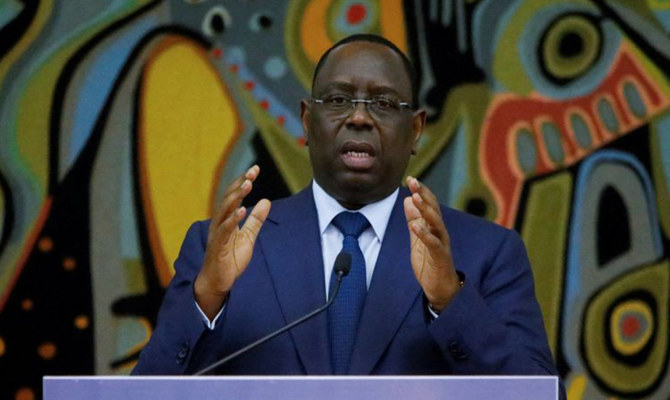
Senegal’s President Macky Sall speaks during a press conference at the presidential palace in Dakar, Senegal. (Reuters/File)
Short Url
Updated 05 August 2022
Follow

Senegal signs peace deal with rebels in country’s south

  • The signed document remains confidential for the time being

BISSAU: Senegal signed an agreement on Thursday with rebels from the country’s south who pledged to lay down their arms and work toward a permanent peace in the home of one of Africa’s oldest active rebellions.
Rebel leader Cesar Atoute Badiate, head of a unit of the Movement of Democratic Forces of Casamance (MFDC), and an emissary of Senegalese President Macky Sall signed the peace deal in Guinea-Bissau.
Sall had made a “definitive peace” in the Casamance region one of the priorities of his second term.
“How many people died, (were) mutilated or left their village? We will accompany you in the search for peace,” Guinea-Bissau President Umaro Sissoco Embalo told Badiate during the signing ceremony.
Embalo, who is also head of the Economic Community of West African States (ECOWAS), added: “I can assure you that we will be the guarantors of this agreement.”
The signed document remains confidential for the time being.
“I welcome the peace agreement and laying down of arms signed this August 4 in Bissau between Senegal and the provisional committee of the political and combatant wings of the MFDC,” Sall said on Twitter.
“I remain committed to the consolidation of lasting peace in Casamance,” he added, thanking Embalo for his mediation.
Casamance, Senegal’s southernmost region, is almost separated from the rest of the country by the tiny state of The Gambia. It has a distinct culture and language derived from its past as a former Portuguese colony.
The MFDC has led a low-intensity separatist campaign since 1982 that has claimed several thousand lives.
But the conflict was mostly dormant until Senegal launched a major offensive last year to drive out the rebels.
In a clash on January 24, four Senegalese soldiers were killed and seven were captured alive and taken across the border to The Gambia. The rebels released the hostages the following month.
In March, the army launched a new operation in which it claimed to have destroyed several rebel bases for the loss of one soldier and eight wounded.


China executes 11 linked to Myanmar scam compounds

Updated 4 sec ago
Follow

China executes 11 linked to Myanmar scam compounds

  • Fraud compounds where scammers lure Internet users have flourished across Southeast Asia
  • The 11 people executed Thursday were sentenced to death in September by a court in Wenzhou
BEIJING: China executed 11 people linked telecom scam operations, on Thursday, state media reported, as Beijing toughens its response to the sprawling, transnational industry.
Fraud compounds where scammers lure Internet users into fake romantic relationships and cryptocurrency investments have flourished across Southeast Asia, including in the lawless borderlands of Myanmar.
Initially largely targeting Chinese speakers, the criminal groups behind the compounds have expanded operations into multiple languages to steal from victims around the world.
Those conducting the scams are sometimes willing con artists, and other times trafficked foreign nationals forced to work.
In recent years, Beijing has stepped up cooperation with regional governments to crack down on the compounds, and thousands of people have been repatriated to face trial in China’s opaque justice system.
The 11 people executed Thursday were sentenced to death in September by a court in the eastern Chinese city of Wenzhou, state news agency Xinhua said, adding that the court also carried out the executions.
Crimes of those executed included “intentional homicide, intentional injury, unlawful detention, fraud and casino establishment,” Xinhua said.
The death sentences were approved by the Supreme People’s Court in Beijing, which found that the evidence produced of crimes committed since 2015 was “conclusive and sufficient,” the report said.
Among the executed were “key members” of the notorious “Ming family criminal group,” whose activities had contributed to the deaths of 14 Chinese citizens and injuries to “many others,” Xinhua added.
Fighting fraud ‘cancer’
Fraud operations centered in Myanmar’s border regions have extracted billions of dollars from around the world through phone and Internet scams.
Experts say most of the centers are run by Chinese-led crime syndicates working with Myanmar militias.
The fraud activities — and crackdowns by Beijing — are closely followed in China.
Asked about the latest executions, a spokesman for Beijing’s foreign ministry said that “for a while, China has worked with Myanmar and other countries to combat cross-border telecom and Internet fraud.”
“China will continue to deepen international law enforcement cooperation” against “the cancer of gambling and fraud,” spokesman Guo Jiakun told a regular press conference.
The September rulings that resulted in Thursday’s executions also included death sentences with two-year reprieves to five other individuals.
Another 23 suspects were given prison sentences ranging from five years to life.
In November, Chinese authorities sentenced five people to death for their involvement in scam operations in Myanmar’s Kokang region.
Their crimes had led to the deaths of six Chinese nationals, according to state media reports.
The United Nations Office on Drugs and Crime warned in April that the cyberscam industry was spreading across the world, including to South America, Africa, the Middle East, Europe and some Pacific Islands.
The UN has estimated that hundreds of thousands of people are working in scam centers globally.