


LONDON: A group of Hezbollah loyalists attacked Lebanese photojournalist Hasan Shaaban on Wednesday after videos of the protests he filmed in his hometown in the Shia-dominated south circulated on social media.
The assault took place shortly after his footage documented the residents in the southern town of Beit Yahoun, in Bint Jbeil district, protesting over water shortages in their homes.
While covering the protests, Hezbollah-affiliated members threatened to kill him if he did not leave town.
#Lebanon:
I was assaulted today by a group affiliated with Hezbollah at 20:40 after videos of a protest in my home town Beit Yahoun circulated social media yesterday, I also received death threats during & after the beating if i stay in the town.#Not_leaving#Photojournalism— Hasan Shaaban (@hasanshaaban) August 3, 2022
"On Wednesday, after the videos I took went viral on social media, a few men whom I believe are affilated with Hezbollah came up to me while I was walking my dog," Shaaban told Arab News. "I didn’t know at the time whether it was intentional, or I just happened to be in their way, but they started attacking me. None of them told me why they’re beating me, they just did it. They didn’t even give me the opportunity to ask why I was being attacked."
"As I tried to flee the scene, one of the men told me that if he would see me again, he will kill me," Shaaban added.
Shaaban highlighted to Arab News that he contacted the Hezbollah leadership in the South of Lebanon, where he resides, and they assured him they will make the men who attacked him accountable for what they did.
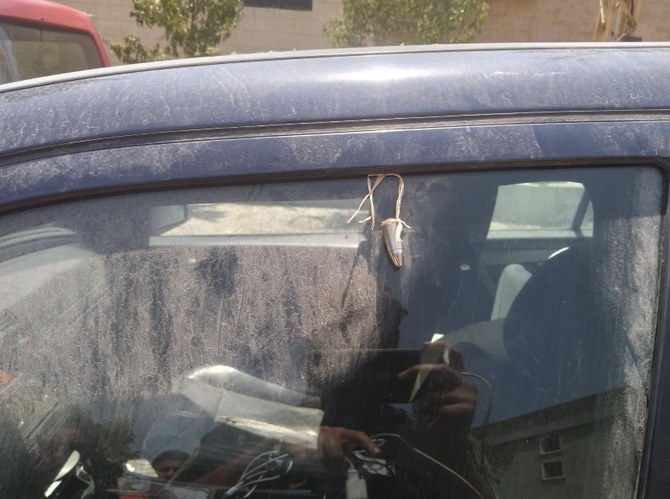
The next morning, however, Shaaban found a bullet stuck to his car window, a move he believed reiterated Hezbollah’s threats against him.
He published a photo of the bullet on his social media pages, and held a Hezbollah member accountable in the event of any harm befalling him or his belongings.
So.. i woke up today to find a bullet sticking to my car window. pic.twitter.com/ejEAThX8Ur
— Hasan Shaaban (@hasanshaaban) August 4, 2022
“I woke up this morning and found a bullet stuck to my car window,” Shaaban wrote in a Facebook post. “I hold the Hezbollah member with the initials ‘H.N.M.’ and all people with him accountable for any harm that befalls me, my dog, my house, my car or my chickens.”
Shaaban mentioned that he did not initially name any Hezbollah memebrs nor did he point any fingers towards anyone specific, as such he was surprised when he saw the bullet on his car the next day. He believes that it could have been any of the men who assaulted him, or someone who was standing within earshot.
“(The Hezbollah member) assaulted me in front of 15 witnesses, even if he wasn’t the one who placed the bullet on the car . . . the information was given to law enforcement, let’s see if they will do anything about it.”
Meanwhile, the Alternative Press Syndicate held “the de facto forces, specifically Hezbollah,” responsible for Shaaban’s safety, and called on the “absent state to assume its responsibilities and hold the aggressors to account immediately.”
Ali Aloush, head of the Press Photographers Syndicate, added that the attack “will not go unpunished, and we will reach out to the judicial and security agencies (or what remains of them) to ensure that whoever assaulted him, no matter the party they belong to, is held to account.”
This is not the first time Hezbollah members have assaulted Lebanese journalists or threatened to kill them.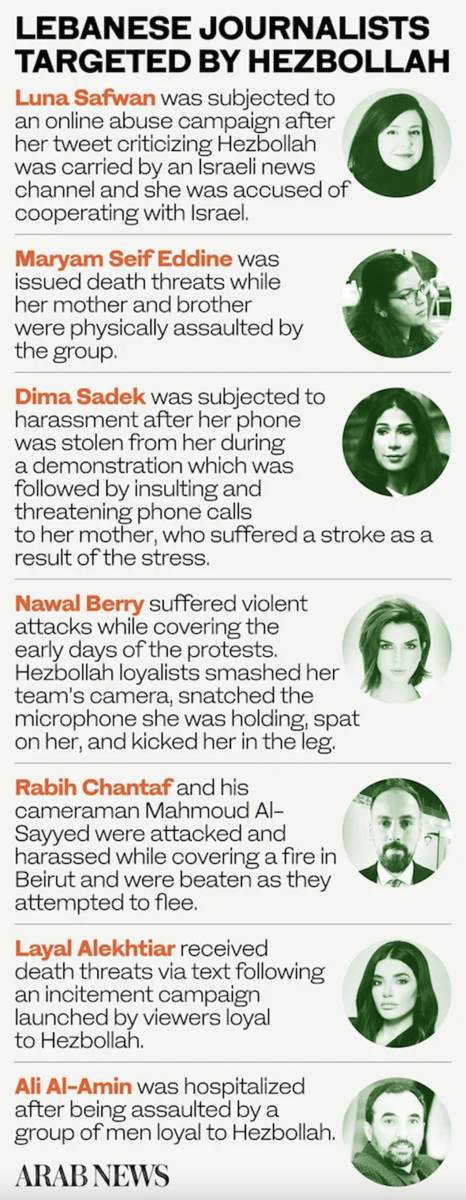
In January, Hezbollah trolls launched a racist campaign against Sudanese-Lebanese journalist Dalia Ahmad following a report on her show that criticized the Lebanese government, including Hezbollah leader Hassan Nasrallah.
In another instance, former Alhurra news anchor Layal Alekhtiar received death threats and was subjected to harassment online after tweeting a video of the unveiling of a Soleimani statue and a line from the Qur’an that said: “What are these statues to which you are so devoted?”
In October 2020, independent journalist Luna Safwan was targeted by Hezbollah in an online abuse campaign after her tweet criticizing the party was carried by an Israeli news channel and she was accused of cooperating with Israel.
Lebanese journalist Maryam Seif Eddine, known for her harsh criticism of Hezbollah despite being Shiite, received death threats from the group while her mother and brother were physically assaulted, with her sibling being left with a broken nose.
Party loyalists targeted her family home in Burj El-Barajneh, in the Hezbollah-dominated southern suburbs of Beirut.
Similarly, former LBC news anchor and Shiite journalist Dima Sadek was subjected to harassment by the group after her phone was stolen from her during a demonstration. The harassment, she said, was followed by insulting and threatening phone calls to her mother.


