Russian court jails US basketball star for nine years over drug smuggling

1 / 2
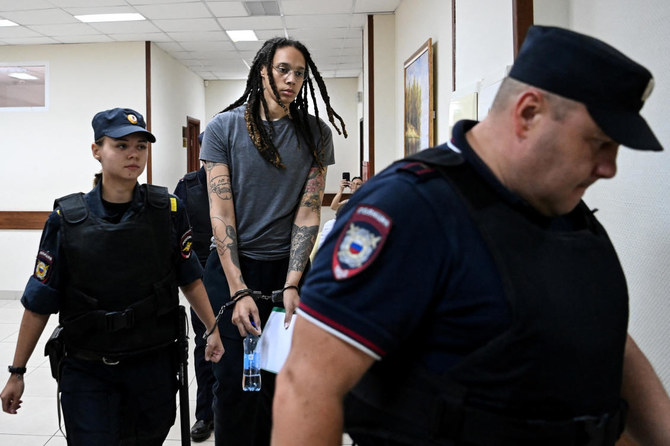
US basketball player Brittney Griner is escorted inside a court building in Khimki, outside Moscow, Russia, August 4, 2022. (Reuters)
2 / 2
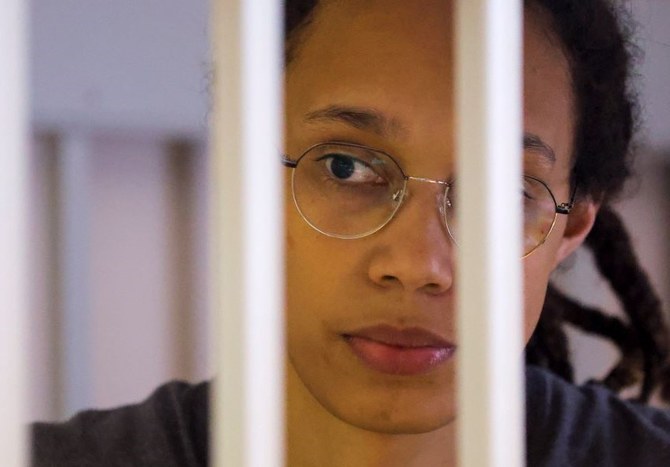
WNBA star and two-time Olympic gold medalist Brittney Griner looks through bars as she listens to the verdict in a courtroom in Khimki, just outside Moscow, Russia, Thursday, Aug. 4, 2022. (AP Photo)
Short Url
Updated 05 August 2022
Follow

Russian court jails US basketball star for nine years over drug smuggling

  • Judge Anna Sotnikova sentenced Griner, 31, to nine years in prison and said she would also have to pay a fine of one million rubles ($16,590)
  • US President Joe Biden immediately released a statement, calling the Russian court’s sentencing of Griner “unacceptable”

KHIMKI, Russia: A Russian court on Thursday sentenced US basketball star Brittney Griner to nine years in prison over drug smuggling as US President Joe Biden called the ruling “unacceptable.”
The court “found the defendant guilty” of smuggling and possessing “a significant amount of narcotics,” judge Anna Sotnikova told a court in the town of Khimki just outside Moscow.
Sotnikova sentenced Griner, 31, to nine years in prison and said she would also have to pay a fine of one million rubles ($16,590).
US President Joe Biden immediately released a statement, calling the Russian court’s sentencing of Griner “unacceptable.”
“Russia is wrongfully detaining Brittney. It’s unacceptable and I call on Russia to release her immediately so she can be with her wife, loved ones, friends and teammates,” Biden said in the statement.
The US president reiterated that he would “work tirelessly and pursue every possible avenue” to repatriate Griner.
Griner’s trial accelerated in recent days as the United States and Russia discuss a potential prisoner swap that could involve the basketball star.
The six-foot-nine (2.06 meters) star was detained at a Moscow airport in February after she was found carrying vape cartridges with cannabis oil in her luggage. The arrest came just days before Moscow launched its military intervention in Ukraine.
Prosecutors had earlier requested the two-time Olympic basketball gold medallist and Women’s NBA champion be sentenced to nine and a half years in prison on drug smuggling charges.
Griner’s trial came with tensions soaring between Moscow and Washington over Russia’s military intervention in Ukraine that has sparked international condemnation and a litany of Western sanctions.
“I made an honest mistake and I hope that your ruling doesn’t end my life here,” Griner said earlier Thursday.
“I want the court to understand it was an honest mistake that I made while rushing, under stress, trying to recover from post-Covid and just trying to get back to my team.”
Griner pleaded guilty to the charges, but said she did not intend to break the law or use the banned substance in Russia.
Her defense team said they were “very disappointed” by the verdict and would appeal.
“The court completely ignored all the evidence of the defense, and most importantly, the guilty plea,” lawyers Maria Blagovolina and Alexander Boykov said in a statement.
“The verdict is absolutely unreasonable. We will certainly file an appeal.”
Prosecutor Nikolay Vlasenko had requested a prison sentence of nine years and six months for Griner, requesting a term just short of the maximum punishment of 10 years.
Vlasenko said Griner “deliberately” proceeded through the green corridor at customs and stated she had nothing to declare “in order to conceal” the substance.
Earlier in the day Griner walked into the courtroom in handcuffs, escorted by several law enforcement officers and a police dog.
Standing inside a cage for defendants before the start of the hearing, she held up a photo of herself with teammates from the Russian club she plays for.
Griner was detained when she came to Russia to play club basketball with UMMC Ekaterinburg during the US off-season — a common path for American stars seeking additional income.
In previous hearings, Griner said she was regularly tested by US, Russian and European leagues.
The WNBA star said she had permission from a US doctor to use medicinal cannabis to relieve pain from her many injuries — “from spine to cartilages.”
Her case has raised speculation about a potential prisoner swap between Moscow and Washington.
US Secretary of State Antony Blinken said last week that Washington had made a “substantial proposal” to Moscow to free Griner and former US Marine Paul Whelan, who was imprisoned on espionage charges.
A prisoner swap was also discussed during a call between Blinken and his Russian counterpart Sergei Lavrov on Friday.
The highest-profile Russian prisoner in the United States is Victor Bout, a 55-year-old arms trafficker, dubbed the “Merchant of Death,” who is serving 25 years in jail.
There is no official confirmation that Washington has offered to exchange him.
Russia and the United States have already conducted one prisoner swap since the start of Moscow’s Ukraine offensive.
In April, Washington exchanged former US Marine Trevor Reed for convicted drug smuggler Konstantin Yaroshenko.


Middle East war puts Asian Football Confederation in a tricky situation

Updated 6 sec ago
Follow

Middle East war puts Asian Football Confederation in a tricky situation

  • Asian football has long been structured around regions, with competitions split between East and West
  • With conflict in the Middle East escalating on Feb. 28, the AFC was forced into emergency mode as the knockout stages of its club competitions approach

DAMMAM: Football in Asia has never been an easy task to manage. Long flights, numerous time zones, conflicting calendars, vastly different football cultures and — perhaps more than any other confederation in the world — politics.
While the war in the Middle East falls under the AFC’s umbrella, its direct effects have so far been limited to the clubs in West Asia. Asian football has long been structured around regions, with competitions split between East and West, although for a period, the second-tier AFC Cup operated in five separate regions.
As a result, AFC club competitions in East Asia continued uninterrupted in the first week of March. A crowd of 31,225 watched Johor Darul Ta’zim’s historic 3-1 victory over Sanfrecce Hiroshima in the AFC Champions League Elite round of 16. Bangkok United defeated Tampines Rovers in the AFC Champions League Two quarter-final, and an all-Cambodian clash between Phnom Penh Crown and PKR Svay Rieng in the AFC Challenge League ended in a 4-1 victory for the visitors.
The situation in West Asia, however, is vastly different.
With the conflict in the Middle East escalating on Feb. 28, the AFC was forced into emergency mode as the knockout stages of its club competitions approach.
Within 24 hours, the confederation announced that all first-leg matches involving West Asian clubs in AFC competitions would be rescheduled until further notice. The same decision was taken for the second-leg matches fixtures just 48 hours later.
Domestic football has also been heavily disrupted. Leagues in Qatar, Bahrain, Kuwait and Lebanon have been postponed indefinitely, with matches continuing behind closed doors in Jordan.
Leagues in Saudi Arabia, Oman, Iraq and Syria continue to operate, but flights in the region are limited.
With the season already compressed by the FIFA Arab Cup, FIFA Intercontinental playoffs and the upcoming FIFA World Cup, member associations throughout the Middle East now find themselves scrambling alongside the AFC to solve a problem that ultimately lies outside their control.
Another issue looms on the horizon. The AFC Champions League final stage will be hosted in Saudi Arabia next month for the second year in a row. While football has not halted in the Kingdom and the security situation is stable, it remains to be seen whether East Asian clubs will be willing to travel if the conflict continues.
What is the real solution, fans ask?
One proposal that has been circulated is to centralize the knockout rounds from the Round of 16 stage instead of the quarter-finals. That option, however, presents its own challenges. East Asian clubs have already begun their journey in the round of 16, and the idea of centralized hosting has historically not been popular across the continent.
When Saudi Arabia and Qatar were selected to host the AFC World Cup Qualifiers fourth round last year, the decision sparked backlash from Indonesia, Iraq, Oman and the UAE. More recently, journalist Ali Al-Marshoud claimed on Saudi sports program “In the 90” that the UAE’s Al-Wasl rejected a proposal for their AFC Champions League Two quarter-final against Al-Nassr as a single-leg match in Jeddah.
The AFC therefore finds itself in a difficult position. It cannot control regional geopolitics, nor can it influence government policies. At the same time, there is no guarantee that East Asian clubs will travel to the region, or that West Asian clubs will agree to surrender their right to play matches at home.
The conflict has also begun to affect international football.
With the FIFA World Cup intercontinental playoffs scheduled for later this month and Iraq facing a crucial qualifier in Mexico on March 31, uncertainty continues to grow.
In a statement released by the Iraqi Football Association, officials confirmed they were in constant contact with FIFA and the AFC regarding potential travel complications.
Head coach Graham Arnold is currently unable to leave the UAE, while several players and staff have struggled to obtain visas to Mexico due to embassy closures. All the while flights through Iraqi airspace have been suspended.
Political complications are not new to Asian football. For years, Saudi and Iranian clubs played each other at neutral grounds. Conflicts in Syria, Palestine, Iraq and Lebanon also forced the AFC to adopt special arrangements at various times. And of course, the COVID-19 pandemic, which fundamentally reshaped the state of football in Asia.
Yet the current situation presents a different scale of challenge.
For the first time in modern history, the AFC must navigate a regional conflict that touches nearly every part of the confederation. With the season entering its decisive stages and the largest World Cup in history approaching, solutions must be found quickly, or Asian football risks a crisis that could reshape the continental game.