

Parts of damaged Beirut grain silos collapse on blast anniversary

1 / 3
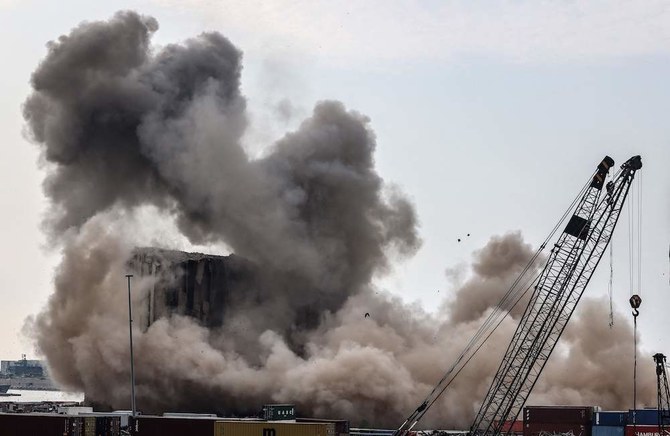
Dust rises from collapsing silos damaged during the August 2020 massive explosion in the port, in Beirut, Lebanon, Thursday, Aug. 4, 2022. (AFP)
2 / 3
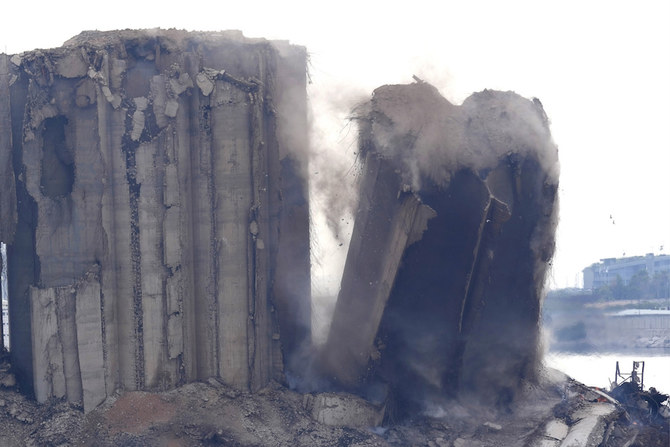
Dust rises from collapsing silos damaged during the August 2020 massive explosion in the port, in Beirut, Lebanon, Thursday, Aug. 4, 2022. (AP)
3 / 3
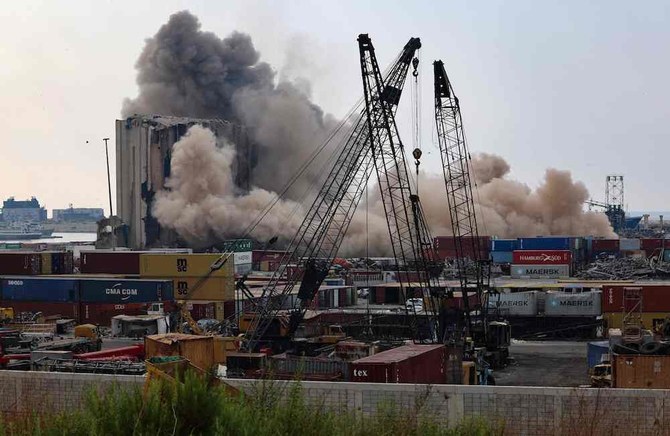
Dust rises from collapsing silos damaged during the August 2020 massive explosion in the port, in Beirut, Lebanon, Thursday, Aug. 4, 2022. (AFP)
Short Url
Updated 04 August 2022
Follow

Parts of damaged Beirut grain silos collapse on blast anniversary

  • The collapse occurred an hour before hundreds of people were to gather outside the facility to mark the 2nd anniversary of the blast

BEIRUT: A large section of Beirut’s giant port grain silos, shredded by a massive explosion two years ago, collapsed on Thursday as hundreds marched in Beirut to mark the second anniversary of the blast that killed scores.

The northern block of the silos consisting of four towers has been slowly tilting for days and collapsed causing a huge cloud of dust that covered the structure that shielded Beirut’s western neighborhoods when the blast occurred on Aug. 4, 2020 killing nearly 220 people, injuring over 6,000 and causing damage worth billions of dollars.

Thursday's collapse of roughly a fourth of the structure occurred an hour before hundreds of people were to gather outside the facility to mark the 2nd anniversary of the blast. Authorities have evacuated parts of the port earlier this week — after an initial section of the silos collapsed on Sunday — as a precautionary measure and there was no indication that anyone was hurt.

Opinion

This section contains relevant reference points, placed in (Opinion field)

The 50 year-old, 48 meter (157 feet) tall silos had withstood the force of the explosion two years ago that destroyed much of the port. Many in Lebanon, including families of the victims, have been demanding that the silos be kept for future generations to witness the result of one of the largest non-nuclear explosions in history caused by widespread corruption and mismanagement in the small Mediterranean nation.

The anniversary came amid calls for an international investigation into one of the largest non-nuclear explosions in history. The domestic investigation has been stalled since December following legal challenges by charged and accused officials against the judge leading the investigation.

Hundreds of people, including families of the victims, marched from three locations in Beirut toward the main road outside the port to mark the blast that occurred at 6:07 p.m. two years ago Thursday. Some carried white coffins with name of some of the victims while others carried gallows demanding punishment for those responsible.

“Two years later the pain is still the same,” said one of the family members who lost his brother.

Two years after the explosions, none of the top politicians have apologized to the Lebanese and the government called for a day of mourning leading many businesses to close.


Syria Kurds chief says ‘all efforts’ being made to salvage deal with Damascus

Updated 25 December 2025
Follow

Syria Kurds chief says ‘all efforts’ being made to salvage deal with Damascus

  • Abdi said the Syrian Democratic Forces (SDF), the Kurds’ de facto army, remained committed to the deal
  • The two sides were working toward “mutual understanding” on military integration and counter-terrorism

DAMASCUS: Syrian Kurdish leader Mazloum Abdi said Thursday that “all efforts” were being made to prevent the collapse of talks on an agreement with Damascus to integrate his forces into the central government.
The remarks came days after Aleppo saw deadly clashes between the two sides before their respective leaders ordered a ceasefire.
In March, Abdi signed a deal with Syrian President Ahmed Al-Sharaa to merge the Kurds’ semi-autonomous administration into the government by year’s end, but differences have held up its implementation.
Abdi said the Syrian Democratic Forces (SDF), the Kurds’ de facto army, remained committed to the deal, adding in a statement that the two sides were working toward “mutual understanding” on military integration and counter-terrorism, and pledging further meetings with Damascus.
Downplaying the year-end deadline, he said the deal “did not specify a time limit for its ending or for the return to military solutions.”
He added that “all efforts are being made to prevent the collapse of this process” and that he considered failure unlikely.
Abdi also repeated the SDF’s demand for decentralization, which has been rejected by Syria’s Islamist authorities, who took power after ousting longtime ruler Bashar Assad last year.
Turkiye, an important ally of Syria’s new leaders, sees the presence of Kurdish forces on its border as a security threat.
In Damascus this week, Turkish Foreign Minister Hakan Fidan stressed the importance of the Kurds’ integration, having warned the week before that patience with the SDF “is running out.”
The SDF control large swathes of the country’s oil-rich north and northeast, and with the support of a US-led international coalition, were integral to the territorial defeat of the Daesh group in Syria in 2019.
Syria last month joined the anti-IS coalition and has announced operations against the jihadist group in recent days.