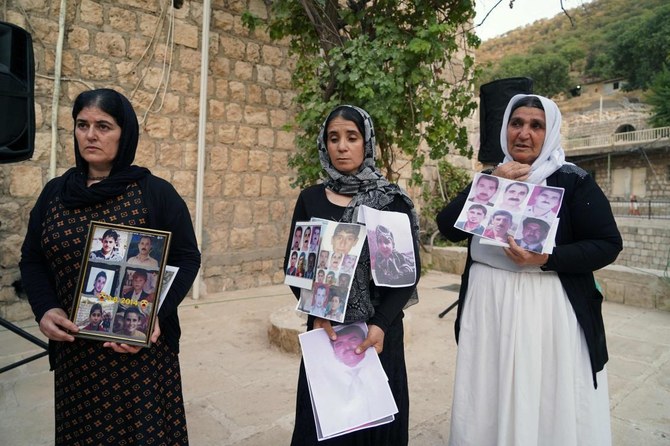
GENEVA: Eight years on since the Daesh militant group’s massacres of Yazidis, more then 200,000 survivors are still displaced from their homes in Iraq, the United Nations said Thursday.
The needs of displaced persons living in and outside camps, and returnees remain high said the UN’s International Organization for Migration (IOM).
After seizing swathes of Iraq in 2014, Daesh militants carried out horrific massacres, including in the northern region of Sinjar where the Kurdish-speaking Yazidi minority — a monotheistic, esoteric community — has long been rooted.
A lack of adequate shelter and basic services such as running water, electricity, health care and education is making durable solutions difficult for Yazidis returning home or seeking to do so.
“Families are forced to focus on meeting their most basic needs rather than on meaningfully rebuilding their lives,” the IOM said.
Daesh destroyed around 80 percent of public infrastructure and 70 percent of civilian homes in Sinjar city and its surrounding areas, the Geneva-based agency said.
Daesh fighters also destroyed the region’s natural resources and farmland.
“Mass executions, forced conversions, abduction and enslavement, systematic sexual violence and other heinous acts” perpetrated by Daesh “reflect a genocidal effort to destroy this historically-persecuted ethno-religious minority,” the IOM said.
More than 2,700 people remain missing, the agency added.
Some are known to be held by Daesh, which persecuted Yazidis for their non-Muslim faith, but the whereabouts of others is uncertain.
Survivors among the non-Arab, Kurdish-speaking minority are unable to mourn lost loved ones, many of whom lie in unmarked and mass graves still awaiting exhumation, said the IOM.
“The scale of the atrocities committed against the Yazidi community is such that it will have an impact on generations to come,” said Sandra Orlovic, IOM Iraq’s reparations officer.
“The government of Iraq and the international community need to create conditions that will assure Yazidis that such atrocities will not happen again and support them in healing and rebuilding their lives.”
The Norwegian Refugee Council said in May that violence and sluggish reconstruction had prevented Sinjar city’s Yazidi, Muslim Kurdish and Arab residents from returning home, as had a surge in violence earlier in the month.
“A staggering 99 percent of those who applied for government compensation had not received any funding for damaged property,” the aid group added.
In early May, fighting broke out between Iraqi troops and Yazidi fighters affiliated with Turkey’s banned Kurdistan Workers’ Party (PKK).
More than 10,000 people fled the fighting, adding to the displaced population.

UN: More than 200,000 Yazidis still displaced in Iraq
Short Url
https://arab.news/4s2ge
UN: More than 200,000 Yazidis still displaced in Iraq
- Daesh militants carried out horrific massacres, including in the northern region of Sinjar where the Kurdish-speaking Yazidi minority has long been rooted
Syrian army and Kurdish forces exchange strikes east of Aleppo
- This marks a potential escalation after recent clashes in the city of Aleppo
- No casualties have been reported
ALEPPO: Syrian government forces and the Kurdish-led Syrian Democratic Forces exchanged fire Tuesday in a tense area of eastern Aleppo province, marking a possible escalation after days of clashes in the northern city.
No casualties were immediately reported, as an impasse continues in negotiations between the central government and the SDF over merging its thousands of fighters into the national army.
The Syrian army earlier declared an area east of Aleppo as a “closed military zone.” Eastern Aleppo province has been a tense frontline dividing areas under the Syrian government and large swaths of northeastern Syria under the SDF.
In a statement, the SDF said government forces have started shelling Deir Hafer district. The group later said government troops launched exploding drones, artillery and rockets to a village south of Deir Hafer.
Syrian state television later said the SDF targeted the village of Homeima on the other side of the Deir Hafer frontline with exploding drones.
Several days of deadly clashes in Aleppo last week displaced tens of thousands of people. They ended over the weekend with the evacuation of Kurdish fighters from the contested neighborhood of Sheikh Maqsoud. Aleppo Governor Azzam Ghareeb said Damascus now has full control of Sheikh Maqsoud and Achrafieh, where clashes took place.
Syrian officials have accused the SDF of building up its forces near the towns of Maskana and Deir Hafer, about 60 kilometers (37 miles) east of Aleppo city. SANA, the state news agency, reported that the army had declared the area a closed military zone because of “continued mobilization” by the SDF, and accused the group of using the area as a launchpad for drone attacks in Aleppo city.
The army statement said the armed groups should withdraw east of the Euphrates River.
A drone hit the Aleppo governorate building on Saturday shortly after two Cabinet ministers and a local official held a news conference on the developments in the city.
The SDF have denied mobilizing in the area or being behind the attack.
The leadership in Damascus, under interim President Ahmad Al-Sharaa, signed a deal in March with the SDF, which controls much of the northeast, for it to merge with the Syrian army by the end of 2025. There have been disagreements on how it would happen.
Some of the factions that make up the new Syrian army, which was formed after the fall of former President Bashar Assad in a rebel offensive in December 2024, were previously Turkiye-backed insurgent groups that have a long history of clashing with Kurdish forces.
The SDF for years has been the main US partner in Syria in fighting against the Daesh group, but Turkiye considers the SDF a terrorist organization because of its association with the Kurdistan Workers’ Party, or PKK, which has waged a long-running insurgency in Turkiye. A peace process is now underway.
Despite the long-running US support for the SDF, the Trump administration has also developed close ties with Al-Sharaa’s government and has pushed the Kurds to implement the March deal.
The recent developments have left the SDF and the autonomous administration that runs northeastern Syria frustrated with Washington and accusing Damascus of not implementing its end of the deal.
“The American government needs to clarify its position of the Syrian government which is committing massacres,” the administration’s foreign relations official, Elham Ahmad, told journalists Tuesday. She accused government forces of committing “horrific violations” and alleged that forces affiliated with IS and foreign fighters took part in the clashes.
Shams TV, a broadcaster based in Irbil — the seat of northern Iraq’s semi-autonomous Kurdish region — had been set to air an interview with Al-Sharaa on Monday but later announced it had been postponed for “technical” reasons, without giving a new date for broadcast.
No casualties were immediately reported, as an impasse continues in negotiations between the central government and the SDF over merging its thousands of fighters into the national army.
The Syrian army earlier declared an area east of Aleppo as a “closed military zone.” Eastern Aleppo province has been a tense frontline dividing areas under the Syrian government and large swaths of northeastern Syria under the SDF.
In a statement, the SDF said government forces have started shelling Deir Hafer district. The group later said government troops launched exploding drones, artillery and rockets to a village south of Deir Hafer.
Syrian state television later said the SDF targeted the village of Homeima on the other side of the Deir Hafer frontline with exploding drones.
Several days of deadly clashes in Aleppo last week displaced tens of thousands of people. They ended over the weekend with the evacuation of Kurdish fighters from the contested neighborhood of Sheikh Maqsoud. Aleppo Governor Azzam Ghareeb said Damascus now has full control of Sheikh Maqsoud and Achrafieh, where clashes took place.
Syrian officials have accused the SDF of building up its forces near the towns of Maskana and Deir Hafer, about 60 kilometers (37 miles) east of Aleppo city. SANA, the state news agency, reported that the army had declared the area a closed military zone because of “continued mobilization” by the SDF, and accused the group of using the area as a launchpad for drone attacks in Aleppo city.
The army statement said the armed groups should withdraw east of the Euphrates River.
A drone hit the Aleppo governorate building on Saturday shortly after two Cabinet ministers and a local official held a news conference on the developments in the city.
The SDF have denied mobilizing in the area or being behind the attack.
The leadership in Damascus, under interim President Ahmad Al-Sharaa, signed a deal in March with the SDF, which controls much of the northeast, for it to merge with the Syrian army by the end of 2025. There have been disagreements on how it would happen.
Some of the factions that make up the new Syrian army, which was formed after the fall of former President Bashar Assad in a rebel offensive in December 2024, were previously Turkiye-backed insurgent groups that have a long history of clashing with Kurdish forces.
The SDF for years has been the main US partner in Syria in fighting against the Daesh group, but Turkiye considers the SDF a terrorist organization because of its association with the Kurdistan Workers’ Party, or PKK, which has waged a long-running insurgency in Turkiye. A peace process is now underway.
Despite the long-running US support for the SDF, the Trump administration has also developed close ties with Al-Sharaa’s government and has pushed the Kurds to implement the March deal.
The recent developments have left the SDF and the autonomous administration that runs northeastern Syria frustrated with Washington and accusing Damascus of not implementing its end of the deal.
“The American government needs to clarify its position of the Syrian government which is committing massacres,” the administration’s foreign relations official, Elham Ahmad, told journalists Tuesday. She accused government forces of committing “horrific violations” and alleged that forces affiliated with IS and foreign fighters took part in the clashes.
Shams TV, a broadcaster based in Irbil — the seat of northern Iraq’s semi-autonomous Kurdish region — had been set to air an interview with Al-Sharaa on Monday but later announced it had been postponed for “technical” reasons, without giving a new date for broadcast.
© 2026 SAUDI RESEARCH & PUBLISHING COMPANY, All Rights Reserved And subject to Terms of Use Agreement.