

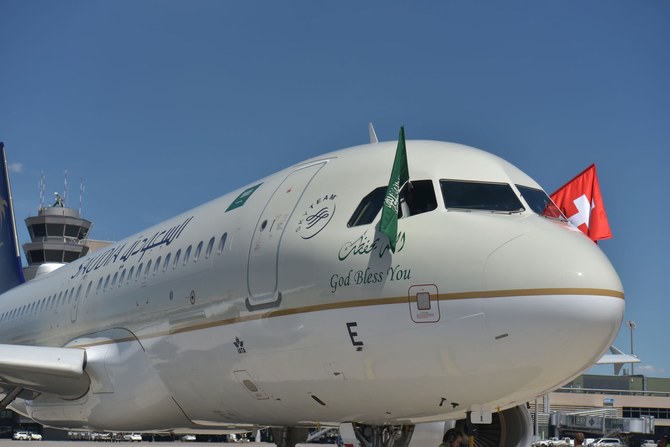
Saudia expands European network to Zurich

1 / 2
(Supplied)
2 / 2
(Supplied)
Short Url
Updated 05 August 2022
Follow

Saudia expands European network to Zurich

Wednesday was an important day both for Saudia and Zurich airport, but more importantly for the connection between Saudi Arabia and Switzerland.

It was 12 years since it had last happened, but in the early afternoon of Aug. 3 the first flight from Riyadh arrived in Zurich.

In Riyadh, the Swiss Ambassador to Saudi Arabia Andre Schaller and Chief Commercial Officer Arved Nikolaus Von Zur Muehlen, as well as other senior airline executives and government representatives, formed the farewell committee.

In Zurich the welcoming committee included Adel Siraj S. Merdad, Saudi Arabia’s ambassador to Switzerland, Hesham Bindkhail, Saudia’s head of Europe operations, as well as senior representatives from Zurich airport and the Saudi tourism authority. The mood was convivial and Saudia officials and representatives of Zurich airport were excited.

“Saudia adding another important destination in Europe reflects Saudi Arabia’s great reforms of Vision 2030 guided by HRH Crown Prince Mohammed bin Salman bin Abdulaziz Al-Saud,” Ambassador Adel Siraj S. Merdad said.

This new route has to be seen in the context of the airline’s air connectivity program where Saudia is expanding its network and destinations globally. In Europe alone, the airline has so far added three airports this year: Amsterdam, Barcelona and Zurich, as well as Malaga and Mykonos as seasonal destinations.

This will doubtless strengthen the relationship between the two countries. Merdad hopes that this new route will bring closer ties between people living in Switzerland and people living in Saudi Arabia.

Beyond that, Saudia hopes that this new route will strengthen both tourism and business relations between the two countries. Saudia has daily direct flights between Jeddah and Geneva and Riyadh and Geneva.

Bindkhail expects the new route to bring tourists and business people to the Kingdom and vice versa to Switzerland — especially as Zurich is the major financial and business hub of the Alpine nation. Swiss ambassador Schaller said he hoped that many tourists from both countries would discover the natural beauty, cultural richness and warm hospitality of both Saudi Arabia and Switzerland.

Developing the tourism sector in Saudi Arabia is an integral part of Saudi Vision 2030, as is the development of the economy beyond the petroleum industry. The new route between Switzerland, a country boasting a GDP of $740 billion, and Saudi Arabia with its GDP of $700 billion (all 2020 figures) is an important milestone for these goals.

Saudia had been the Kingdom’s flag carrier for 77 years and has been called the “wings of Vision 2030.”

Like everywhere in Saudi Arabia these days, ambitions are high. The airline has one of the youngest fleets, with an average age of 6.5 years for its 144 aircraft, and is flying to 100 destinations (including seasonal destinations) — and counting.

Saudi Vision 2030 is bold and ambitious, as are the plans for the country’s flag carrier. According to Bindkhail the ambition is to grow Saudia massively and have the carrier connect people between countries such as India and Europe — allowing them a stopover in the Kingdom for a minimal fee.

This makes sense for Muslims choosing to undertake Umrah. It also gives travelers the opportunity to explore historic tourism sites such as AlUla, the future Red Sea resort destinations or to enjoy the Riyadh Season or experience the “Winter Wonderland.”

The new Riyadh-Zurich flight is another piece of the plan reflecting Saudia’s status as the “wings of vision 2030.”



Airports in GCC are turning stopovers into tourism growth

Updated 14 February 2026
Follow

Airports in GCC are turning stopovers into tourism growth

  • Governments and airport operators are turning aviation as a central pillar of tourism and economic strategy

CAIRO: Once defined by fleeting layovers and duty-free corridors, airports across the Gulf Cooperation Council are increasingly gateways to short-stay tourism, driving non-oil growth, hospitality revenues and job creation. 

Across the region, governments, airlines and airport operators are treating aviation not merely as a transport sector but as a central pillar of tourism and economic strategy. Through streamlined visa regimes, airline-led stopover programs and sustained investment in airport infrastructure and technology, GCC countries are turning transit passengers into visitors. 

“Across the GCC, destinations have shifted from functioning primarily as global transit hubs to positioning themselves as places travelers actively choose to visit, even for short stays during onward journeys,” Nicholas Nahas, partner at Arthur D. Little, told Arab News. 

Airports in the Middle East are investing heavily in biometric processing systems, e-gates and digital border controls designed to shorten waiting times and improve passenger flow. These upgrades, backed by coordinated public-private initiatives, are narrowing the gap between arrival and exploration, making short stays viable even for passengers transiting for less than 48 hours. 

Unified GCC visa 

Two years after its initial proposal, the long-discussed unified GCC tourist visa is moving through final coordination stages, a development expected to further accelerate tourism spending linked to stopovers. 

Looking ahead, the visa could allow the region to function as a single tourism corridor. Robert Coulson, executive adviser for real estate at Accenture, said the next phase is about regional continuity. “The next leap for the GCC is making the region feel like one seamless journey while differentiating each stop with a distinct identity,” he told Arab News. 

First proposed in 2023 and approved in principle in 2024, the visa is designed to allow travel across Bahrain, Kuwait, Oman, Qatar, Saudi Arabia and the UAE under a single permit. Analysts say Saudi Arabia is positioned to be among the biggest beneficiaries, given its scale, expanding destination portfolio and growing aviation capacity. 

The unified visa is expected to complement existing stopover initiatives by allowing travelers to combine short visits to Saudi Arabia with trips to Dubai or Doha, effectively turning the Gulf into a single multi-country itinerary rather than a series of isolated transit points. 

Saudi aviation surge 

Saudi Arabia’s aviation-driven tourism growth has accelerated rapidly. The Kingdom welcomed an estimated 122 million visitors in 2025, moving closer to its Vision 2030 target of attracting 150 million tourists annually. 

“GCC travel hubs have stopped selling connections and started selling experiences,” Coulson said. “They’ve cracked the stopover-to-stayover model, turning a layover into a mini-holiday rather than dead time.” 

In January, Abdulaziz Al-Duailej, president of the General Authority of Civil Aviation, said international destinations served from Saudi Arabia increased to 176 in 2025, while the Kingdom remained home to some of the world’s busiest air routes. 

He credited this performance to the “unlimited support” of the Kingdom’s leadership, identifying aviation as a key enabler of Vision 2030 and broader economic diversification. 

Saudi Arabia’s newest airline, Riyadh Air, is expected to contribute more than $20 billion to non-oil gross domestic product and create over 200,000 direct and indirect jobs, underscoring aviation’s expanding economic footprint. 

A key pillar of Saudi Arabia’s strategy has been the introduction of a digital stopover visa in 2023, allowing transit passengers to enter the Kingdom for up to 96 hours. The initiative enables short visits for Umrah, trips to Madinah or exploration of the country’s cultural and historical sites.  The policy reflects a broader regional effort to turn time spent between flights into economic activity beyond the airport terminal, particularly in hospitality, transport and cultural tourism. 

Short-stay shift 

This evolution has been driven by global connectivity, simplified visa access and the ability to deliver high-quality experiences within a 24-to-72-hour window. The UAE, particularly Dubai, was the earliest and most established example of this transition, converting a growing share of its transit traffic into visitors through airline-led stopover packages, flexible visa categories and dense, short-stay-friendly attractions. 

Dubai International Airport handles more than 85 million passengers annually. Curated stopover products combining hotel stays with cultural and entertainment experiences have helped transform transit traffic into leisure demand. Direct metro access and streamlined entry processes have further reduced friction. As a result, Dubai welcomed around 19 million international overnight visitors in 2025. 

Other GCC destinations have since adopted similar models. Abu Dhabi expanded stopover offerings through its national carrier, promoting entertainment and cultural districts as compelling short-stay experiences. Qatar embedded stopover tourism into its national tourism strategy, converting transfer traffic at Hamad International Airport into city stays. Saudi Arabia expanded its tourism offering through its 96-hour digital visa linked to onward flights. 

A smooth transit experience is often the deciding factor in whether passengers remain airside or choose to explore. Fast entry processes, intuitive airport design and reliable airport-to-city connectivity can turn even a six- to eight-hour layover into usable time rather than idle waiting. 

Under Vision 2030, Saudi Arabia has invested heavily in airport expansion, digital border processes and urban mobility projects designed to shorten the distance between arrival and experience. Airline stopover platforms, transport apps and airport-based destination messaging increasingly reduce uncertainty and enable spontaneous exploration. 

Beyond transit traffic, Nahas said tourism growth across the GCC has been driven by integrated destination ecosystems. Successful destinations are designed end-to-end — from trip planning and arrival through accommodation, mobility, experiences and departure — requiring coordination across tourism authorities, airlines, airports, transport providers and experience operators. 

Designing destinations 

For developers shaping the region’s next phase of tourism growth, the focus has shifted toward creating destinations that capture travelers from the moment they arrive. 

Sultan Moraished, group head of technology and corporate excellence at Red Sea Global, said next-generation destinations are being designed to resonate with global travelers beyond a flight connection. 

“As we design and build next-generation destinations, our focus is always on creating experiences that resonate with global travelers from the moment they arrive to when they choose to explore beyond a flight connection,” he told Arab News. 

Moraished said offering experiences travelers cannot find elsewhere, from cultural immersion to nature-based activities, creates compelling reasons to extend visits beyond simple transit. He added that collaboration across aviation, hospitality and destination authorities ensures that every part of the journey is aligned with a shared vision for tourism growth. 

Looking ahead, Moraished said the intersection of innovation and hospitality will continue to open new pathways, from smart digital experiences to regenerative tourism practices that appeal to increasingly conscious travelers and encourage repeat visitation. 

Experience economy 

Airports have shifted from being standalone infrastructure assets to functioning as world-class distribution engines for cities and destinations. Investments in gateway airports have made them part of the destination brand promise. 

Tourism operates as a continuous conversion funnel, Coulson said. Every step removed between the flight gate and the city increases the likelihood that travelers will leave the terminal and spend money locally. Fast connections, predictable baggage handling and clear wayfinding reduce perceived risk, while simplified transit visas make spontaneity possible. 

A unified GCC tourist visa could unlock longer stays and multi-country itineraries, supported by investment in walkable districts, waterfronts and climate-smart design. 

Taken together, the transformation of transit hubs into tourism powerhouses reflects a broader shift in how the Gulf approaches aviation-led growth. Airports are no longer just points of passage but economic gateways where short stopovers translate into tourism spending, jobs and long-term diversification.