

‘Well done, Butt saab’: Weightlifter wins first gold medal for Pakistan at Commonwealth Games

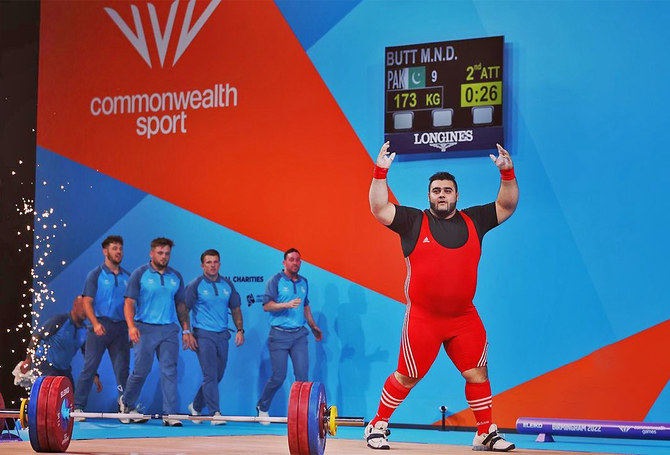
Muhammad Nooh Dastgir Butt of Team Pakistan reacts during the Men's 109+kg Final at 2022 Commonwealth Games in Birmingham, England, on August 03, 2022.(Pakistan Olympic Association)
Short Url
Updated 04 August 2022
Follow

‘Well done, Butt saab’: Weightlifter wins first gold medal for Pakistan at Commonwealth Games

  • Muhammad Nooh Dastgir Butt wins gold in the Men’s 109+kg
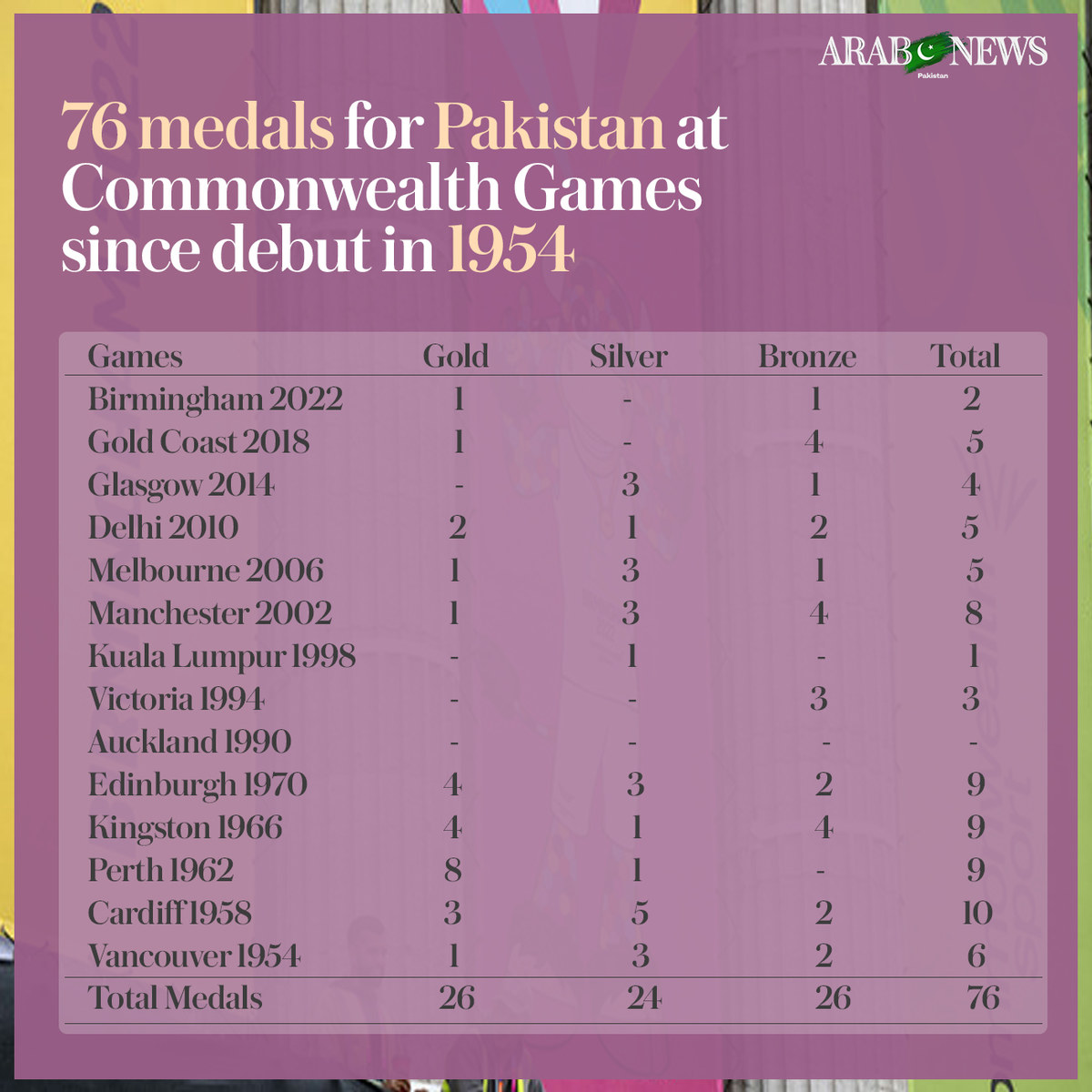
  • Pakistan has won 76 medals at Commonwealth Games since 1954 

ISLAMABAD: Pakistani Prime Minister Shehbaz Sharif congratulated weightlifter Nooh Dastagir Butt on Thursday as he won the first gold medal for Pakistan in the Commonwealth Games 2022 with a record lift of 405kg. 

This is the first gold for Pakistan in any category in the ongoing games in Birmingham.

 “Well done, Butt saab,” Sharif wrote on Twitter. 

This was Pakistan’s second medal overall after Judoka Shah Hussain Shah won bronze, bagging the South Asian nation’s first medal on Wednesday in the -90kg category after defeating South Africa’s Thomas-Laszlo Breytenbach. 

With the two latest additions, Pakistan now has 76 medals at the Commonwealth Games since the South Asian country made its debut in 1954, when it won six medals. These include 26 gold, 24 silver and 26 bronze medals. Neighbouring India has over 500 medals. 

On Wednesday, the Commonwealth Games official Twitter account said the world had seen two new Commonwealth Games records in weightlifting by teams England and Pakistan. 

Weightlifter Butt has set a new Commonwealth Games record by lifting 173kg in snatch in the 109+kg category. He also set another record by lifting 232kg in clean and jerk. Overall, he lifted 405kg, another CWG record. 

Quoting Butt, the Commonwealth Games Twitter account said his father had been “really upset” with him the last time he won bronze and didn’t talk to him for a while. 

“His dad will be speaking to him tonight,” the tweet said. 

Following is a breakdown of Pakistan’s medal tally at the Commonwealth Games since 1954:  


Anti-fuel smuggling drive boosts Pakistan revenues 82%, PM office says

Updated 19 December 2025
Follow

Anti-fuel smuggling drive boosts Pakistan revenues 82%, PM office says

  • Crackdown targets illegal petroleum trade using GPS tracking and pump registration
  • July–November gains cited as government intensifies tax, customs enforcement

ISLAMABAD: The Pakistani prime minister’s office said on Friday revenues from petroleum products rose 82% between July and November 2025 after a nationwide crackdown on fuel smuggling, as the government steps up enforcement to curb tax evasion and losses that have long strained public finances.

The increase was cited during a weekly performance review of the Federal Board of Revenue (FBR), where Prime Minister Shehbaz Sharif directed authorities to accelerate action against smuggling and tax evasion, according to a statement issued by the PM’s Office.

Fuel smuggling has been a persistent problem in Pakistan, where subsidised or untaxed petroleum products are often trafficked across borders or sold through unregistered pumps, depriving the state of revenue and distorting domestic energy markets. Successive governments have blamed the practice for billions of rupees in annual losses, while international lenders have repeatedly urged tighter enforcement as part of broader fiscal reforms.

“Every year the nation loses billions due to smuggling,” Sharif was quoted as saying in a statement, praising customs authorities for successful operations and noting that revenues from petroleum products increased by 82% from July to November 2025 compared with the same period last year.

The PM said stricter enforcement had brought several goods back into the formal economy, adding that there would be “no leniency” toward those involved in tax evasion or illegal trade.

Officials briefed the prime minister that Pakistan Customs has rolled out a nationwide enforcement framework, including GPS tracking of petroleum product transportation, registration of fuel stations through a digital monitoring system, and legal action against illegal machinery under updated petroleum laws.

The government has also instructed provincial administrations to cooperate fully with federal authorities in shutting down illegal petrol pumps, the statement said.

Sharif said enforcement efforts would continue until smuggling networks were dismantled and tax compliance improved, as the government seeks to strengthen revenues amid ongoing economic reforms.

Pakistan has struggled for years with weak tax collection and a narrow revenue base, forcing repeated bailouts from the International Monetary Fund. Smuggling of fuel, cigarettes, electronics and consumer goods has been identified by policymakers as a major obstacle to improving revenues and stabilising the economy.

Independent research shows that Pakistan loses an estimated Rs750 billion (about $2.7 billion) annually in tax revenue due to illicit trade and smuggling across sectors such as petroleum, tobacco and pharmaceuticals. Broader analyzes suggest total tax revenue losses linked to the informal economy and smuggling may reach as high as Rs3.4 trillion (around $12.1 billion) a year, roughly a quarter of the government’s annual tax targets.

Smuggled petroleum products alone are thought to cost the state about Rs270 billion (around $960 million) a year in lost revenue, underscoring why authorities have focused recent enforcement efforts on fuel tracking and pump registration.