

UN calls for ‘urgent’ solutions to Iraq political crisis

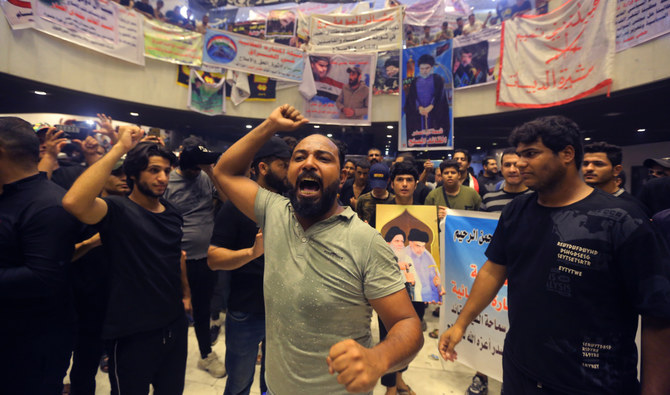
Followers of Shiite cleric Muqtada Al-Sadr hold posters with his photo during a sit-in protest, in Baghdad, Iraq, Wednesday, Aug. 3, 2022. (AP)
Short Url
Updated 04 August 2022
Follow

UN calls for ‘urgent’ solutions to Iraq political crisis

  • Nearly 10 months on from elections, the oil-rich country still has no government and no new prime minister or president

BAGHDAD: The UN mission in Iraq called on leaders on Wednesday to put their country first and end a long-running political power struggle, as tensions soar in the war-scarred nation.

Nearly 10 months on from elections, the oil-rich country still has no government and no new prime minister or president.

“We appeal to all actors to commit, actively engage and agree on solutions without delay,” the UN Assistance Mission for Iraq said in a statement.

“Leaders must prioritize (the) national interest,” it said.

On Wednesday, followers of powerful Shiite preacher and political kingmaker Muqtada Al-Sadr continued a mass sit-in at parliament for a fifth day.

The Sadr bloc opposes a nomination for prime minister by the Coordination Framework, a rival, Iran-backed Shiite faction.

Outgoing Prime Minister Mustafa Al-Kadhimi has called for a “national dialogue” in a bid to bring all sides together to talk, and on Wednesday spoke with President Barham Saleh.

Both men stressed the importance of “guaranteeing security and stability” in the country, according to the Iraqi News Agency.

“Meaningful dialogue among all Iraqi parties is now more urgent than ever, as recent events have demonstrated the rapid risk of escalation in this tense political climate,” the UN mission warned.

On Tuesday, a top Sadrist official gave followers 72 hours to shift their protests from the main meeting halls of parliament to the entrance of the building and a surrounding encampment.

“Iraq is facing an extensive list of outstanding domestic issues: It is in desperate need of economic reform, effective public service delivery as well as a federal budget — to name a few,” the UN added.

“Hence, it is past time for political stakeholders to assume their responsibilities and act in the national interest.”

Iraq is the second largest producer in the Organization of the Petroleum Exporting Countries and derives 90 percent of federal revenue from oil.

But it has still not adopted its budget for 2022.

In June, parliament passed an emergency finance bill, to ensure gas supplies and buy grain for “food security.”


Sudan paramilitary used mass graves to conceal war crimes: ICC deputy prosecutor

Updated 2 sec ago
Follow

Sudan paramilitary used mass graves to conceal war crimes: ICC deputy prosecutor

UNITED NATIONS: Sudan’s paramilitary Rapid Support Forces carried out mass killings in Darfur and attempted to conceal them with mass graves, the International Criminal Court’s deputy prosecutor said on Monday.
In a briefing to the UN Security Council, Nazhat Shameem Khan said it was the “assessment of the office of the prosecutor that war crimes and crimes against humanity” had been committed in the RSF’s takeover of the city of El-Fasher in October.
“Our work has been indicative of mass killing events and attempts to conceal crimes through the establishment of mass graves,” Khan said in a video address, citing audio and video evidence as well as satellite imagery.
Since April 2023, a civil war between the Sudanese army and the RSF has killed tens of thousands, displaced 11 million and created the world’s largest displacement and hunger crisis.
Reports of mass killings, sexual violence, abductions and looting emerged in the wake of the RSF’s sweep of El-Fasher, which was the army’s last holdout position in the Darfur region.
Both warring sides have been accused of atrocities throughout the war.
Footage reviewed by the ICC, Khan said, showed RSF fighters detaining, abusing and executing civilians in El-Fasher, then celebrating the killings and “desecrating corpses.”
According to Khan, the material matched testimony gathered from affected communities, while submissions from civil society groups and other partners had further corroborated the evidence.
The atrocities in El-Fasher, she added, mirror those documented in the West Darfur capital of El-Geneina in 2023, where UN experts determined the RSF killed between 10,000 and 15,000 people, mostly from the Massalit tribe.
She said a picture was emerging of “appalling organized, widespread mass criminality.”
“It will continue until this conflict and the sense of impunity that fuels it are stopped,” she added.
Khan also issued a renewed call for Sudanese authorities to “work with us seriously” to ensure the surrender of all individuals subject to outstanding warrants, including former longtime president Omar Al-Bashir, former ruling party chairman Ahmed Haroun and ex-defense minister Abdul Raheem Mohammed Hussein.
She said Haroun’s arrest in particular should be “given priority.”
Haroun faces 20 counts of crimes against humanity and 22 war-crimes charges for his role in recruiting the Janjaweed militia, which carried out ethnic massacres in Darfur in the 2000s and later became the RSF.
He escaped prison in 2023 and has since reappeared rallying support for the Sudanese army.
Khan spoke to the UN Security Council via video link after being denied a visa to attend in New York due to sanctions in place against her by the United States.