

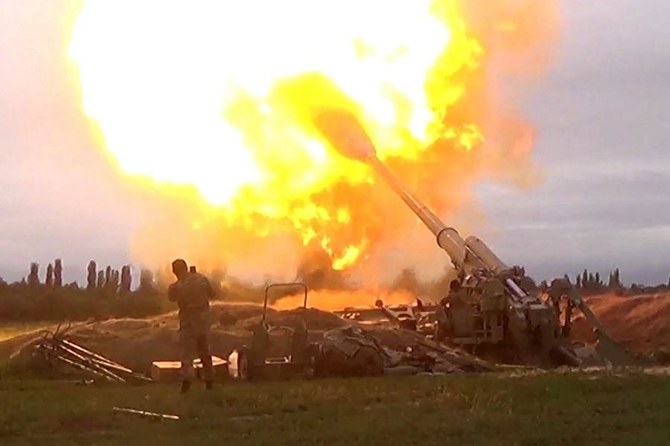
New tensions explode over Nagorno-Karabakh, 3 soldiers killed

1 / 2
Aerial images of Azerbaijan’s Defense Ministry show their alleged strikes against Armenian positions in Nagorno-Karabakh. (AFP)
2 / 2
Arch enemies Armenia and Azerbaijan fought two wars -- in 2020 and in the 1990s -- over Azerbaijan's Armenian-populated region of Nagorno-Karabakh. (File/AFP)
Short Url
Updated 05 August 2022
Follow

New tensions explode over Nagorno-Karabakh, 3 soldiers killed

  • Russia accuses Baku of violating the brittle cease-fire, EU urges an ‘immediate cessation of hostilities’
  • Arch enemies Armenia and Azerbaijan fought two wars, in 2020 and in the 1990s

BAKU: New tensions erupted over Nagorno-Karabakh on Wednesday as three soldiers were killed and Azerbaijan said it had taken control of several strategic heights in the disputed region.
The escalation drew immediate international rebuke, with Russia accusing Baku of violating the brittle cease-fire and the European Union urging an “immediate cessation of hostilities.”
Arch enemies Armenia and Azerbaijan fought two wars — in 2020 and in the 1990s — over Azerbaijan’s Armenian-populated region of Nagorno-Karabakh.
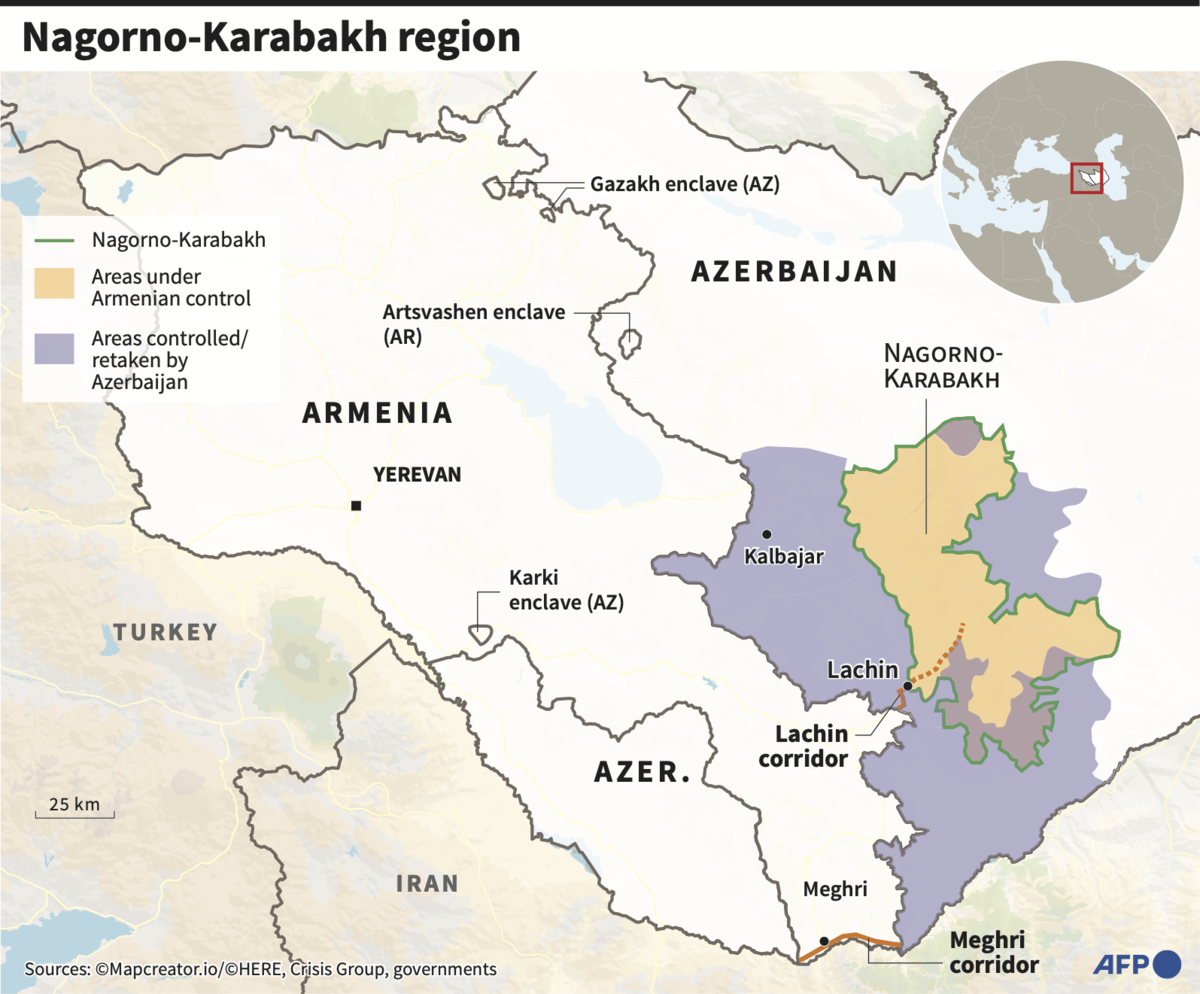
In the aftermath of the latest war, Armenia was forced to cede swathes of territory it had controlled for decades, and Russia deployed some 2,000 peacekeepers to oversee a fragile truce, but tensions persist despite a cease-fire agreement.
On Wednesday, new tensions flared as Azerbaijan said it had lost a soldier and the Karabakh army said two of its troops had been killed and more than a dozen injured.
The Azerbaijani defense ministry said Karabakh troops targeted its army positions in the district of Lachin, which is under the supervision of the Russian peacekeeping force, killing an Azerbaijani conscript.
The Azerbaijani army later said it conducted an operation dubbed “Revenge” in response and took control of several strategic heights in Karabakh.
The army of the breakaway statelet for its part accused Azerbaijan of violating a cease-fire and killing two soldiers and wounding another 14.
Karabakh declared a “partial mobilization,” the army said in a statement.
Armenia called on the international community to help stop Azerbaijan’s “aggressive actions” after the flare-up.
“Azerbaijan continues its policy of terror against the population of Nagorno-Karabakh,” the foreign ministry said.
Armenia accused Azerbaijan of seeking to make unilateral changes over the Lachin corridor that links Armenia and Karabakh.
Russia accused Azerbaijan of breaking the cease-fire and vowed to stabilize the situation.
“The cease-fire regime was violated by the armed forces of Azerbaijan around the Saribaba height,” the Russian defense ministry said in a statement.
“The command of the Russian peacekeeping force, with representatives of Azerbaijan and Armenia, are taking measures to stabilize the situation.”
The escalation came after Russian President Vladimir Putin spoke to Armenian Prime Minister Nikol Pashinyan on Tuesday.
The European Union called for an “immediate cessation of hostilities” between Azerbaijani and Armenian forces in Karabakh.
“It is essential to de-escalate, fully respect the cease-fire and return to the negotiating table to seek negotiated solutions,” EU foreign policy chief Josep Borrell’s spokesman said in a statement.
“The European Union remains committed to help overcome tensions and continue its engagement toward sustainable peace and stability in the South Caucasus,” he added.
US State Department spokesman Ned Price, meanwhile, expressed concern at the renewed fighting and urged “immediate steps to reduce tensions and avoid further escalation.”
In his statement, he also called for “a negotiated, comprehensive, and sustainable settlement of all remaining issues” tied to the conflict.
Following Russia’s intervention in Ukraine on February 24, an increasingly isolated Moscow lost its status as the primary mediator in the Karabakh conflict.
Six weeks of fighting in the autumn of 2020 claimed more than 6,500 lives and ended with a Russian-brokered cease-fire agreement.
In July, Azerbaijan began the process of returning its people to land recaptured from Armenian separatists in what Baku calls “The Great Return.”
The oil-rich country has vowed to repopulate the recaptured lands.
President Ilham Aliyev had for years promised to recapture lands lost in the 1990s and the first returns marked a symbolic moment for Azerbaijan.

Faced with Trump, Greenlanders try to reassure their children

Updated 6 sec ago
Follow

Faced with Trump, Greenlanders try to reassure their children

NUUK: In a coffee shop in Greenland’s capital Nuuk, Lykke Lynge looked fondly at her four kids as they sipped their hot chocolate, seemingly oblivious to the world’s convulsions.
Since Donald Trump returned to the White House last year with a renewed ambition to seize Greenland, international politics has intruded into the Arctic island’s households.
Dictated by the more or less threatening pronouncements of the US president, it has been an unsettling experience for some people here — but everyone is trying to reassure their children.
Lynge, a 42-year-old lawyer, relied on her Christian faith.
“There’s a lot of turmoil in the world,” she said. “But even if we love our country, we have even higher values that allow us to sleep soundly and not be afraid,” she said.
As early as January 27, 2025, one week after Donald Trump’s inauguration, the Greenlandic authorities published a guide entitled “How to talk to children in times of uncertainty?“
“When somebody says they will come to take our country or they will bomb us or something, then of course children will get very scared because they cannot navigate for themselves in all this news,” said Tina Dam, chief program officer for Unicef in the Danish territory.

- Unanswerable questions -

This guide — to which the UN agency for children contributed — recommends parents remain calm and open, listen to their children and be sensitive to their feelings, and limit their own news consumption.
As in many parts of the world, social media, particularly TikTok, has become the primary source of information for young people.
Today, children have access to a lot of information not meant for them, said Dam — “and definitely not appropriate for their age,” she added.
“So that’s why we need to be aware of that as adults and be protective about our children and be able to talk with our children about the things they hear — because the rhetoric is quite aggressive.”
But reassuring children is difficult when you do not have the answers to many of the questions yourself.
Arnakkuluk Jo Kleist, a 41-year-old consultant, said she talked a lot with her 13-year-old daughter, Manumina.
The teenager is also immersed in TikTok videos but “doesn’t seem very nervous, luckily, as much as maybe we are,” she added.
“Sometimes there are questions she’s asking — about what if this happens — that I don’t have any answers to” — because no one actually has the answer to such questions, she said.

- ‘Dear Donald Trump’ -

The Arctic territory’s Inuit culture also helped, said Kleist.
“We have a history and we have conditions in our country where sometimes things happen and we are used to being in situations that are out of our control,” said Kleist.
“We try to adapt to it and say, well, what can I do in this situation?“
Some Greenlandic children and teenagers are also using social media to get their message out to the world.
Seven-year-old Marley and his 14-year-old sister Mila were behind a viral video viewed more than two million times on Instagram — the equivalent of 35 times the population of Greenland.
Serious in subject but lighthearted in tone, the boy addresses the American president.
“Dear Donald Trump, I have a message for you: you are making Greenlandic kids scared.”
Accompanied by hard stares, some serious finger-wagging and mostly straight faces, he and his sister go on to tell Trump: “Greenland is not for sale.”
“It’s a way to cope,” his mother, Paninnguaq Heilmann-Sigurdsen, told AFP of the video. “It’s kid-friendly, but also serious.
“I think it’s a balance between this is very serious, but also, this is with kids.”