

Pakistan backs ‘One-China’ policy as Beijing enraged over Nancy Pelosi visit to Taiwan

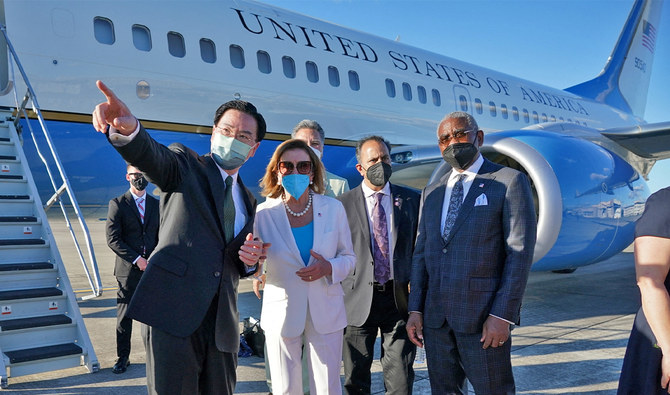
U.S. House of Representatives Speaker Nancy Pelosi talks with Taiwan Foreign Minister Joseph Wu before boarding a plane at Taipei Songshan Airport in Taipei, Taiwan on August 3, 2022. (Taiwan Ministry of Foreign Affairs via REUTERS)
Short Url
Updated 03 August 2022
Follow

Pakistan backs ‘One-China’ policy as Beijing enraged over Nancy Pelosi visit to Taiwan

  • China has furiously condemned the highest-level US visit to Taiwan in 25 years
  • China views visits by US officials as encouraging signal to pro-independence camp

ISLAMABAD: Pakistan reaffirmed its commitment to the ‘One-China’ policy on Wednesday as tensions between Beijing and Washington escalated over United States House Speaker Nancy Pelosi’s visit to Taiwan.

China furiously condemned the highest-level US visit to Taiwan in 25 years as Pelosi hailed the self-ruled island as “one of the freest societies in the world” and pledged American solidarity.

Beijing demonstrated its anger with Pelosi’s presence on an island that it says is part of China with a burst of military activity in surrounding waters, summoning the US ambassador in Beijing and halting several agricultural imports from Taiwan.

The ‘One-China’ policy is the diplomatic acknowledgement of China’s stance that there is only one Chinese government. Beijing considers Taiwan, a self-ruled island, an inalienable part of its territory and has not ruled out the possible use of force to “reunify” the country. The One-China policy is a key cornerstone of relations between the US and China also.

“Pakistan reaffirms its strong commitment to ‘One-China’ Policy and firmly supports China’s sovereignty and territorial integrity,” the Ministry of Foreign Affairs said in a press statement.

Pakistan said it was “deeply concerned” over the evolving situation in the Taiwan Strait which could have serious implications for regional peace and stability. Islamabad said the world was already reeling from the consequences of Russia’s invasion of Ukraine, especially when it came to food and energy supplies.

“The world cannot afford another crisis that has negative consequences for global peace, security and economy,” the foreign ministry said.

Islamabad said it believed inter-state relations should be based on mutual respect and non-interference in internal affairs and called for the implementation of the principles of the UN charter, international law and bilateral agreements.

The United States has no official diplomatic relations with Taiwan but is bound by American law to provide it with the means to defend itself. China views visits by US officials to Taiwan as sending an encouraging signal to the pro-independence camp on the island.

Taiwan rejects China’s sovereignty claims, saying only the Taiwanese people can decide the island’s future.


Kazakhstan president to explore trade, connectivity cooperation in first state visit to Pakistan tomorrow

Updated 12 min 19 sec ago
Follow

Kazakhstan president to explore trade, connectivity cooperation in first state visit to Pakistan tomorrow

  • Kazakhstan President Kassym-Jomart Tokayev to visit Pakistan from Feb. 3-4 with high-level delegation, says Pakistan’s foreign office
  • Kazakh president to meet Pakistani counterpart, hold talks with PM Shehbaz Sharif and address Pakistan-Kazakhstan Business Forum

ISLAMABAD: Kazakhstan President Kassym-Jomart Tokayev will explore bilateral cooperation with Pakistan in trade, regional connectivity, logistics and other sectors when he undertakes his first state visit to the country this week, Pakistan’s foreign office said on Monday. 

Tokayev will arrive in Pakistan leading a high-level delegation comprising senior cabinet ministers and high-ranking officials from Feb. 3-4, the Pakistani foreign office said in a statement. 

Tokayev is expected to meet his Pakistani counterpart President Asif Ali Zardari, hold talks with Prime Minister Shehbaz Sharif and address the Pakistan-Kazakhstan Business Forum during the visit, the foreign office said. 

“The visit will provide the two sides an important and timely opportunity to undertake a comprehensive review of bilateral relations, discuss new avenues for broadening cooperation, particularly in trade, logistics, regional connectivity, people-to-people contacts, and explore collaboration at regional and international forums,” the statement said. 

The foreign office said Tokayev’s visit reflects the strengthening bonds between Pakistan and Kazakhstan, their mutual commitment to transforming historic and cultural affinities into robust cooperation, as well as their common desire for peace and progress in the region. 

Relations between Pakistan and Kazakhstan are rooted in shared Islamic heritage and a growing strategic partnership, with Pakistan offering landlocked Central Asian republics access to southern seaports for global trade. Pakistan was among the first countries to recognize Kazakhstan when it gained independence in December 1991 and formally established diplomatic relations with it on Feb. 24, 1992. 

The two countries have held regular interactions over the past couple of years on the sidelines of the Shanghai Cooperation Organization (SCO) meetings and other international events. Kazakhstan’s Deputy Prime Minister Murat Nurtleu visited

Pakistan in September 2025 to discuss economic and trade cooperation with Islamabad. 

Islamabad and Astana engage with each other to promote business and political ties via three forums mainly, which are: Bilateral Political Consultations, the Intergovernmental Joint Commission on Trade, Economic, Scientific, Technological and Cultural Cooperation, and the Joint Business Council. 

According to the government of Kazakhstan, bilateral trade between the two countries amounted to $53.7 million in 2024. Pakistan’s main exports to Kazakhstan include citrus fruits, pharmaceutical products, garments, soap, sports equipment and gear and others.

Kazakhstan’s exports to Pakistan primarily include onions and garlic, dried leguminous vegetables, oats, buckwheat and other cereal grains, seeds and fruits of other oil-bearing crops, among others.