

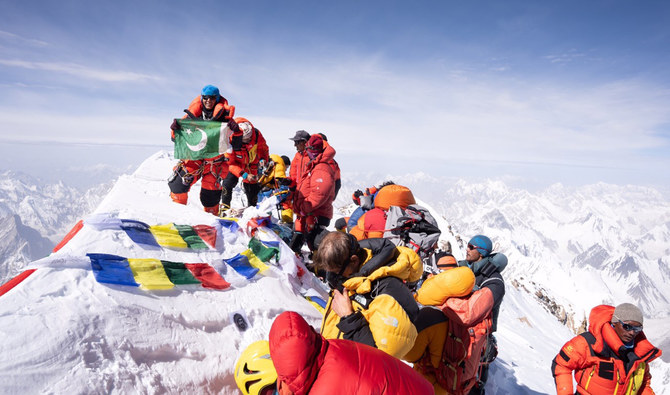

SKARDU: When Pakistani mountaineer Samina Baig hoisted the country’s green and white flag atop K2 last month, she had two reasons to celebrate: that she was the first Pakistani woman to summit K2, and that more than 20 other women joined her in achieving the feat.
Located on the Pakistan China border, the 8,611-meter-high K2 peak is the second highest on Earth, and popularly called the Savage Mountain because of its challenging terrain and treacherous weather, making it one of the most difficult mountains to climb in the world.
Until last year, fewer than 20 women had summited K2.
“I still can’t believe that I have climbed the summit of Mount K2, being the first Pakistani woman,” Baig said in a recent interview with Arab News.
“I think it’s an honor for me to hoist Pakistan’s flag on the second highest mountain, Mount K2, which is in Pakistan. And being the first woman from my country, it’s an absolute honor.”
Baig was among a record number of 87 climbers from Asia, the Middle East and Western countries who on July 22 summited K2, according to the Alpine Club of Pakistan, which helps coordinate the climbs and respond in case of an emergency.
But to encourage even more climbers to come to Pakistan, Baig said the government needed to improve infrastructure.
“We have great potential in tourism. The only thing is we need to work on infrastructure,” she said. “Whether it’s winter sports or adventure tourism, we have all sorts of tourism in the country.”
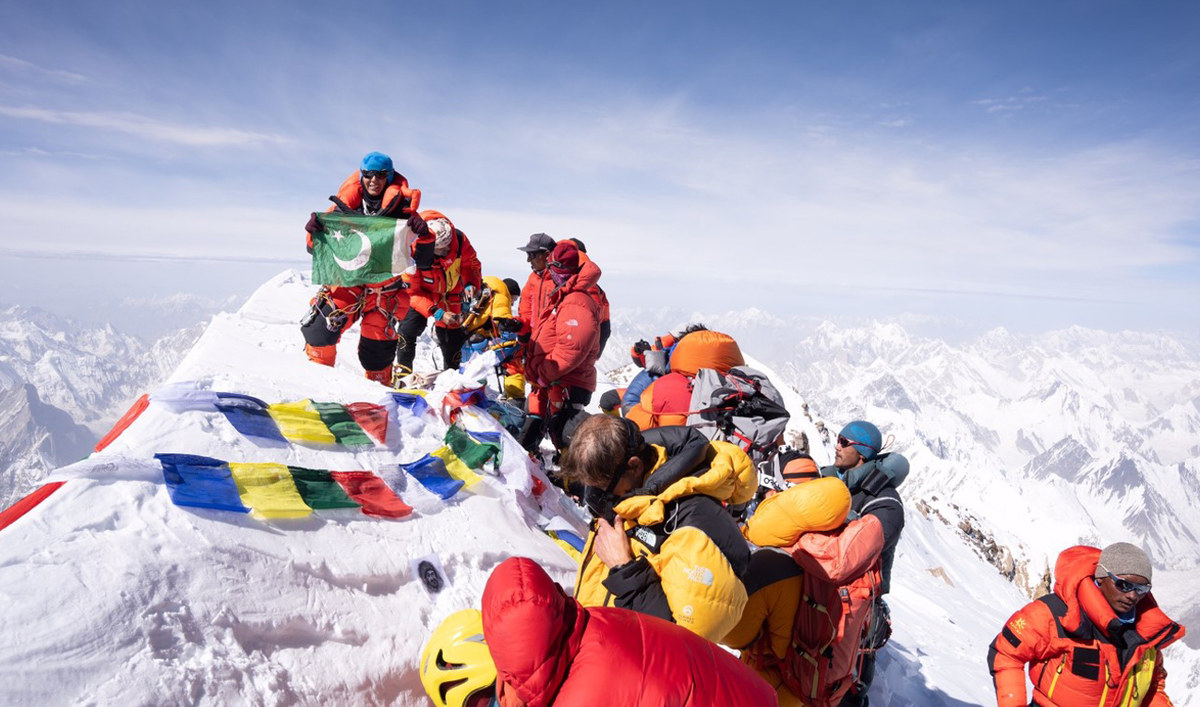
Samina Baig poses for a group photograph at the top of K2, located in Gilgit-Baltistan, Pakistan on July 22, 2022 (Mingma David Sherpa)
Baig has previously scaled the Seven Summits, which refers to the seven highest mountains in each continent, and this was her third attempt to summit K2.
She spoke about the challenges of climbing K2 and remembered three climbers, including famed Pakistani climber, Muhammad Ali Sadpara, who died on K2 last year after going missing, with the government launching a weeks-long extraordinary rescue mission that had involved the military and international mountaineers.
“It’s is a very, very challenging mountain,” said Baig, who won the Pride of Performance award for her successful ascent of Everest in 2013. “Number one, weather, and then the terrain on the mountain is very, very dangerous, very difficult, and then the rockfall and avalanches.”
“And this year it was totally different conditions on the mountain. There was not a lot of snow on the mountain so the chances of rocks falling were very, very high...it’s not an easy mountain at all.”
What’s next for Baig?
“There are many mountains [of] 6000, 7000 meter peaks, which are totally untouched or unclimbed, so maybe I will go for that, but for now, I am just celebrating what I have achieved.”
Baig was also thrilled to see more women taking an interest in mountaineering.
“This year, more than 20 women summited K2, which is amazing and shows women are taking more interest in adventure sports, which were normally considered male-dominated sports,” Baig said. “I am so happy to see all these wonderful women from different countries summiting big mountains.”

Climbers, after summiting K2, descending from the top of K2, located in Gilgit-Baltistan, Pakistan on July 22, 2022. (Mingma David Sherpa)
Among these 20 climbers was Lebanese Nelly Attar, who became the first Arab woman to summit K2, and Taiwan’s Grace Tseng, 29, the world’s youngest female mountaineer to do so.
“You have to work hard and you have to believe in yourself,” Baig said in a message for women. “Nothing is impossible in this world, nothing.”


