

More downpours predicted in Karachi as monsoon rains, floods kill over 500 in Pakistan

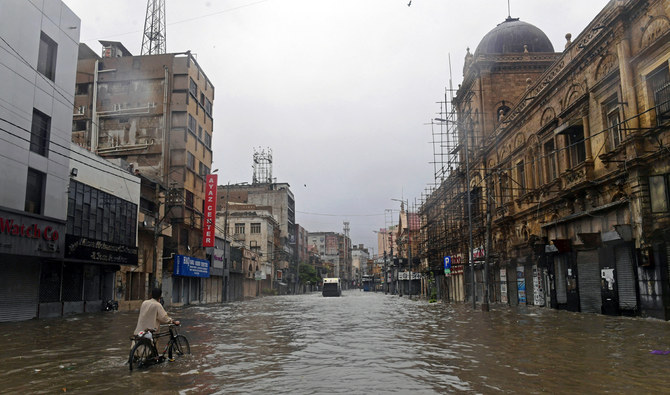
A commuter makes his way through a flooded street after a heavy rain shower in Karachi, Pakistan on July 11, 2022. (AFP/File)
Short Url
Updated 03 August 2022
Follow

More downpours predicted in Karachi as monsoon rains, floods kill over 500 in Pakistan

  • 502 people have died in Pakistan in rain-related incidents since the monsoon season began in mid-June
  • Worst hit area is southwestern Balochistan province where deaths have crossed 150, mostly due to flooding

KARACHI: Climate Minister Sherry Rehman has said more rains were predicted in Karachi, the country’s megacity, where torrential rains last month caused widespread flooding and damage, warning that heavy downpours could cause water-logging in several cities of the southern Sindh province.

According to data as of Tuesday, 502 people have died in Pakistan in rain-related incidents since the monsoon season began in mid-June. The worst hit area has been the southwestern province of Balochistan where deaths have crossed 150, mostly due to floods caused by unusually heavy monsoon rains.

In Karachi, 39 people died between July 4-31, according to data from the city commissioner’s office.

On Tuesday, the Pakistani military said a helicopter carrying a senior commander and five others crashed on a mountain and all on board were killed. The army aviation helicopter, which was helping with flood relief work in Balochistan, lost contact with air traffic control on Monday.

“More rain predicted for Karachi from August 6th-9th,” the climate minister said on Twitter. “In a fresh forecast issued today,the Met office also cautioned that heavy falls may generate water-logging in low-lying areas of Karachi, Badin,Thatta, Sujawal,Tando Muhammad khan,Tando Allayar, Dadu,Jamshoro Kambar Shahdadkot.”

Last month, rains in Karachi left many parts of the financial hub, including its crucial business district, inundated. Most underpasses were flooded and there was nowhere to pump the flood waters out to.

The streets of posh areas such as the Defense Housing Authority (DHA) complex and Clifton were flooded, with water gushing into houses.

Karachi’s main streets, which house financial institutions and bank headquarters including Pakistan’s central bank, were flooded and rescue services were using boats to reach stranded people.

Record-breaking heavy rain in Karachi in August 2020 killed over 100 people and disrupted the lives of many of the city’s more than 15 million residents as water flooded main roads and homes.


Pakistan, UK sign £35 million Green Compact to strengthen climate resilience

Updated 21 December 2025
Follow

Pakistan, UK sign £35 million Green Compact to strengthen climate resilience

  • Pakistan ranks among nations most vulnerable to climate change and has seen erratic changes in its weather patterns
  • UK will help Pakistan mobilize climate finance, strengthen regulatory frameworks and develop bankable climate projects

ISLAMABAD: Pakistan and the United Kingdom (UK) have formalized a comprehensive climate partnership with the launch of a Green Compact that aims to enhance climate resilience, accelerate clean energy transition and scale up nature-based solutions, including mangrove conservation, Pakistani state media reported on Sunday.

The agreement, signed in Islamabad by Federal Minister for Climate Change and Environmental Coordination Dr. Musadik Malik and UK Minister for International Development Jennifer Chapman, unlocks £35 million in targeted support for green development and long-term climate action, according to Radio Pakistan broadcaster.

Pakistan ranks among nations most vulnerable to climate change and has seen erratic changes in its weather patterns that have led to frequent heatwaves, untimely rains, storms, cyclones, floods and droughts in recent years. In 2022, monsoon floods killed over 1,700 people, displaced another 33 million and caused over $30 billion losses, while another 1,037 people were killed in floods this year.

Mohammad Saleem Shaikh, a spokesperson for Pakistan’s Ministry of Climate Change, described the compact as a “decisive move toward action-oriented climate cooperation,” noting that its implementation over the next decade will be critical for Pakistan which regularly faces floods, heatwaves and water stress.

“The Compact is structured around five core pillars: climate finance and investment, clean energy transition, nature-based solutions, innovation and youth empowerment, and adaptation and resilience,” the report read.

“Under the agreement, the UK will work with Pakistan to mobilize public and private climate finance, strengthen regulatory frameworks for green investment, and develop bankable climate projects.”

Clean energy forms a central component of Pakistan’s transition, with Islamabad planning to expand solar and wind generation to reduce fossil fuel dependence, improve energy security and stabilize power costs, according to Shaikh.

“Renewable energy is now economically competitive, making the transition both environmentally and financially viable,” he was quoted as saying.

“Nature-based solutions, particularly large-scale mangrove restoration, will protect coastal communities from storm surges and erosion while enhancing biodiversity and carbon sequestration.”

Under the Compact, technical support, mentoring and access to investors will be provided to climate-smart startups and young innovators, reflecting Pakistan’s recognition of youth-led initiatives as central to future climate solutions.

On the occasion, Chapman, on her first official visit to Pakistan, underscored the urgency of climate action, highlighting the UK’s support for renewable energy, mangrove and ecosystem restoration, early-warning systems, climate budgeting and international investment flows into Pakistan.

Shaikh described the Green Compact as “a strategic turning point” in Pakistan–UK relations on climate change, saying its effective implementation is essential for Pakistan to meet its national climate targets.