

Afghans hoping to resettle in West live in tent camps in Pakistani capital — and wait

Afghan refugees seeking asylum abroad gather at an open field in protest to demand help from the United Nations High Commissioner for Refugees (UNHCR), in Islamabad, Pakistan, on May 7, 2022. (AFP)
Short Url
Updated 02 August 2022
Follow

Afghans hoping to resettle in West live in tent camps in Pakistani capital — and wait

  • Roughly 500 Afghan families are camped in two parks in Islamabad since over three months waiting to immigrate to Western nations
  • Pakistan government says Afghans who arrived after Taliban takeover not considered refugees as they plan to resettle in third country

ISLAMABAD: Bahishta Ismail Khel, 13, was studying in the third grade and described living “a happy life” with her family in Kabul when the Taliban overthrew the Ashraf Ghani administration in August 2021, forcing Khel’s family to escape to Pakistan to flee the ensuing violence.

But life after entering Pakistan via Spin Boldak, a border town in Afghanistan, has been far from easy for the Khel family, which is currently squatting in a makeshift tent village in Islamabad’s posh F-6 sector — one of roughly 500 Afghan refugee families, comprising five to eight members each, who have been camped in two parks in the capital for over three months. 

Most of the families do not want to live in Pakistan permanently and are hoping for Western embassies to process their immigration applications. In the meantime, they wait.

Pakistan is home to around 2.8 million Afghan refugees, including 1.5 million registered and 1.3 million unregistered Afghan nationals, according to the United Nations refugee agency, the UNHCR. After the Taliban takeover of the war-battered country in August 2021, some 250,000 additional Afghans took shelter in neighboring Pakistan.

“Here mosquitoes bite us at night, there is no food for us,” Khel told Arab News from inside a plastic tent. “I was going to school in Kabul and living a happy life. We fled after law and order deteriorated there.” 


Bahishta Ismail Khel, 13, speaks to Arab News in Islamabad, Pakistan, on July 30, 2022. (AN Photo)

As Khel spoke, rain battered the roof of the flimsy shelter. Heavy rains have lashed the country in recent days, leaving large swathes of the country inundated with water, and killing over 430 people nationwide.

“I miss my friends and home,” the 13-year-old said, trying to hold back tears.

Many Afghans also fled their country after the Taliban closed girls’ schools in Afghanistan in March, hoping female members of their families could continue their education in Pakistan.

But it was only after arriving in Pakistani cities that they realized their children could not be admitted to Pakistani government-run schools without proper documents, while private institutions were too expensive for them to afford.

“One of my daughters has gotten mentally ill after the schools’ closure. They insist on going to school, but there is no facility for them [in Pakistan],” Basmina Sadaat, an Afghan mother of three, told Arab News. “What about their studies and future? We don’t have money to pay their fees [in private schools].” 
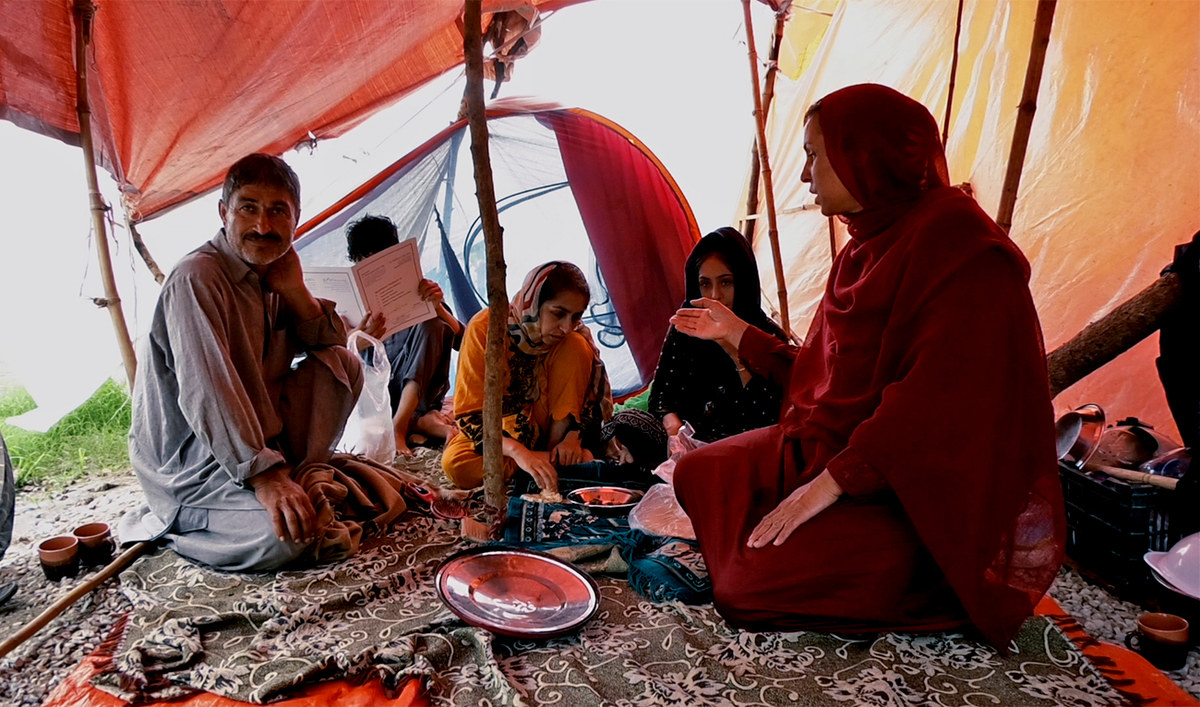


Basmina Sadaat (right), an Afghan mother of three, is pictured with her family in Islamabad, Pakistan, on July 30, 2022. (AN Photo)

Sadaat said her family left Kabul in March after the new Taliban authorities withheld the salary of her husband, an Afghan government employee. 

“We were living in a rented house in Kabul, but when the Taliban took over, they stopped my husband’s salary,” she said. “We didn’t even have money for food, let alone for the house rent.”

“Our country is destroyed and isn’t liveable now, but we have no identity here either.”

Many Afghan refugees have set up a protest camp outside the National Press Club in Islamabad and urged the UNHCR, the United States (US), and other western countries to grant them immigration for a better future.

“So far nobody from the embassy of any country has approached us for any sort of help,” Khel’s father, Aimal Ismail Khel, told Arab News.

“I had to flee Kabul with my family after the Taliban killed my brother and threatened to kill me as well for working with the Afghan army as a driver.” 

Aimal said he borrowed Rs40,000 ($167) from a friend to bear the cost of traveling to Islamabad. 

His family is now living on charity: “I have no savings. We are going through the worst phase of our life.”

The Pakistani government says Afghans who arrived in Pakistan after the Taliban takeover are not considered refugees as they plan to resettle in a third country, preferably the US or in Europe. 

“These Afghans are not protesting against Pakistan, instead they have been requesting the US and western countries to relocate them in their countries,” Muhammad Abbas Khan, a commissioner in Islamabad for Afghan refugees, told Arab News. 

“We have extended their visas till December, and may extend it further to facilitate their stay in Pakistan. I have personally visited them in Islamabad, but they are not ready to register with us. In fact, they avoid us as they have been using Pakistan as a transit territory.” 

Khan said the Afghan nationals had a “genuine issue,” which was why the Pakistani government was not evacuating them.

“We aren’t harassing them in any way, rather we want them to leave for their intended destinations as quickly as possible,” he added.

The UNHCR said it was working with the Pakistani government to provide protection and assistance to Afghan and other refugees. 

“We are currently discussing with the government of Pakistan the way forward on registration and documentation of asylum-seekers, predominantly from Afghanistan,” Qaiser Khan Afridi, a spokesperson for the UNHCR Pakistan, told Arab News. 

Asif Khan Zadran, a press attaché at the Afghan mission in Islamabad, said the embassy had helped Afghan nationals camped in Islamabad get temporary residency in Pakistan so they could work on processing their applications for relocation. 

“The embassy is attesting the applications of all those who are getting immigration offers from other countries,” Zadran told Arab News. “This is up to these Afghans to approach and plead embassies of European countries here in Islamabad for visas. We can’t help them, but we are also not trying to create any hurdles for them.” 


Pakistan military says 12 soldiers killed in border fighting as Kabul calls for dialogue

Updated 50 min 46 sec ago
Follow

Pakistan military says 12 soldiers killed in border fighting as Kabul calls for dialogue

  • Military says 274 Afghan fighters killed, over 400 injured in ongoing operation
  • Afghan authorities earlier said 55 Pakistani soldiers killed in retaliatory strikes

ISLAMABAD: Pakistan’s military said on Friday 12 soldiers had been killed in cross-border fighting with Afghan forces, as it detailed the scale of an ongoing border operation and accused the Kabul government of coordinating with militant groups targeting Pakistan.

The announcement followed days of escalating hostilities triggered by Pakistani airstrikes earlier this week on what Islamabad said were Tehreek-e-Taliban Pakistan (TTP) and Daesh militant camps inside Afghanistan. Since then, both governments have reported retaliatory operations and issued conflicting casualty figures, marking the most serious deterioration in relations between the neighbors in recent months.

The 2,600-kilometer (1,600-mile) shared frontier between the two nations, a key trade and transit corridor, has remained closed to trade and movement since October 2025 amid recurring tensions.

Lt. Gen. Ahmed Sharif Chaudhry, director general of Inter-Services Public Relations (ISPR), told a news conference in Rawalpindi that Pakistani forces had repelled coordinated attacks at 53 locations along the border and responded under what he described as Operation Ghazab lil-Haq.

“While safeguarding Pakistan’s honor and territorial integrity, 12 brave soldiers have embraced martyrdom in the operation so far, while 27 have been injured and one soldier is missing in action,” he said.

Chaudhry said Pakistan had killed 274 Taliban fighters and injured more than 400, describing those figures as conservative estimates. He added that 73 Afghan posts had been completely destroyed along the border and 18 had been captured.

He said Afghan Taliban forces had launched physical raids “in collusion and in support of an internationally declared terrorist organization” and accused the Taliban administration of acting in coordination with militant groups.

“The Afghan Taliban regime is the master proxy of these terrorist proxies which are operating from Afghanistan,” he said.

Kabul has repeatedly said it does not allow militants to operate in its territory. 

Chaudhry said Pakistan had targeted 22 locations across the border, including in Kabul, Kandahar, Paktia, Nangarhar, Khost and Paktika.

“All targets were selected with great care based on intelligence. They were military objectives, and utmost care was taken to avoid any civilian collateral damage,” he said.

He said the Taliban authorities faced a choice.

“Either they choose terrorists and terrorism or side with Pakistan,” he said.

KABUL CALLS FOR DIALOGUE 

Separately on Friday afternoon, Afghan Taliban spokesperson Zabihullah Mujahid called for talks to resolve the crisis.

“We have always emphasized peaceful resolution, and now too we want the issue to be resolved through dialogue,” he said.

In a detailed statement earlier in the day, Afghanistan’s Ministry of National Defense said it had carried out airstrikes inside Pakistan in response to what it described as Pakistani “aerial incursions” into Kabul, Kandahar and Paktia.

Afghan officials said 55 Pakistani soldiers were killed and that several posts were captured, claims denied by Islamabad.

None of the casualty figures or battlefield claims from either side could be independently verified.

Pakistan’s Information Minister Attaullah Tarar earlier said militants had attempted to launch drones inside Pakistani territory.

“Fitna al khawarij terrorists have attempted to launch small drones in Abbotabad, Swabi and Nowshera. Anti Drone Systems have brought down all the drones. No damage to life,” Tarar said.

“The incidents have again exposed direct linkages between Afghan Taliban Regime and Terrorism in Pakistan.”

Separately, Prime Minister Shehbaz Sharif on Friday visited General Headquarters (GHQ) in Rawalpindi, where he was briefed by the military leadership on the evolving situation. 

According to a statement from the Prime Minister’s Office, Sharif said there would be “zero tolerance” toward what he described as collusion between the Afghan Taliban regime and militant elements.

“Pakistan knows very well how to defend itself against any aggression,” the statement quoted him as saying, adding that the armed forces were ready to safeguard the country.
Regional concern

Cross-border violence has intensified in recent weeks, with Pakistan blaming a surge in suicide bombings and militant attacks on insurgents it says are based in Afghanistan. Kabul denies providing safe havens and says Pakistan’s security challenges are an internal matter.

The latest clashes mark the third major escalation between the neighbors in less than a year. Similar strikes last year triggered weeklong fighting before Qatar, Türkiye and other regional actors mediated a ceasefire in October.

Several countries, including China, Russia, Saudi Arabia and Iran, have expressed concern and urged restraint.

Operations on both sides were ongoing as of Friday evening.