

90% fish consumed in Pakistan contaminated — WWF

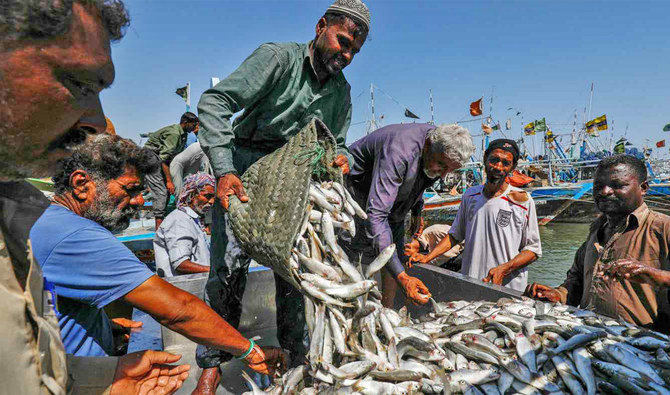
Fishermen unload baskets of fish from a boat after they returned with the day's catch at a harbor in Ibrahim Hyderi fishing village on the outskirts of Karachi, Pakistan, on April 29, 2020. (REUTERS/File)
Short Url
Updated 01 August 2022
Follow

90% fish consumed in Pakistan contaminated — WWF

  • WWF technical adviser says vendors keep fish at room temperature and sometimes above 40 degrees Celsius 
  • Says fish needs to be stored under 5 degrees Celsius to prevent rotting, remain fit for human consumption

ISLAMABAD: Approximately 90 percent of fish consumed in Pakistan is contaminated, a World Wide Fund for Nature (WWF) official said at a seminar on Sunday, raising alarm about catch unfit for human consumption being widely sold across the country. 

Muhammad Moazzam Khan, WWF’s technical adviser on marine fisheries and a former director general of the marine fisheries department, shared the assessment at a seminar titled ‘Blue Economy: An Avenue for Development in Pakistan’ held at the Pakistan Institute of International Affairs.

“Fish are very delicate protein items and putrefy very quickly if not iced or frozen as soon as possible,” Khan said, adding that 90 percent fish being sold was contaminated. 

“Fish are usually kept at room temperature and sometimes at above 40 degrees Celsius and vendors sprinkle water on them to make them look fresher and keep them from decaying. But they have already become unfit for consumption, yet people buy and consequently, fall sick.”

He said fish need to be stored between 0 and 5 degrees Celsius to prevent it from rotting and remain fit for human consumption.

The WWF representative said Pakistan exported around 10 percent of its produce while the rest was degraded or damaged as most boats lacked proper deep freezers and other facilities to store catch.

While the export of seafood in terms of volume was increasing, Khan said Pakistan was unable to grow its target due to a number of factors, including a lack of proper processing facilities and low-quality controls. 


Pakistan defense minister discusses regional, global developments with counterparts in Munich

Updated 5 sec ago
Follow

Pakistan defense minister discusses regional, global developments with counterparts in Munich

  • The high-powered meeting of government leaders, diplomats comes shortly before Russia’s war on Ukraine enters its fifth gruelling year
  • Bruised by President Donald Trump’s comments, European leaders at summit have pledged to shoulder more of the burden of shared defenses

ISLAMABAD: Pakistan’s Defense Minister Khawaja Asif on Friday met his Italian and Albanian counterparts to discuss bilateral cooperation and regional and global developments on the sidelines of the Munich Security Conference, the Pakistani embassy in Germany said.

The high-powered Munich meeting of government leaders, diplomats, defense and intelligence chiefs comes shortly before Russia’s full-scale war on Ukraine is set to enter its fifth gruelling year.

Bruised by President Donald Trump’s designs on Greenland and his often hostile comments about America’s traditional bedrock allies, European leaders at the conference have pledged to shoulder more of the burden of shared defenses.

Asif met his Italian counterpart Guido Crosetto during the conference, running from Feb. 13 till Feb. 15, with both sides agreeing to enhance bilateral ties, according to the Pakistani embassy.

“Asif met the Defense Minister of Republic of Albania, Mr. Pirro Vengu, on the sidelines of the 62nd Munich Security Conference,” the Pakistani embassy said on X.

“Discussed matters related to enhancing bilateral cooperation in the wake of recent regional and international developments.”

The development came as US Secretary of State Marco Rubio was set to address European leaders on Saturday as they try to step up their autonomy in defense while salvaging transatlantic ties badly strained under President Trump.

German Chancellor Friedrich Merz acknowledged a “rift” had opened up between Europe and the United States, fueled by culture wars, but issued an appeal to Washington: “Let’s repair and revive transatlantic trust together.”

“In the era of great power rivalry, even the United States will not be powerful enough to go it alone,” said the conservative leader, who has ramped up defense spending in the top EU economy.

Macron said a new framework was needed to deal with “an aggressive Russia” once the fighting in Ukraine ends.

Ukrainian President Volodymyr Zelensky, who has been in Munich since Friday and meeting multiple allies, was expected to address the meeting on Saturday. No Russian officials have been invited.

Kremlin critic Mikhail Khodorkovsky said he feared “a new cold war” between Europe and Russia in the coming decade, making reopening dialogue with Moscow essential.

“If it makes sense to talk, we are willing to talk,” said Merz, but he also charged that “Russia is not yet willing to talk seriously.”