


PM visits flood relief camps in Balochistan as provincial death toll jumps to 136

Pakistan Prime Minister Shehbaz Sharif (R) visits the flood relief camps in Balochistan’s Qila Saifullah district on August 1, 2022. (Government of Pakistan)
Short Url
Updated 01 August 2022
Follow

PM visits flood relief camps in Balochistan as provincial death toll jumps to 136

  • People at the camps tell the prime minister local authorities have not been providing them food
  • PM Sharif also describes absence record in medical camp as ‘weakness’ that must be addressed

QUETTA: Prime Minister Shehbaz Sharif on Monday visited flood relief camps in Balochistan’s Qila Saifullah district where he also interacted with their inhabitants and asked the province’s chief minister to act against local administration officials for not providing food to people. 

Pakistan has witnessed torrential rains since monsoon began in June, causing flash floods in different parts of the country. 

According to the latest statistics circulated by the National Disaster Management Authority (NDMA), 434 people lost their lives in rains across Pakistan since the onset of the season. 

Nine people were killed in Balochistan in the last 24 hours, taking the total number of rain-related deaths in the region to 136 since mid-June. 

Sharif, who was also accompanied by Chief Minister Mir Abdul Quddus Bizenjo, said he had witnessed several administrative weaknesses in the relief camps, including the absence of proper record maintained by doctors and paramedics responsible for treating flood victims. 

“There are camps in which people have come from adjoining areas with their families, leaving behind their houses which have been destroyed in rains,” the prime minister said. “I have met them, including children and elderly people. However, I could not get any confirmation that they were given food. In fact, the inhabitants of the relief camps clearly told us they had not been fed.” 
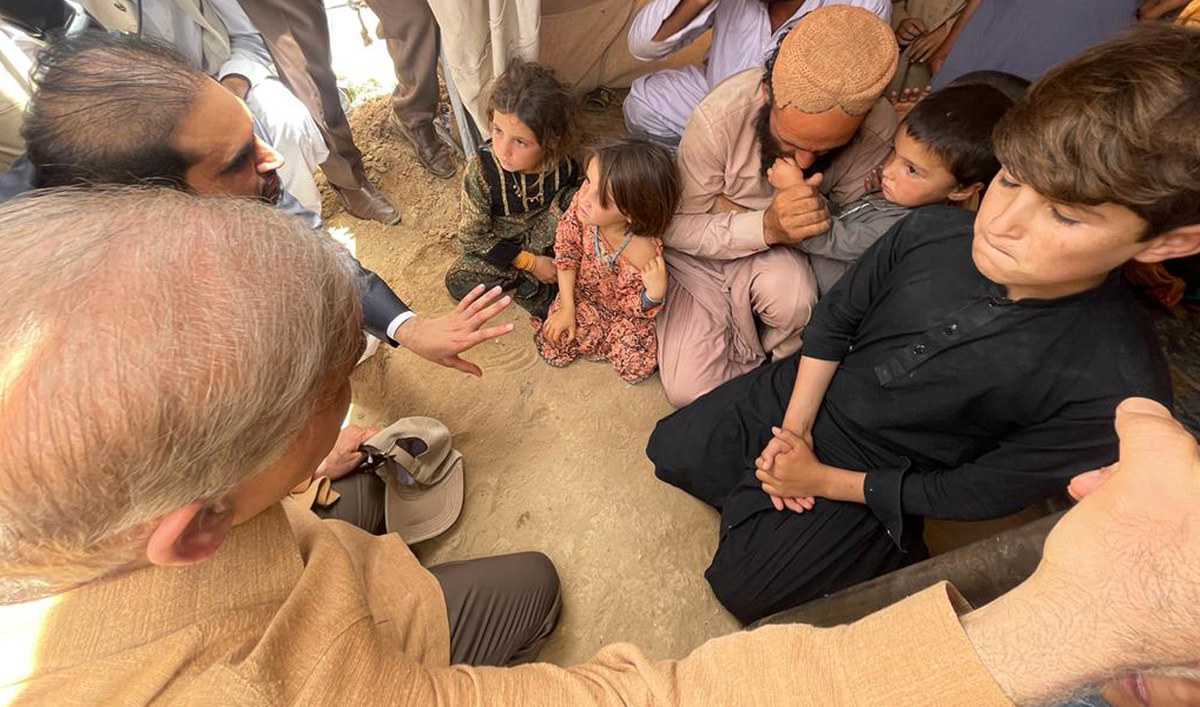


Pakistan Prime Minister Shehbaz Sharif (L) visits the flood relief camps in Balochistan’s Qila Saifullah district on August 1, 2022. (Government of Pakistan)

Sharif directed the chief minister to take immediate and strict action against all negligent officials. 

According to a statement issued by his office, the prime minister gave instructions to NDMA officials to pay the compensation amount within 24 hours to the next of kin of those who had died in monsoon rains in Balochistan. 

“It is our national tragedy that timely construction of dams was not ensured in the past,” Sharif said. 

Meanwhile, Bizenjo said his administration was told by the district and provincial disaster management officials that one-month ration had been distributed among people in relief camps. 

He announced to act against all officials who had misguided the provincial government. 

Earlier, the prime minister arrived in Quetta to evaluate the flood situation in the province and was received by Bizenjo. 

His visit to the southwestern province came soon after the meteorological department of Pakistan predicted “above-normal” rain in the month of August. 

The Met Office also forecast relatively high temperatures in mountainous regions, indicating a faster rate of snowmelt that could cause floods in the northern areas. 

Experts have already warned that climate change has made monsoon highly erratic in terms of its onset, intensity and area of coverage. 

One of them, Dr. Ghulam Rasul, told Arab News last week that monsoon had started penetrating “shadow zones,” including Balochistan and high mountains of Khyber Pakhtunkhwa and Gilgit-Baltistan which mostly remained dry in the past. 


ADB, Pakistan sign over $300 million agreements to undertake climate resilience initiatives

Updated 11 sec ago
Follow

ADB, Pakistan sign over $300 million agreements to undertake climate resilience initiatives

  • Pakistan ranks among nations most vulnerable to climate change and has seen erratic changes in weather patterns
  • The projects in Sindh and Punjab will restore nature-based coastal defenses and enhance agricultural productivity

ISLAMABAD: The Pakistani government and the Asian Development Bank (ADB) have signed more than $300 million agreements to undertake two major climate resilience initiatives, Pakistan’s Press Information Department (PID) said on Tuesday.

The projects include the Sindh Coastal Resilience Sector Project (SCRP), valued at Rs50.5 billion ($180.5 million), and the Punjab Climate-Resilient and Low-Carbon Agriculture Mechanization Project (PCRLCAMP), totaling Rs34.7 billion ($124 million).

Pakistan ranks among nations most vulnerable to climate change and has seen erratic changes in its weather patterns. In 2022, monsoon floods killed over 1,700 people, displaced another 33 million and caused over $30 billion losses, while another 1,037 people were killed in floods this year.

The South Asian country is ramping up climate resilience efforts, with support from the ADB and World Bank, and investing in climate-resilient infrastructure, particularly in vulnerable areas.

“Both sides expressed their commitment to effectively utilize the financing for successful and timely completion of the two initiatives,” the PID said in a statement.

The Sindh Coastal Resilience Project (SCRP) will promote integrated water resources and flood risk management, restore nature-based coastal defenses, and strengthen institutional and community capacity for strategic action planning, directly benefiting over 3.8 million people in Thatta, Sujawal, and Badin districts, according to ADB.

The Punjab project will enhance agricultural productivity and climate resilience across 30 districts, improving small farmers’ access to climate-smart machinery, introducing circular agriculture practices to reduce residue burning, establishing testing and training facilities, and empowering 15,000 women through skills development and livelihood diversification.

Earlier this month, the ADB also approved $381 million in financing for Pakistan’s Punjab province to modernize agriculture and strengthen education and health services, including concessional loans and grants for farm mechanization, Science, Technology, Engineering and Mathematics (STEM) education, and nursing sector reforms.