

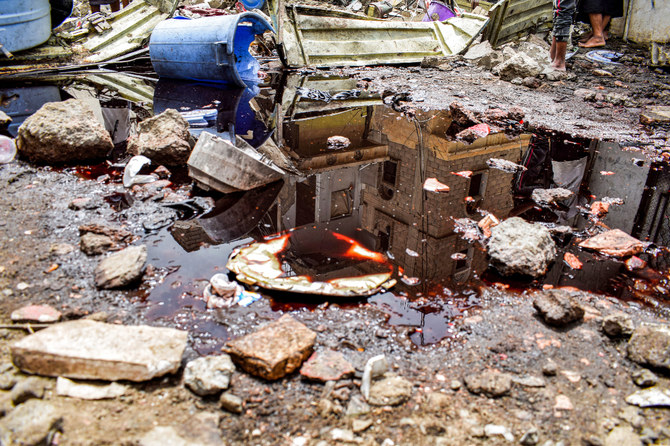
Blast kills 5 engineers at Houthi missile factory in Yemen

Houthis have been accused of using the Sanaa's airport facilities as warehouses to manufacture ballistic missiles and drones, claims that the Iran-backed militia denied. (AFP)
Short Url
Updated 01 August 2022
Follow

Blast kills 5 engineers at Houthi missile factory in Yemen

  • The engineers, some of them foreigners, were assembling missiles when the explosion happened
  • Omani delegation in last-ditch bid to push militia to extend ceasefire

AL-MUKALLA, Yemen: Five Houthi ballistic missile engineers, including foreigners, were killed in a large explosion that rocked Houthi-held Sanaa, Yemen’s Information Minister Muammar Al-Eryani said on Sunday.

He slammed the Houthis for endangering the lives of thousands of people who live in the capital by storing and manufacturing weapons inside residential areas.

The Yemeni minister said the five engineers were assembling a ballistic missile at a military location on Saturday near Sanaa airport, which was being used as a missile factory and rigging drones with explosives.

“This incident confirms the continued flow of Iranian weapons to the Houthi militia, its indifference to international community, disavowal of its obligations, & exploitation of UN-sponsored truce to accumulate more Iranian smuggled weapons in residential areas, & using civilians as human shields,” Al-Eryani said on Twitter.

Less than a day after the Houthi engineers were killed, a group of Omani diplomats arrived in militia-occupied Sanaa to discuss extending the UN-brokered truce.

The Houthi movement’s chief negotiator, Mohammed Abdul Salam, said he and an Omani delegation touched down in Sanaa on Sunday on an Omani plane to discuss with the Houthi leaders issues related to the truce and the UN Yemen proposal on addressing humanitarian and economic problems.

The Omanis arrived in Sanaa to push the Houthis into accepting the UN Yemen envoy’s proposal in ending their siege on Taiz and extending the truce, which is due to expire on Aug. 2.

UN, Western and regional envoys are pushing the Yemeni factions into extending the truce to six months and turning it into a sustainable peace deal to end the war.

The visit came as the UN Yemen envoy, Hans Grundberg, failed to convince the Houthis to accept his proposal on opening roads in Taiz and alleviating their siege on the city.

The Houthi objection blocked progress in the implementation of the truce and threatened to ruin it as the internationally recognized government of Yemen refused to move to discuss other issues before the Houthis opened roads in Taiz.

The Yemeni government said the Houthis did not implement all of the truce’s terms, refused to pay the salaries of the public servants in areas under their control despite generating more than 100 billion riyals ($86,956,522) from oil ships during the truce and continued attacking government-controlled areas in Taiz and Hodeidah, Marib and other areas.

On Saturday, the UN Yemen envoy returned empty-handed from Aden after the president of the Presidential Leadership Council, Rashad Al-Alimi, snubbed a meeting with him in protest against the Houthi violations of the truce, their objection to opening roads in Taiz and the UN’s soft stand with the movement.


Aleppo Citadel is a witness to the city’s great history and legacy

This aerial view shows the Citadel of Aleppo overlooking the northern Syrian city on December 11, 2024. (AFP)
Updated 11 sec ago
Follow

Aleppo Citadel is a witness to the city’s great history and legacy

  • Parts of military fortress date back nearly 2 millennia
  • Historian Abdullah Hajjar provides an extensive study

DAMASCUS: Towering above the old city, the Aleppo Citadel has stood for centuries as both a military stronghold and symbol of the location’s layered history.

After years of closure, neglect, and damage during the war, the Aleppo Citadel reopened to visitors on Sept. 27 following months of restoration.

The site has been listed as a UNESCO World Heritage landmark since 1986.

Rising around 38 meters above its surroundings, the fortress has played a central role in Aleppo’s political, military, and urban development.

Surrounded by a deep defensive moat, the citadel reflects advanced military engineering.

According to historian Abdullah Hajjar in his book “Archaeological Landmarks of Aleppo,” first published in 2010, the moat was excavated and reinforced during the reign of Ayyubid ruler Al-Zahir Ghazi.

At times it was 22 meters deep and about 30 meters wide, and filled with water to strengthen defenses.
Parts of the citadel date back nearly two millennia.

The lower section of its main entrance originates from the third century A.D., while the upper additions were made in the 15th century. Most of the towers and walls were built or expanded between the 13th and 16th centuries.

The citadel has repeatedly been damaged and rebuilt over the centuries. It was destroyed by the Sassanids in 540 A.D., but later restored.

Inside its walls, the citadel contains mosques, military structures, and residential buildings, offering a rare glimpse into daily life within a medieval fortress.

Among its landmarks are the Ibrahim Al-Khalil Mosque, the Great Mosque, defensive towers, barracks, and several historic houses.

Archaeological excavations have uncovered remains from multiple eras. This includes a ninth-century B.C. temple, Roman and Byzantine sarcophagi, and water cisterns dating to the reign of Byzantine Emperor Justinian, who rebuilt Aleppo’s fortifications in the sixth century against Persian invaders.

The citadel flourished during the Mamluk period, when it was restored by Sultan Baybars after the 1260 Battle of Ain Jalut.

Later inscriptions document victories by Mamluk rulers over Crusader and Mongol forces.

Under Ottoman rule, following the Battle of Marj Dabiq in 1516, the fortress gradually lost its military role and became an administrative and residential site.

The book outlines the various stages of restoration of the Aleppo Citadel over the centuries.

It highlights that Al-Zahir Ghazi, son of Saladdine Ayyubi, excavated the moat, reinforced the entrance with three wrought-iron gates, and built a large mosque within the fortress.

Later, Al-Zahir Baybars restored the citadel after the Mongol invasion, and in 1417, Sultan Al-Mu’ayyad Shaykh repaired its walls following their destruction by Timur in 1401.

The Aleppo Citadel has also survived powerful earthquakes, including a devastating quake in 1138 and another in 1822, each followed by major restoration efforts led by regional rulers of the time.

Beyond the citadel itself, Hajjar’s research documents Aleppo’s wider architectural heritage, including historic bathhouses and caravanserais that once supported the city’s role as a major trade center.