ODESA, Ukraine: Ukrainian President Volodymyr Zelensky visited a Black Sea port Friday as crews prepared terminals to export grain trapped by Russia’s five-month-old war.
Work has been inching forward a week after a deal was struck to allow critical food supplies to flow to millions of impoverished people facing hunger worldwide.
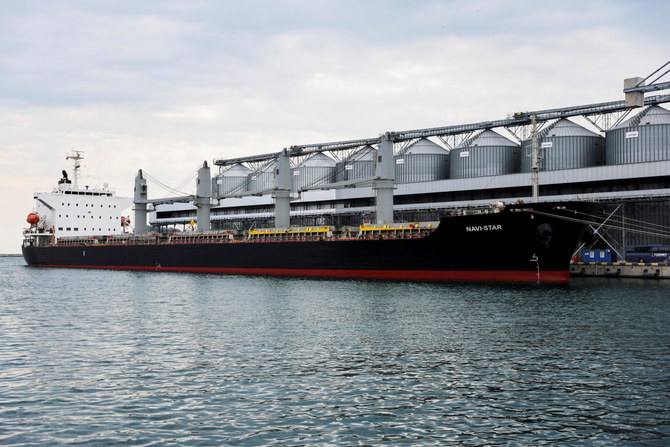
“The first vessel, the first ship is being loaded since the beginning of the war,” Zelensky said at a port in the Odesa region.
He said, however, that the departure of wheat and other grain will begin with several ships that were already loaded but could not leave Ukrainian ports after Russia invaded in late February. Ukraine is a key global exporter of wheat, barley, corn and sunflower oil, and the loss of those supplies has raised global food prices, threatened political insecurity and helped push more people into poverty and hunger in already vulnerable countries.
Ukraine’s military is committed to the safety of ships, Zelensky said, adding that “it is important for us that Ukraine remains the guarantor of global food security.”
His unannounced visit to the port is part of a broader push by Ukraine to show the world that it is nearly ready to export millions of tons of grains after last week’s breakthrough agreements, which were brokered by Turkey and the United Nations and signed separately by Ukraine and Russia.
The sides agreed to facilitate the shipment of wheat and other grains from three Ukrainian ports through safe corridors on the Black Sea, as well as fertilizer and food from Russia.
But a Russian missile strike on Odesa hours after signing the deal has thrown Moscow’s commitment into question and raised new concerns about the safety of shipping crews, who also have to navigate waters strewn with explosive mines.
The security concerns and complexities of the agreements have set off a slow, cautious start, with no grains having yet left Ukrainian ports. The sides are facing a ticking clock — the deal is only good for 120 days.
The goal over the next four months is to get some 20 million tons of grain out of three Ukrainian sea ports blocked since the Feb. 24 invasion. That provides time for about four to five large bulk carriers per day to transport grain from the ports to millions of people in Africa, the Middle East and Asia, who are already facing food shortages and, in some cases, famine.
Getting wheat and other food out is also critical to farmers in Ukraine, who are running out of storage capacity amid a new harvest.
“We are ready,” Ukraine’s minister of infrastructure, Oleksandr Kubrakov, told reporters at the port of Odesa on Friday.
But he said Ukraine is waiting on the UN to confirm the safe corridors that will be used by ships navigating the waters. In the meantime, a ship at the port of Chernomorsk was being loaded with grains, he said.
Martin Griffiths, the UN official who mediated the deals, cautioned that work was still being done to finalize the exact coordinates of the safest routes, saying this must be “absolutely nailed down.”
Lloyd’s List, a global publisher of shipping news, noted Friday that while UN officials are pushing for the initial voyage this week to show progress in the deal, continued uncertainty on key details will likely prevent an immediate ramping-up of shipments.
“Until those logistical issues and detailed outlines of safeguarding procedures are disseminated, charters will not be agreed and insurers will not be underwriting shipments,” wrote Bridget Diakun and Richard Meade of Lloyd’s List.
They note, however, that UN agencies, such as the World Food Program, have already arranged to charter much of the grain for urgent humanitarian needs.
Since the deal was signed a week ago, shipping companies have not rushed in because explosive mines are drifting in the waters, ship owners are assessing the risks and many still have questions over how the agreement will unfold.
Ukraine, Turkey and the UN are trying to show action on the deal signed a week ago. Turkish Defense Minister Hulusi Akar told Al Jazeera on Thursday that “the deal has started in practice” and that the first ship leaving Ukraine with grains is expected to depart “very soon.”
Turkish Foreign Minister Mevlut Cavusoglu expressed similar optimism in a press briefing, framing the deal as a significant step forward between the warring sides.
“This is not just a step being taken to lift the hurdles in front of the export of food. If implemented successfully, it will be a serious confidence-building measure for both sides,” he said.
The deal stipulates that Russia and Ukraine will provide “maximum assurances” for ships that brave the journey through the Black Sea to the Ukrainian ports of Odesa, Chernomorsk and Yuzhny.
For ships heading to Ukraine’s three ports, smaller Ukrainian pilot boats will guide the vessels through approved corridors. The entire operation will be overseen by a Joint Coordination Center in Istanbul staffed by officials from Ukraine, Russia, Turkey and the United Nations.
Once ships reach port, they will be loaded with tens of thousands of tons of grains before departing back to the Bosphorus Strait, where they will be boarded to inspect them for weapons. There will likely be inspections for ships embarking to Ukraine as well.

Zelensky visits port as Ukraine readies for grain exports
Short Url
https://arab.news/2h87t
Zelensky visits port as Ukraine readies for grain exports
- “The first vessel, the first ship is being loaded since the beginning of the war,” Zelensky said at a port in the Odesa region
- The departure of wheat and other grain will begin with several ships that were already loaded
UN refugee agency says up to 3.2 million people in Iran have been displaced by the war
- It said Thursday that most have fled from Tehran and other major cities toward the north of the country or rural areas
DUBAI: The UN refugee agency says up to 3.2 million people in Iran have been displaced by the ongoing war.
It said Thursday that most have fled from Tehran and other major cities toward the north of the country or rural areas.
THIS IS A BREAKING NEWS UPDATE. AP’s earlier story follows below.
DUBAI, United Arab Emirates: Unrelenting Iranian attacks on shipping traffic and energy infrastructure pushed oil above $100 a barrel on Thursday, as American and Israeli strikes pounded the Islamic Republic with no sign of an end to the war in sight.
Iran hit a container ship off the coast of Dubai, caused a blaze near Bahrain’s international airport, targeted a major Saudi oil field with a drone attack and forced Iraq to halt operations at all the country’s oil terminals after an attack on its port of Basra on the Arabian Gulf.
Iran flouted a United Nations Security Council resolution from the previous day demanding that it halt strikes on its Gulf neighbors with new attacks also reported in Kuwait and the United Arab Emirates.
Sirens wailed before dawn in Jerusalem after Israel said it was working to intercept missiles launched from Iran. The country also announced it had begun a “wide-scale wave of strikes” on Tehran. In Lebanon, where Israel says it is targeting Iran-linked Hezbollah militants, 11 people were killed in two early morning strikes.
Since the United States and Israel sparked with war with a Feb. 28 attack on Iran, Tehran has embarked on a campaign generated at inflicting enough global economic pain to pressure them to relent in their attacks.
In addition to attacking energy infrastructure around the region, Iran has a stranglehold on the Strait of Hormuz, the strategic waterway leading from the Arabian Gulf toward the Indian Ocean through which a fifth of the world’s oil is transported.
With traffic in the Strait effectively stopped, the price of Brent crude oil, the international standard, rose another 9 percent on Thursday to more than $100 a barrel, up some 38 percent over what it cost when the war started.
Iran fires at multiple Gulf Arab countries and hits ship in Arabian Gulf
The UN Security Council voted Wednesday to approve a resolution demanding a halt to Iran’s “egregious attacks” on its Gulf neighbors, but Tehran showed no signs of changing its strategy.
As the day began Thursday, a container ship in the Arabian Gulf was hit with a projectile off the coast of Dubai, sparking a small fire, according to British military’s United Kingdom Maritime Trade Operations Center. It said the crew of the vessel were safe.
In Bahrain, an early Iranian attack sparked a major fire on Muharraq Island, home to the country’s international airport. Authorities urged people to stay indoors and close windows to avoid smoke. The airport has jet fuel tanks, and other tanks in the area serve the kingdom’s oil industry.
Kuwait’s Defense Ministry said an Iranian drone smashed into a residential building, wounding two people, the UAE said it had activated air defenses twice to protect Dubai from attacks, and firefighters extinguished a blaze at a tower in Dubai Creek Harbor after a drone hit.
Saudi Arabia said it had shot down a drone targeting the diplomatic quarter of the capital, Riyadh, and also reported downing drones in kingdom’s east, including at least one trying to target its Shaybah oil field in the Empty Quarter desert.
Following an attack on Iraq’s Basra port that killed at least one person, officials said Thursday that it had been forced to halt operations at all the country’s oil terminals.
Farhan Al-Fartousi, the director-general of the General Company for Ports of Iraq, said the attack targeted a vessel in a ship-to-ship transfer area of the Arabian Gulf port.
Explosions rock Jerusalem while Lebanon and Tehran are hit by Israeli strikes
Sirens wailed and loud explosions were heard shortly after midnight in Jerusalem and other parts of Israel. The Israeli military said it was responding with another “wide-scale wave of strikes” in Tehran.
Overnight missile launches from Iran and Hezbollah also sent Israelis to shelters in multiple other areas, including Tel Aviv and the northern border with Lebanon.
An Israeli strike hit a car Thursday in Ramlet Al-Bayda, a major seaside tourist area of Beirut where dozens of displaced people have been sheltering. Eight people were killed and 31 others were wounded, the Lebanese Health Ministry said. The Israeli military press office told The Associated Press it was “not aware” of a strike at that location.
In Aramoun, a town about 10 kilometers (six miles) south of Beirut, another three people were killed and a child was wounded in another early Israeli attack.
Casualties continue to climb as conflict continues
At least 634 people have been killed in Lebanon since the latest fighting began, the Lebanese Health Ministry said Wednesday.
The UN refugee agency said at least 759,000 people have been internally displaced in Lebanon.
Iranian authorities say more than 1,300 people have been killed there, and Israel has reported 12 people dead. The US has lost seven soldiers while another eight have suffered severe injuries.
It said Thursday that most have fled from Tehran and other major cities toward the north of the country or rural areas.
THIS IS A BREAKING NEWS UPDATE. AP’s earlier story follows below.
DUBAI, United Arab Emirates: Unrelenting Iranian attacks on shipping traffic and energy infrastructure pushed oil above $100 a barrel on Thursday, as American and Israeli strikes pounded the Islamic Republic with no sign of an end to the war in sight.
Iran hit a container ship off the coast of Dubai, caused a blaze near Bahrain’s international airport, targeted a major Saudi oil field with a drone attack and forced Iraq to halt operations at all the country’s oil terminals after an attack on its port of Basra on the Arabian Gulf.
Iran flouted a United Nations Security Council resolution from the previous day demanding that it halt strikes on its Gulf neighbors with new attacks also reported in Kuwait and the United Arab Emirates.
Sirens wailed before dawn in Jerusalem after Israel said it was working to intercept missiles launched from Iran. The country also announced it had begun a “wide-scale wave of strikes” on Tehran. In Lebanon, where Israel says it is targeting Iran-linked Hezbollah militants, 11 people were killed in two early morning strikes.
Since the United States and Israel sparked with war with a Feb. 28 attack on Iran, Tehran has embarked on a campaign generated at inflicting enough global economic pain to pressure them to relent in their attacks.
In addition to attacking energy infrastructure around the region, Iran has a stranglehold on the Strait of Hormuz, the strategic waterway leading from the Arabian Gulf toward the Indian Ocean through which a fifth of the world’s oil is transported.
With traffic in the Strait effectively stopped, the price of Brent crude oil, the international standard, rose another 9 percent on Thursday to more than $100 a barrel, up some 38 percent over what it cost when the war started.
Iran fires at multiple Gulf Arab countries and hits ship in Arabian Gulf
The UN Security Council voted Wednesday to approve a resolution demanding a halt to Iran’s “egregious attacks” on its Gulf neighbors, but Tehran showed no signs of changing its strategy.
As the day began Thursday, a container ship in the Arabian Gulf was hit with a projectile off the coast of Dubai, sparking a small fire, according to British military’s United Kingdom Maritime Trade Operations Center. It said the crew of the vessel were safe.
In Bahrain, an early Iranian attack sparked a major fire on Muharraq Island, home to the country’s international airport. Authorities urged people to stay indoors and close windows to avoid smoke. The airport has jet fuel tanks, and other tanks in the area serve the kingdom’s oil industry.
Kuwait’s Defense Ministry said an Iranian drone smashed into a residential building, wounding two people, the UAE said it had activated air defenses twice to protect Dubai from attacks, and firefighters extinguished a blaze at a tower in Dubai Creek Harbor after a drone hit.
Saudi Arabia said it had shot down a drone targeting the diplomatic quarter of the capital, Riyadh, and also reported downing drones in kingdom’s east, including at least one trying to target its Shaybah oil field in the Empty Quarter desert.
Following an attack on Iraq’s Basra port that killed at least one person, officials said Thursday that it had been forced to halt operations at all the country’s oil terminals.
Farhan Al-Fartousi, the director-general of the General Company for Ports of Iraq, said the attack targeted a vessel in a ship-to-ship transfer area of the Arabian Gulf port.
Explosions rock Jerusalem while Lebanon and Tehran are hit by Israeli strikes
Sirens wailed and loud explosions were heard shortly after midnight in Jerusalem and other parts of Israel. The Israeli military said it was responding with another “wide-scale wave of strikes” in Tehran.
Overnight missile launches from Iran and Hezbollah also sent Israelis to shelters in multiple other areas, including Tel Aviv and the northern border with Lebanon.
An Israeli strike hit a car Thursday in Ramlet Al-Bayda, a major seaside tourist area of Beirut where dozens of displaced people have been sheltering. Eight people were killed and 31 others were wounded, the Lebanese Health Ministry said. The Israeli military press office told The Associated Press it was “not aware” of a strike at that location.
In Aramoun, a town about 10 kilometers (six miles) south of Beirut, another three people were killed and a child was wounded in another early Israeli attack.
Casualties continue to climb as conflict continues
At least 634 people have been killed in Lebanon since the latest fighting began, the Lebanese Health Ministry said Wednesday.
The UN refugee agency said at least 759,000 people have been internally displaced in Lebanon.
Iranian authorities say more than 1,300 people have been killed there, and Israel has reported 12 people dead. The US has lost seven soldiers while another eight have suffered severe injuries.
© 2026 SAUDI RESEARCH & PUBLISHING COMPANY, All Rights Reserved And subject to Terms of Use Agreement.