

Syrian ship carrying ‘stolen Ukrainian barley, flour’ docks in Lebanon

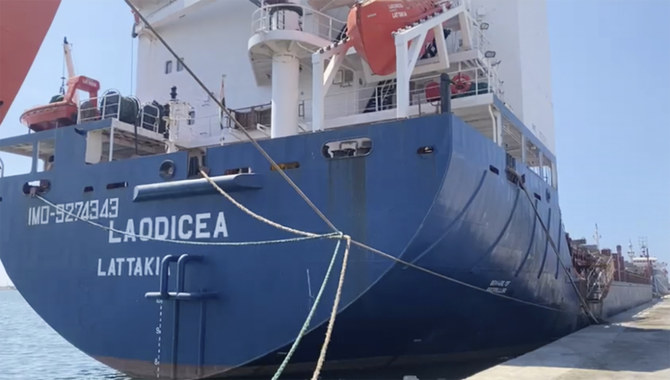
This frame grab from a video provided on Friday, July 29, 2022, shows a Syrian cargo ship Laodicea docked at a seaport, in Tripoli, north Lebanon. (AP)
Short Url
Updated 29 July 2022
Follow

Syrian ship carrying ‘stolen Ukrainian barley, flour’ docks in Lebanon

  • According to the Ukrainian Embassy in Beirut, the cargo vessel Laodicea docked in the port of Tripoli
  • It was carrying 5,000 tons of flour and 5,000 tons of barley

BEIRUT: A Syrian ship under US sanctions has docked in the northern Lebanese port of Tripoli carrying barley and wheat that Ukraine Embassy officials in Beirut claim has been plundered by Russia from Ukrainian stores.

The Laodicea moored up in the Mediterranean city on Wednesday, according to shipping data website MarineTraffic.

In a statement, the embassy said: “The ship has traveled from a Crimean port that is closed to international shipping, carrying 5,000 tons of barley and 5,000 tons of flour that we suspect was taken from Ukrainian stores.”

Nasser Yassin, Lebanon’s caretaker environment minister, said: “Lebanon respects international laws. The ship said to be stolen from Ukraine and docked in Tripoli had not been offloaded.”

He added that the matter was being looked into by the Lebanese ministers of economy and public works.

Igor Ostatch, the Ukrainian ambassador to Lebanon, notified Lebanese President Michel Aoun of the situation during a meeting, warning that “imports of Ukrainian grain stolen by Russia might harm bilateral relations.”

However, the Russian Embassy in Lebanon said that “the Syrian ship carrying the cargo is from a private company in Lebanon,” and it denied any “knowledge of or relation to it.”

It added: “The accusations of the Ukrainian ambassador against Russia regarding the flour stolen from Ukrainian warehouses are unfounded.”

Some Lebanese observers fear certain parties may take advantage of the economic and political chaos in Lebanon to smuggle goods into Syria and circumvent US sanctions on the war-torn country, especially following claims that the Laodicea belonged to the Syrian General Directorate of Ports.

Lebanon is currently facing an acute bread shortage due to a scarcity of flour and a lack of funds to import subsidized wheat. The country used to import 60 percent of its needs from Ukraine.

A Lebanese Economy Ministry source told Arab News: “Importing wheat or flour from abroad doesn’t require the approval of the ministry unless it was subsidized by the central bank.

“Other than that, private companies and mills have the right to freely import wheat or flour, provided that the Lebanese customs check the legitimacy of the importation.”

The Ukrainian Embassy in Lebanon has claimed that, “since the invasion of Ukraine last February, Russia worked on sending about 100,000 tons of stolen wheat to Syria.”

In May, the Ukrainian Ministry of Defense stated that “ships carrying stolen Ukrainian wheat and raising the Russian flag were heading to Syria.”

An officer from the Turkey-based grains trading company, Loyal Agro, told Reuters: “Russia is the source of the flour carried by the ship docked in Tripoli. The flour wasn’t stolen from Ukraine and the company sought to import 5,000 tons of flour to Lebanon to sell it to buyers from the private sector and not the Lebanese government.

“The cargo had not been offloaded and the Lebanese customs had not yet granted an import license, as they were investigating Ukraine’s assertions that the flour has been stolen by Russia from its territories following the invasion.

“The company provided the Lebanese customs with documentation clarifying that the source of the cargo was legitimate,” the official added.

Lebanon’s Minister of Foreign Affairs Abdallah Bou Habib said Lebanese authorities had not been able as of the early hours of Friday to “determine the source of the flour and barley cargo carried by the ship.”

He noted that Lebanon had “received a number of complaints and warnings from a number of Western countries” following the docking of the ship.

The maritime row comes a week before Lebanon commemorates the second anniversary of the Beirut port blast on Aug. 4. A ship called the MV Rhosus had carried the ammonium nitrate to the port seven years before it exploded, killing 232 people, and leaving thousands injured. The chemicals had been stored in one of the port’s hangars.

In recent days dust has been seen rising from blast-damaged grain silos at the port forcing Lebanese authorities to take precautionary measures and put security forces on alert in case the structures collapse. Around 200,000 masks have been distributed among residents in the area.


Syrian church marks Christmas and reaffirms faith months after deadly attack

Updated 15 min 26 sec ago
Follow

Syrian church marks Christmas and reaffirms faith months after deadly attack

  • The June attack was blamed on a Daesh cell, which authorities said had also planned to target a Shiite shrine

DWEIL’A: At a church in Syria where a suicide attack killed 25 people in June, hundreds of worshippers gathered before Christmas to remember those they lost and reaffirm their faith.
With a small detail of security forces standing guard outside, members of Mar Elias Church held Mass on Tuesday evening and lit an image of Christmas tree made of neon lights on the wall of the courtyard outside. The tree was hung with pictures of those who were killed in the attack.
They include three men the congregation hails as heroes for tackling the bomber, potentially averting a much higher death toll in the June 22 attack.
A man opened fire then detonated an explosive vest inside the Greek Orthodox church in Dweil’a on the outskirts of Damascus as it was filled with people praying on a Sunday.
Before he detonated the vest, brothers Boutros and Gergis Bechara and another congregant, Milad Haddad, tackled the shooter and pushed him out of the center of the church, congregants said.
“If it weren’t for the three of them, maybe not one person would remain out of 400 people,” said Imad Haddad, the brother of Milad Haddad, who attended Tuesday’s Christmas tree lighting.
He hasn’t decorated for Christmas or put up a tree at home, but gathering at the church was “is a message of peace and love” and a message that “we are believers and we are strong and we are steadfast in spite of everything,” he said.
Thana Al-Masoud, the widow of Boutros Bechara, recalled searching frantically for her husband after the explosion but she never found him, alive or dead. His body had been ripped apart by the blast.
“There’s no holiday, neither this year nor next year nor the one after it,” she said.
She takes comfort in the belief that her husband and the two other men who confronted the attacker are martyrs for their faith.
“Our Lord chose them to be saints and to spread His word to all the world,” she said. “But the separation is difficult.”
Attack stoked Christian fears
The attack on the church was the first of its kind in Syria in years and came as a new Sunni militant- dominated government in Damascus sought to win the confidence of religious minorities following the ouster of former President Bashar Assad.
Interim President Ahmad Al-Sharaa has struggled to exert authority across the country, even in the ranks of allied groups. There have been several deadly outbreaks of sectarian violence in the country in the past year.
While the new government has condemned attacks on minorities, many accuse it of failing to act to control the armed factions it is trying to absorb into the new state army and security forces.
The June attack was blamed on a Daesh cell, which authorities said had also planned to target a Shiite shrine. Daesh did not claim responsibility for the attack, while a little-known group called Saraya Ansar Al-Sunna said one of its members had carried out the attack. The government said the group was a cover for Daesh.
Christians made up about 10 percent of Syria’s population of 23 million before mass anti-government protests in 2011 were met by a brutal government crackdown and spiraled into a brutal 14-year civil war that saw the rise of IS and other extremist groups.
Hundreds of thousands of Christians fled during the war, during which there were sectarian attacks on Christians including the kidnapping of nuns and priests and destruction of churches. Now many are once again seeking to leave.
Solidifying faith and seeking peace
Since losing her husband in the church attack, Juliette Alkashi feels numb.
The couple had been sweethearts before she left Syria with her mother and brother to emigrate to Venezuela. In 2018, when Emile Bechara asked her to marry him, Alkashi moved back to Syria even though it was still in the midst of a civil war.
“Whatever is going to happen will happen, and I’ve surrendered to it,” she said. “If one goes to pray and dies in the church — whatever God has written is what will be.”
The only thing that matters now, Alkashi said, is that she and her 3-year-old son remain together.
Some congregants said the attack only strengthened their faith.
“I saw a column of smoke rising from the ground to the ceiling, and I heard a voice saying, ‘I will not forsake you and I will not leave you,’” said Hadi Kindarji, who described an intense spiritual experience in the moment of the explosion.
He believes today that even the seemingly senseless violence was part of God’s plan.
“Our God is present, and He was present in the church,” he said.
Yohanna Shehadeh, the priest of Mar Elias church, acknowledged many in the congregation are afraid of more deadly violence.
“Fear is a natural state. I’m not going to tell you there is no fear, and I’m not only talking about the Christians but about all the Syrian people, from all sects,” Shehadeh said.
As Christmas approaches, he said, they are praying for peace.