

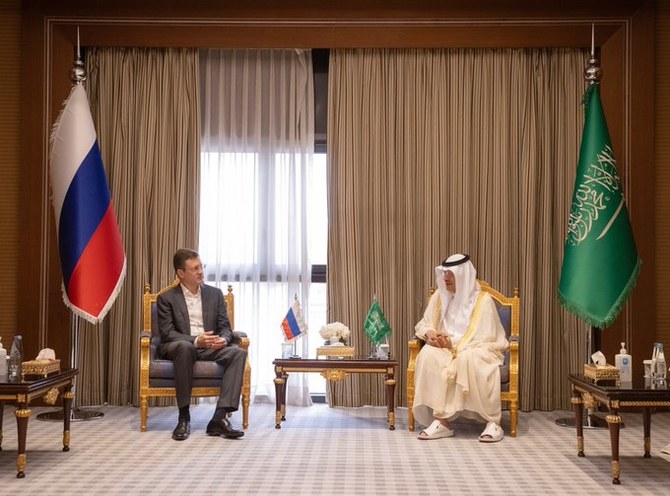

RIYADH: Saudi Arabia’s Energy Minister Prince Abdulaziz bin Salman met Russian Deputy Prime Minister Alexander Novak on Friday in Riyadh, the Saudi energy ministry said on Twitter.
The two discussed the latest developments in the work of the joint Saudi-Russian committee as well as opportunities for cooperation between their countries, the ministry added.
Their meeting came ahead of a meeting of The Organization of the Petroleum Exporting Countries and its allies, known as OPEC+, set for Aug 3.
The organization is under pressure — particularly from the US — to increase production in order to reduce global oil prices.
US President Joe Biden visited Saudi Arabia this month hoping to strike a deal to open the taps, but he is set to be disappointed, OPEC+ sources have told Reuters.
The news agency is reporting that the group will consider keeping oil output unchanged for September, saying a modest increase would be discussed.
Saudi Arabia is clear that OPEC+ is playing a vital role in maintaining stability in the oil markets and actively considers all options.
Speaking at an Arab News Japan Roundtable event on July 19, Saudi Arabia’s Foreign Minister Prince Faisal bin Farhan described dialogue in the alliance as “quite robust”, and that it is “responding as needed to the requirements of the oil markets.”
“We don’t see a lack of oil in the market, there is a lack of refining capacity,” he added.
At its last meeting, in July, OPEC+ agreed to stick to plans to increase production by 648,000 barrels per day for the month of August.
The prospect of the group sticking to modest increases when it meets next month saw oil prices rise in European trading on Friday
Brent crude futures for September settlement, due to expire on Friday, gained $2.34 to $109.48 a barrel by 0933 GMT for its highest since July 5. The more active October contract was up $2.30 at $104.13.
US West Texas Intermediate crude futures rose $2.16 to $98.58 a barrel.
“The oil market in Europe is considerably tighter than in the US, which is also reflected in the sharply falling Brent forward curve," said Commerzbank analyst Carsten Fritsch.


