

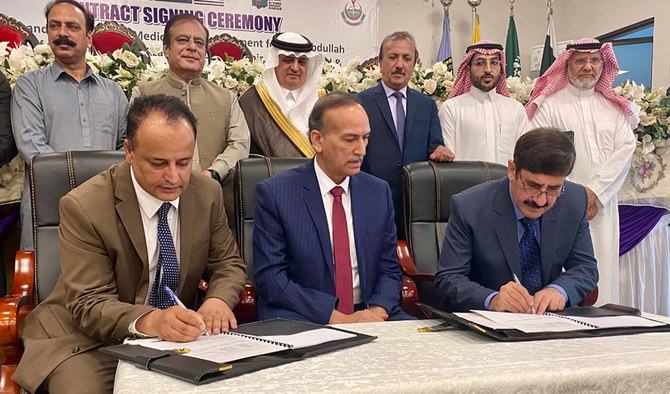
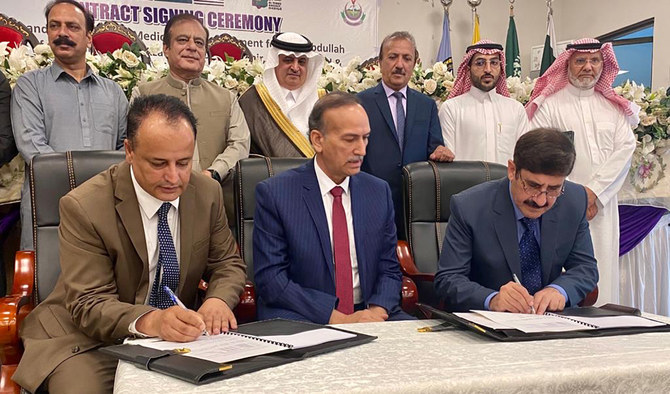
ISLAMABAD: A Saudi development agency has earmarked a grant of $21.5 million to donate medical equipment and furniture to the King Abdullah Campus of the University of Azad Jammu and Kashmir and King Abdullah Teaching Hospital in Mansehra, said the kingdom’s envoy to Pakistan on Thursday.
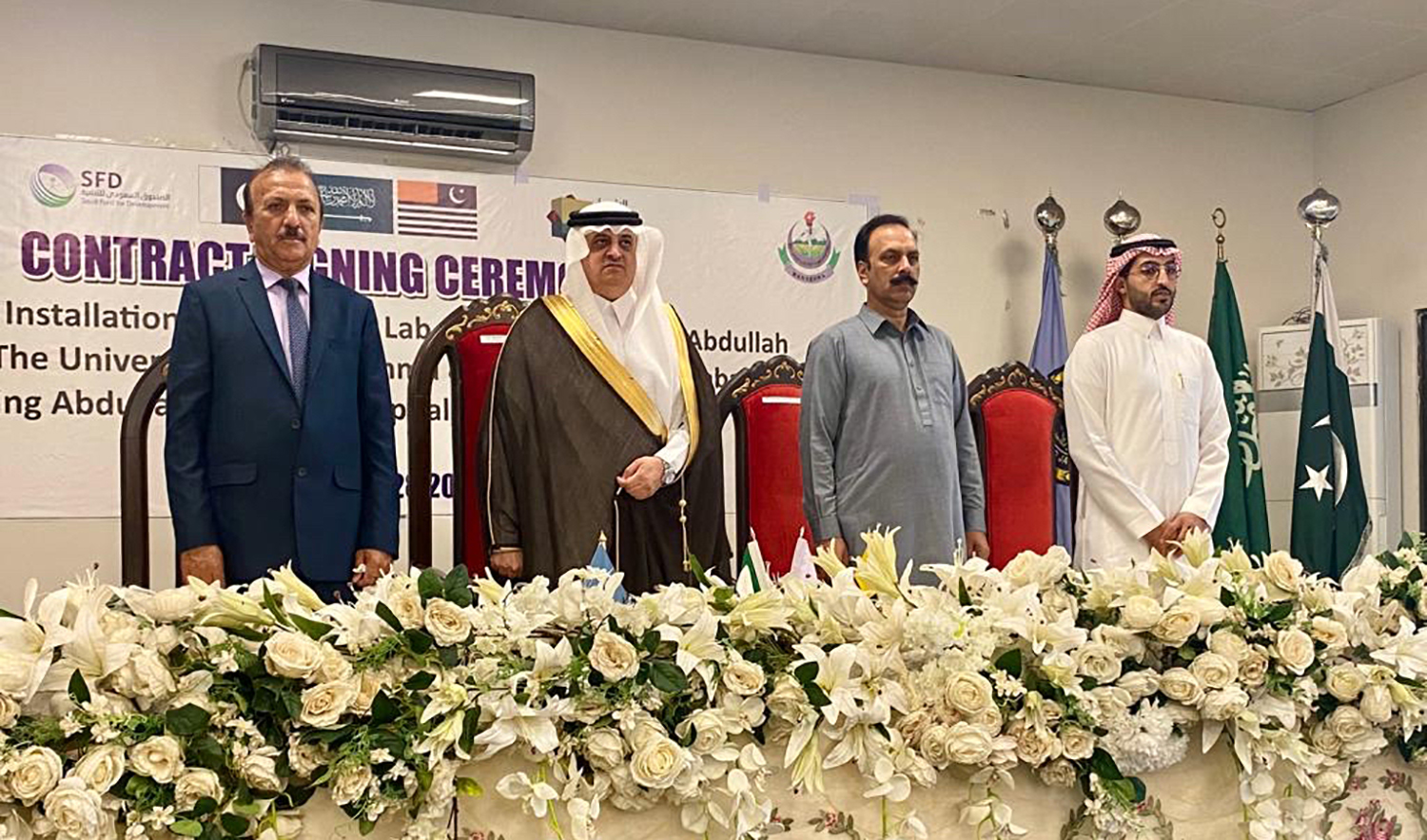
Saudi Ambassador Nawaf bin Said Al-Malki (2nd left) is participating in the signing ceremony held in Islamabad, Pakistan, on July 28, 2022, for the provision of medical equipment to local universities. (AN Photo)
The multimillion-dollar King Abdullah Campus in Kashmir, located 22 kilometers from Muzaffarabad, was built as part of the development projects funded by the Saudi authorities after a devastating earthquake in October 2005 which flattened out much of the infrastructure in the area. The campus stretches across a vast piece of land where classes began in September 2020.
The Saudi Fund for Development (SFD) has set aside $21.5 million to carry out the two projects which can now be implemented after a tripartite agreement was signed in Islamabad between the AJK University, King Abdullah Teaching Hospital, and the kingdom’s National Scientific Company Limited.
“I am pleased to express my happiness at signing contracts to equip and furnish the most important development projects that serve the education and health sectors [in Pakistan],” Saudi Ambassador Nawaf bin Said Al-Malki said while addressing the signing ceremony in Islamabad.
“These two projects directly achieve the third and fourth objectives of the sustainable development goals related to achieving good health and quality education,” he added.
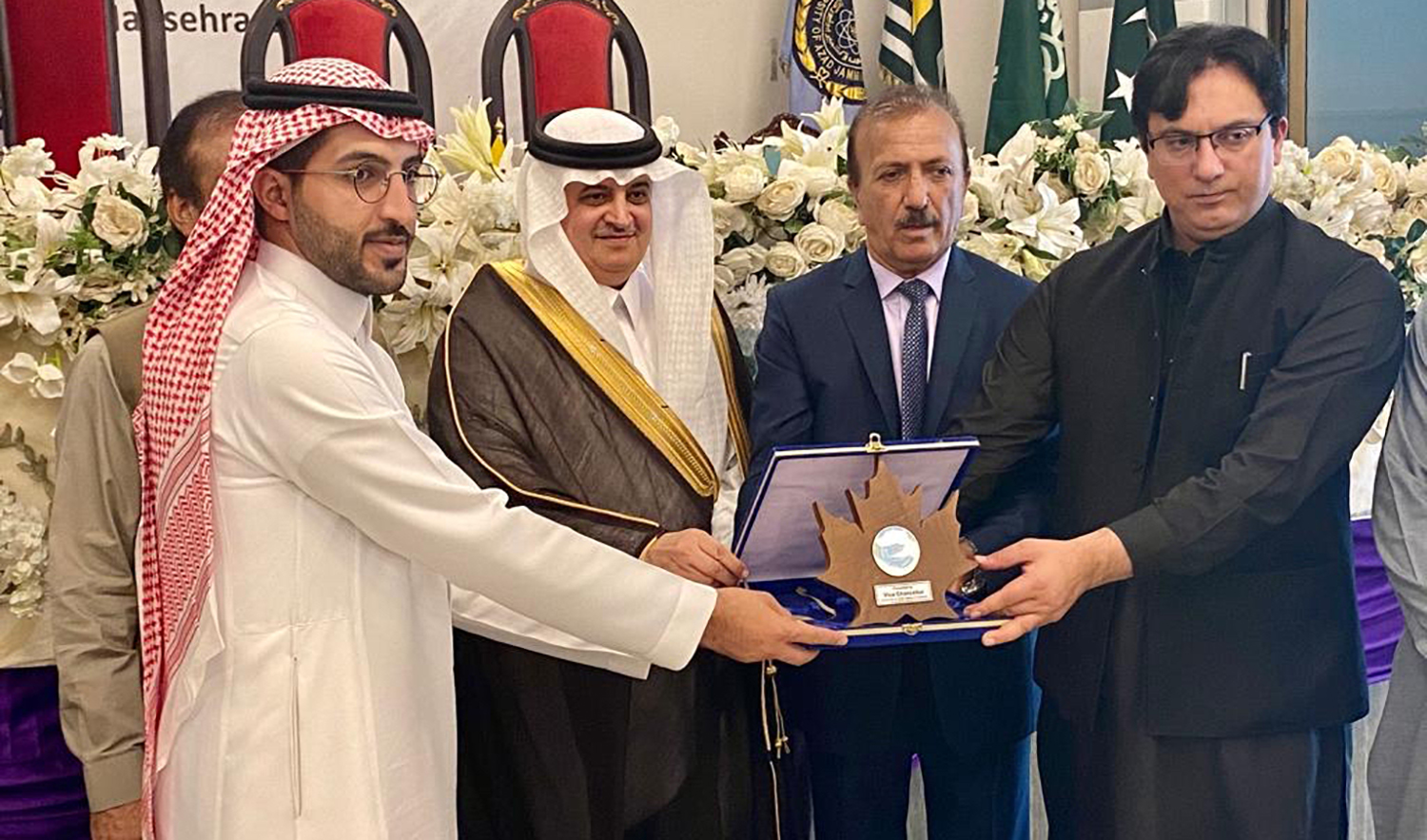
Officials of the Azad Jammu and Kashmir government are presenting a shield to Saudi Ambassador Nawaf bin Said Al-Malki (2nd left) in Islamabad, Pakistan, on July 28, 2022. (AN Photo)
The ambassador said the SFD had also provided three grants to Pakistan with a total amount of more than $333 million to help implement 23 other projects.
He added that 13 of these projects had been completed while 10 were still being implemented.
“Quality projects were completed in the fields of education, health and infrastructure through these grants,” Al-Malki said.
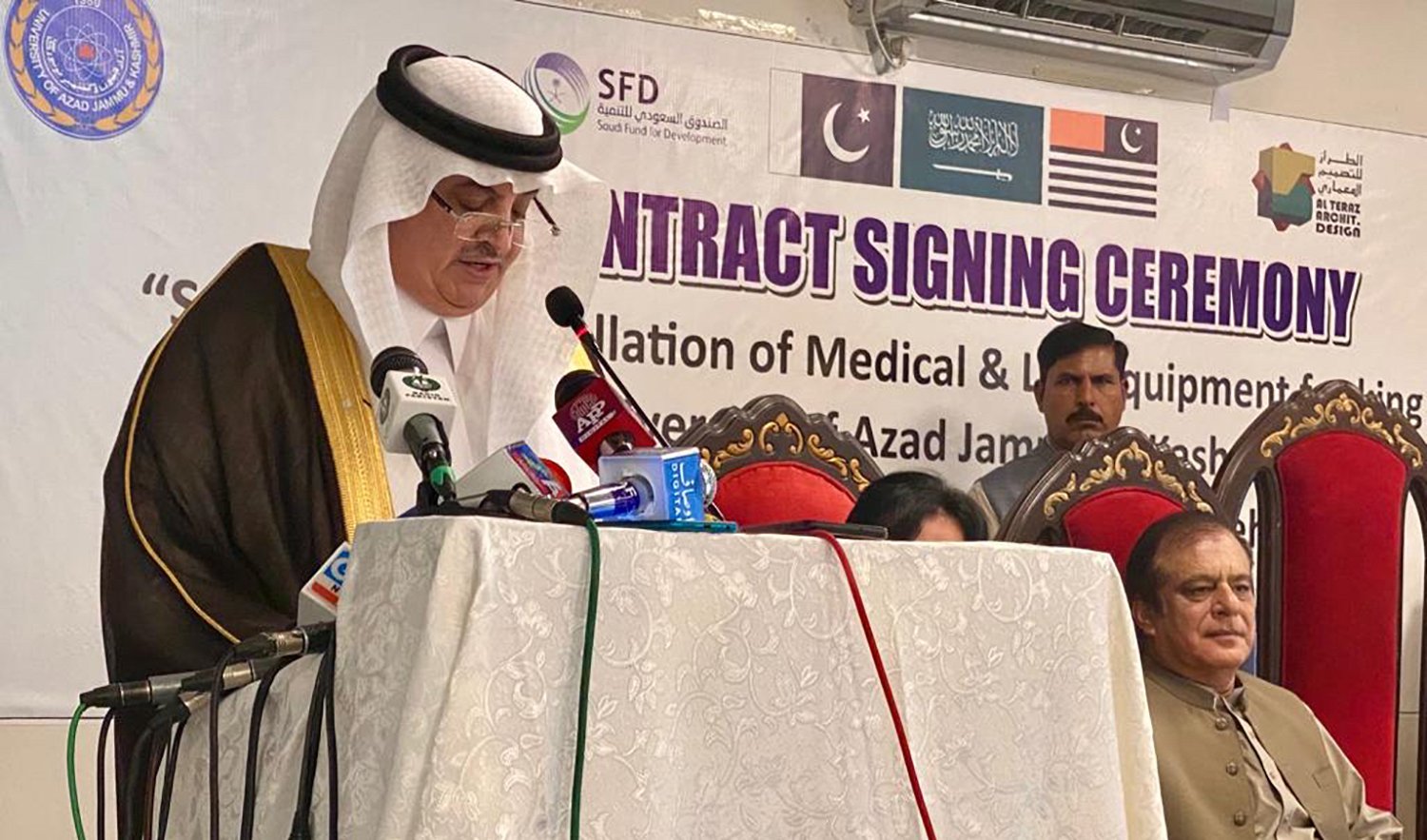
Saudi Ambassador Nawaf bin Said Al-Malki is addressing a ceremony in Islamabad, Pakistan, on July 28, 2022. (AN Photo)
Speaking to Arab News, an SFD official said his organization was excited about signing the contract to further strengthen the development projects.
“The SFD is delighted to sign this contract to complete these two projects for the welfare of the students and people,” Eng. Abdulelah Dh. Alluhaidan said.
Vice Chancellor of AJK university Dr. Muhammad Kaleem Abbasi maintained the project would help the education institute develop its labs along modern lines.
“Modern lab equipment are essential functioning components of any academic or research organization,” he said. “Therefore, we have submitted this project for the provision of equipment and furniture for the King Abdullah Campus.”
“The new campus can accommodate more than 7,000 students of 14 academic departments and institutes,” he continued. “Additionally, it has six student hostels, an administrative block and auditorium along with a mosque, hi-tech labs and a shopping mall.”
Dr. Maqsood Ali Khan, regional director general health of Khyber Pakhtunkhwa province, said the project would improve research and education quality at the King Abdullah Teaching Hospital in Mansehra.
“As a result of this contract, there will be installation of a new medical laboratory and upgradation of equipment at the training hospital,” he told Arab News while describing the project as great humanitarian assistance provided to the people of his province by the Saudi authorities.


