

Yemeni conjoined twins successfully separated in Riyadh

1 / 3
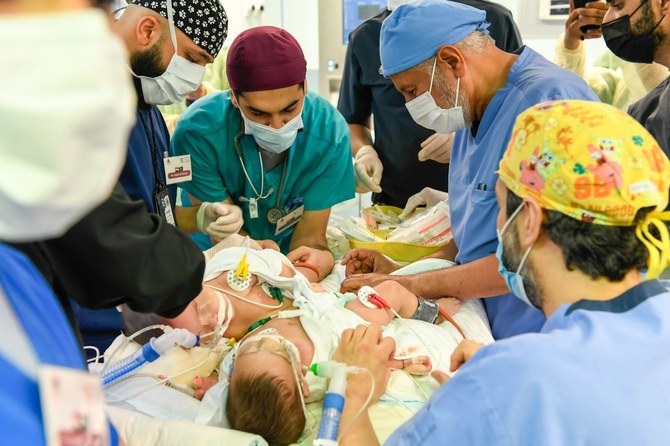
Yemeni twins Mawaddah and Rahma have been successfully separated. (SPA)
2 / 3
Earlier examinations showed the twin girls share a liver and intestines and are suspected to be attached by a heart membrane. (SPA)
3 / 3
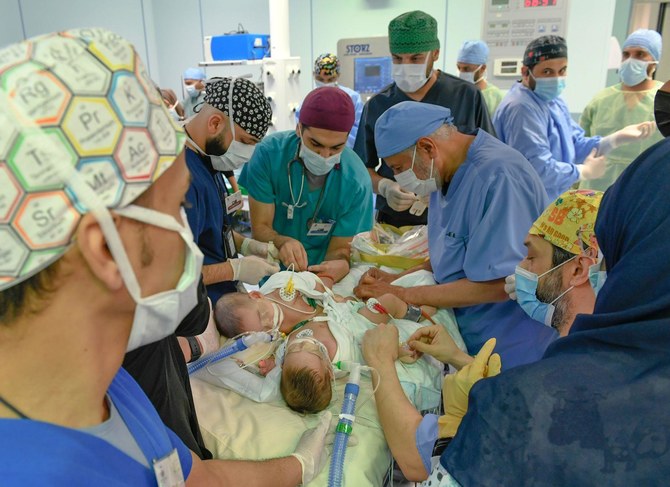
Earlier examinations showed the twin girls share a liver and intestines and are suspected to be attached by a heart membrane. (SPA)
Short Url
Updated 28 July 2022
Follow

Yemeni conjoined twins successfully separated in Riyadh

  • The twin girls were born conjoined to the lower chest and abdomen
  • Operation was expected to take 11 hours but only took five

RIYADH: A team of surgeons at a Riyadh hospital have successfully separated twin girls from Aden, Yemen who were conjoined, Saudi Press Agency reported on Thursday.

The operation, funded by Saudi Arabia’s King Salman Humanitarian Aid and Relief Center, separated Mawaddah and Rahma who were born conjoined at the lower chest and abdomen.

Earlier examinations showed the twin girls shared a liver and intestines and were suspected to be attached by a heart membrane.

The procedure, upon directives from King Salman, was carried out at King Abdullah Specialist Children’s Hospital in Riyadh and was expected to take 11 hours. However, it only took five hours. 

The team of 28 Saudi doctors, specialists, and nurses performed the delicate surgical procedures in six stages involving the separation of the liver and intestines and organ reconstruction.
KSrelief’s Saudi Conjoined Twins Programme has so far sponsored 52 separation surgeries involving over 124 twins from 23 countries.


Saudi defense chief rallies international support amid escalating Iranian strikes

Updated 12 March 2026
Follow

Saudi defense chief rallies international support amid escalating Iranian strikes

  • Iran unleashes wave of drone strikes on Kingdom’s Eastern Province
  • Missiles fired at Prince Sultan Air Base intercepted, destroyed

RIYADH: Saudi Defense Minister Prince Khalid bin Salman held separate phone calls with his Turkish, Romanian, and South Korean counterparts as Iranian attacks on Gulf facilities continued on Thursday.

Iran escalated strikes on its Gulf neighbors in retaliation for ongoing US-Israeli attacks on Iranian territory. 

After a brief pause Wednesday, drone attacks on Saudi Arabia resumed at 9 p.m., targeting the Eastern Province and the Shaybah oil field in the Empty Quarter. All the drones were stopped, the Saudi Ministry of Defense confirmed.

Missiles aimed at Prince Sultan Air Base in Al-Kharj were also intercepted and shot down, the ministry added.

In his call with Turkish Defense Minister Yasar Guler, Prince Khalid reaffirmed commitment to joint security measures and condemned Iranian aggression. 

His conversation with Romanian counterpart Radu Miruta covered regional threats to global stability. 

A call with South Korea’s Ahn Gyu-back similarly focused on condemning Iran’s actions and reviewing the broader regional picture.

The crisis traces back to February 28, when US and Israeli forces struck Iran. Tehran has since targeted Gulf states and US-Israeli assets across the region.

Iran has also declared a blockade on energy shipments through the Strait of Hormuz — a critical chokepoint for global oil and gas flows — sending commodity prices surging.