

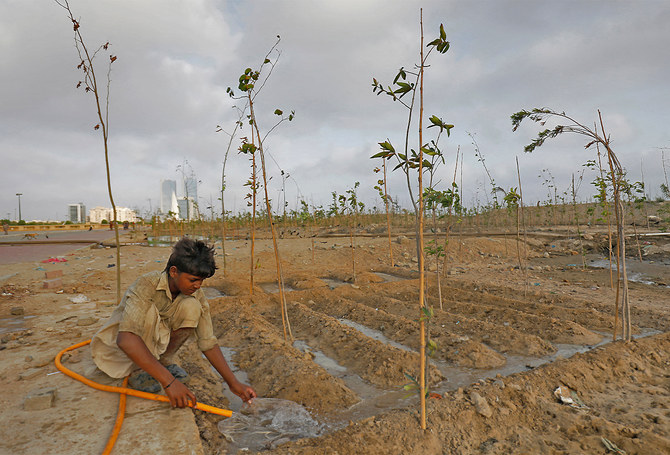

KARACHI: Mulazim Hussain is proud of the trees he has planted.
Surrounded by neem saplings and vegetables sprouting up from scrubland in the Clifton district of Pakistan’s largest city Karachi, the 61-year-old recalls a time a few years ago when the area was a giant, informal rubbish tip.
“Now there is greenery and happiness, children come in the evening to play, people come to walk,” he said, speaking near a patch of trees amid a barren expanse bordered by the sea on one side and tower blocks and offices in the distance on the other.
“I have raised these plants like my children over the last four years,” he added, taking a break from his labors amid a fierce summer heatwave.
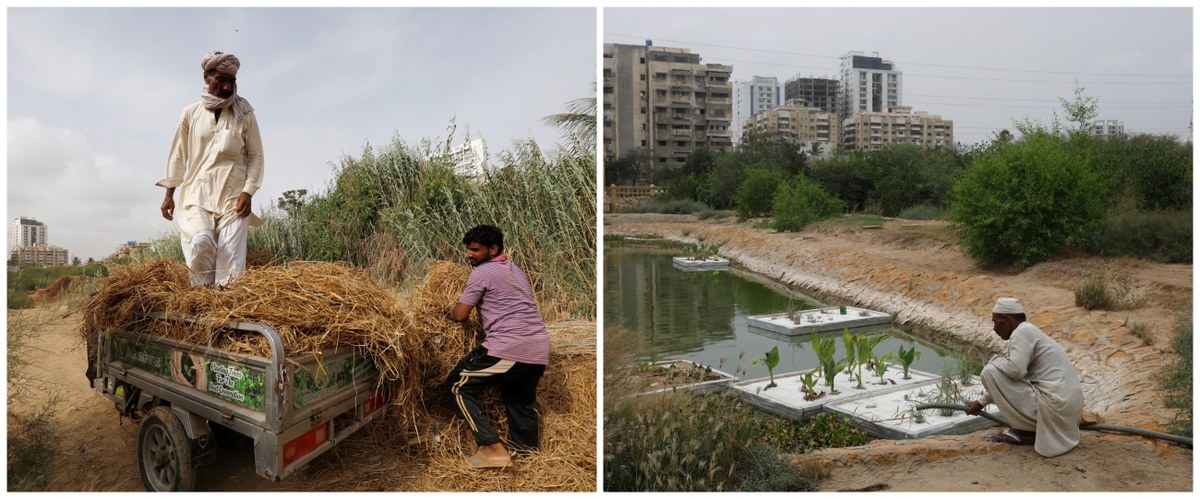
A combination picture shows Mulazim Hussain, 61, a farmer at the urban forest plantation project, collecting dry grass in his electric rickshaw (tuktuk) in Karachi, Pakistan on July 9, 2021 (left) and Mulazim Hussain watering plants near the reservoir at the Clifton Urban Forest project in Karachi, on July 2, 2022. (REUTERS)
Wearing a white and brown scarf around his head and a loose, cream-colored shirt, Hussain collected dry grass from the ground and watered his cherished trees during a recent visit by Reuters reporters to the urban forest plantation project.
At the end of the day, he turned the hose on himself to cool off and clean up before heading home on his motorcycle.
The father of two is employed by an urban afforestation project in a government-owned park in Karachi’s upmarket Clifton area that is run by Shahzad Qureshi, who has worked on similar projects in other Pakistani cities and overseas.

A combination picture shows Lakshman, 40, pushing a stick used to support a seedling, as he works at Clifton Urban Forest, previously a garbage dumping site in Karachi, Pakistan on May 26, 2021 (top) and a general view of the same plantation at the Clifton Urban Forest in Karachi, Pakistan on June 29, 2022. (REUTERS)
It is one of dozens of state-owned and private planting initiatives in Pakistan, where forest cover lags far behind average levels across South Asia. Trees absorb carbon dioxide, emissions of which contribute to warming global temperatures.
The aim in Clifton is to counterbalance rapid urbanization in Karachi, a sprawling port city of some 17 million people where breakneck expansion of roads and buildings means there is less and less space for trees and parkland.
Qureshi wanted to provide shade for residents seeking escape from rising temperatures — a heatwave in 2015 killed more than 400 people in the city in three days, and temperatures in the surrounding Sindh region reached record highs this year.
The trees can also attract local wildlife, mitigate urban flooding and provide new sources of food.
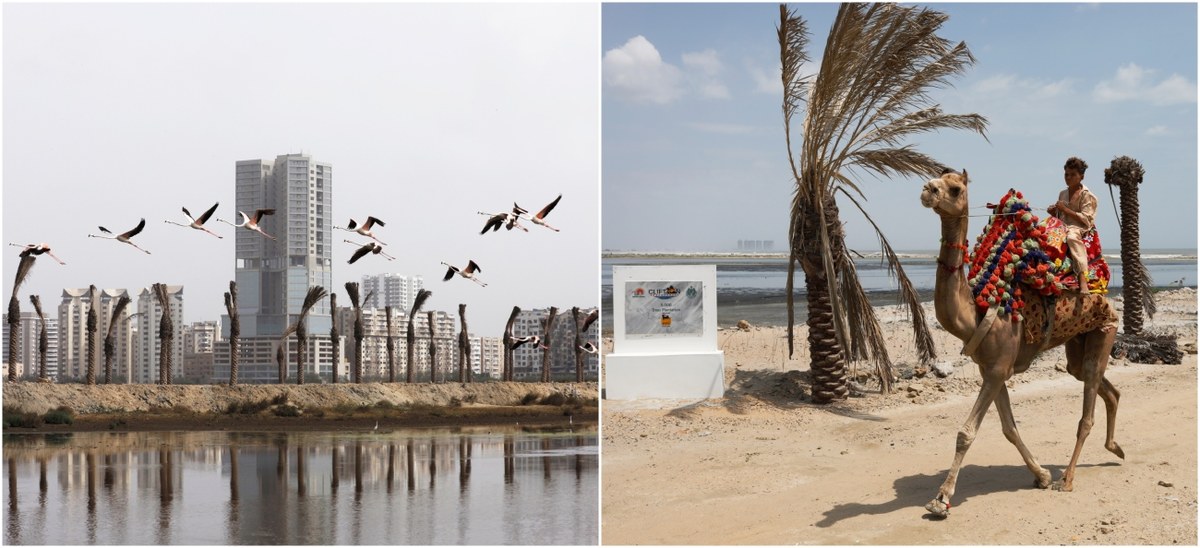
A combination picture shows pink flamingos flying past the new palm tree plantation at the Clifton Urban Forest, on June 22, 2022 (left) and a person riding on a camel as he passes through the new plantation of palm trees at the Clifton Urban Forest, on July 15, 2022. (REUTERS)
“The bigger the tree cover of the city the more the cooling, with a difference of up to 10 (degrees) Celsius when you are surrounded by trees,” he told Reuters, adding that the project only used native species.
“As you plant ... it attracts insects, and varieties of birds start coming. Presently mongoose are roaming around in the park, and four or five varieties of chameleon.
“You give them a home, you give them food and let it happen. Nature is so beautiful.”
DOES PLANTING HELP?
Overall forest cover in Pakistan, home to more than 220 million people, is around 5.4 percent, according to Syed Kamran Hussain, manager for the Khyber Pakhtunkhwa province at the World Wide Fund for Nature’s national branch.
That compares with 24 percent in neighboring India and 14.5 percent in Bangladesh, and the previous government announced a mass forestation program that envisaged planting 10 billion trees between 2019 and 2023.
“Pakistan is among the top 10 most vulnerable countries affected by global warming,” Hussain said. “After oceans, trees are the second largest sink of carbon.”

Traffic moves under a bridge displaying a banner from the monsoon tree plantation campaign in Karachi, Pakistan on July 5, 2022. (REUTERS)
Some climate change experts question the impact of afforestation projects — the planting of trees where there were none before — in urban settings.
The choice of species is important, because it affects the amount saplings may need to be watered — a major factor in Pakistan where water is generally scarce.
And whether to plant trees at all is not a simple question: the benefits are not always clear and significant investment is needed to nurture saplings into fully grown trees.

Irfan Husain, 55, a former employee at a power utility in the Middle East, rides on a bike while carrying Azadirachta Indica seedlings, which he will plant in Karachi, Pakistan on May 31, 2021. (REUTERS)
“What is missing from urban forestry is a holistic approach to the environment,” said Usman Ashraf, a doctoral researcher in development studies at the University of Helsinki. He was not commenting specifically on the Karachi project.
“It’s about visual success, the numbers, small patches here and there,” he said. “It won’t even make a dent on any of the environmental harm in these cities.”
Masood Lohar, who founded the Clifton Urban Forest that has planted trees on the beach front not far from Qureshi’s project, said afforestation could help make Karachi more resilient against natural disasters and encourage wildlife to settle.

Masood Lohar, 54, a development expert who has overseen Clifton Urban Forest, previously a garbage dumping site, shows eggs laid by moorhen in Karachi, Pakistan on July 1, 2022. (REUTERS)
Experts say it can also provide relief from heatwaves, with the sea breeze getting hotter as it passes through concrete structures while roadways and rooftops absorb heat. Where to plant is a key question, with wealthier urban areas often better off in terms of tree cover.
In the absence of more trees, “we are turning the city into hell,” Lohar said.
In the Sakhi Hassan Graveyard in the center of the city, small saplings grow among uneven tombstones crammed close together, while larger trees offer shade from the midday sun.

Children help Irfan Husain, 55, a former employee at a power utility in the Middle East, to plant Azadirachta Indica seedlings at a graveyard on the outskirts of Karachi, Pakistan on June 17, 2021. (REUTERS)
Mohammad Jahangir, 35, is a caretaker there who waters the plants for a small cash donation from relatives who seeded them. Viewed from above, the graveyard is a sea of green that stands out against a low-rise neighborhood.
“We don’t feel the heat here in the graveyard, while the city sizzles,” said Jahangir. “These trees are a blessing.”


