Resuming talks with Russia, Blinken offers ‘substantial’ deal on prisoners

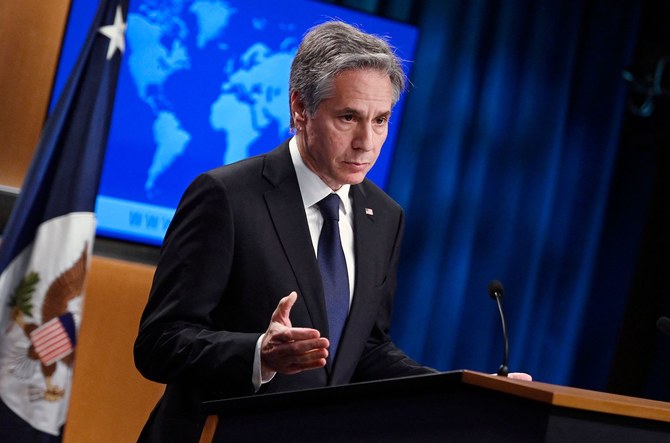
US Secretary of State Antony Blinken speaks during a press conference at the State Department in Washington, DC, on July 27, 2022. (AFP)
Short Url
Updated 01 August 2022
Follow

Resuming talks with Russia, Blinken offers ‘substantial’ deal on prisoners

  • President Joe Biden has faced growing pressure to free Griner, who faces up to 10 years in prison

WASHINGTON: The US has made “a substantial offer” to Russia to release US citizens detained there, US Secretary of State Antony Blinken said on Wednesday, adding that he would be pressing his Russian counterpart to respond in a conversation planned for the coming days.
Washington offered Moscow a deal to bring home WNBA star Brittney Griner and former US Marine Paul Whelan weeks ago, Blinken said at a State Department news conference, and hoped to advance the process when he speaks to Russian foreign minister Sergei Lavrov.
“There was a substantial proposal on the table weeks ago to facilitate their release. Our governments have communicated repeatedly and directly on that proposal. And I’ll use the conversation to follow up personally and I hope move us toward a resolution,” Blinken said.
The pair “have been wrongfully detained and must be allowed to come home,” Blinken told reporters.
Citing the sensitivity, he declined to say what the US was offering in return. CNN reported that Washington was willing to exchange Russian arms trafficker Viktor Bout, who is serving a 25 year-prison sentence in the US, as part of a deal to secure the release of the two Americans.
Asked if US President Joe Biden was involved in the process, Blinken said: “He signs off on any proposal that we make. Certainly when it comes to Americans who are being arbitrarily detained abroad, including this specific case.”
The US and Russia already engaged in one prisoner swap in the heat of the Ukraine war: In April Washington exchanged former US Marine Trevor Reed for convicted drug smuggler Konstantin Yaroshenko.
President Joe Biden has faced growing pressure to free Griner, who faces up to 10 years in prison and whose wife earlier accused the administration of doing too little.
Whelan, a security official at an auto parts company, was arrested in Moscow in December 2018 and in 2020 sentenced to 16 years in prison for espionage, which he denies.
Whelan’s family welcomed news of the US offer. “We hope the Russian government responds to the US government and accepts this or some other concession that enables Paul to come home to his family,” David Whelan, Paul’s brother, said in a statement.
The telephone conversation will be the first between Blinken and Lavrov since February 15 when the top US diplomat warned Russia against invading Ukraine.
President Vladimir Putin went ahead and attacked nine days later, leading the US and its allies to impose sweeping sanctions and to seek to isolate Russia on the world stage.
The conversation “will not be a negotiation about Ukraine,” Blinken told reporters.
“Any negotiation regarding Ukraine is for its people and people to determine,” he said.
Blinken said the US — which has been pouring billions in military aid into Ukraine — was “under no illusion” that Russia was ready to engage “meaningfully and constructively” to end the war.
“In the meantime, we’ll continue to do all that we can to strengthen Ukraine’s position on the battlefield,” he said.
Blinken said he would urge Russia to fulfill a breakthrough agreement reached last week in Turkey to allow the release of Ukrainian grain after a blockade has sent global food prices soaring.
“Hundreds of millions of people are waiting for these ships to set forth from Ukraine’s ports,” Blinken said.
He also said he would warn of further consequences if Russia annexes more Ukrainian territory. Moscow in 2014 seized Crimea and declared the peninsula to be part of Russia, a decision not recognized by most of the world.
The White House recently said that Russia was laying the groundwork for “sham referenda” in areas it seized, possibly as early as September.
Blinken pointedly declined to meet Lavrov when they both attended Group of 20 talks earlier this month in Bali, with the US rallying its allies in criticizing Russia in the closed-door sessions.
Griner, a two-time Olympic basketball gold medalist and Women’s NBA champion who had played in Russia, was detained just days before Moscow launched its offensive.
She has pleaded guilty to drug charges over possessing vape cartridges with cannabis oil and said that she had brought in banned drugs unintentionally.
Speaking at her trial in Khimki, just outside Moscow, Griner said she still did not know how the cartridges ended up in her bag and had no intention to use them.
“I did not think of or plan to bring banned substances into Russia,” said Griner, wearing a Phoenix Mercury T-shirt and black basketball trousers.
“I did not intend to break Russian law,” she added, saying that she was in a rush packing and tired after a recovery from Covid.
“I wouldn’t do anything that would hurt my team.”
(With AFP and Reuters)


Court ruling jeopardizes freedom for pro-Palestinian activist Mahmoud Khalil

Updated 10 sec ago
Follow

Court ruling jeopardizes freedom for pro-Palestinian activist Mahmoud Khalil

  • The panel ruled a federal judge in New Jersey didn’t have jurisdiction to decide the matter at this time
  • The law bars Khalil “from attacking his detention and removal in a habeas petition,” the panel added

WASHINGTON: A federal appeals panel on Thursday reversed a lower court decision that released former Columbia University graduate student Mahmoud Khalil from an immigration jail, bringing the government one step closer to detaining and ultimately deporting the Palestinian activist.
The three-judge panel of the 3rd US Circuit Court of Appeals didn’t decide the key issue in Khalil’s case: whether the Trump administration’s effort to throw Khalil out of the US over his campus activism and criticism of Israel is unconstitutional.
But in its 2-1 decision, the panel ruled a federal judge in New Jersey didn’t have jurisdiction to decide the matter at this time. Federal law requires the case to fully move through the immigration courts first, before Khalil can challenge the decision, they wrote.
“That scheme ensures that petitioners get just one bite at the apple — not zero or two,” the panel wrote. “But it also means that some petitioners, like Khalil, will have to wait to seek relief for allegedly unlawful government conduct.”
The law bars Khalil “from attacking his detention and removal in a habeas petition,” the panel added.
Ruling won’t result in immediate detention
It was not clear whether the government would seek to detain Khalil, a legal permanent resident, again while his legal challenges continue.
Thursday’s decision marked a major win for the Trump administration’s sweeping campaign to detain and deport noncitizens who joined protests against Israel.
In a statement distributed by the American Civil Liberties Union, Khalil said the appeals ruling was “deeply disappointing, but it does not break our resolve.”
He added: “The door may have been opened for potential re-detainment down the line, but it has not closed our commitment to Palestine and to justice and accountability. I will continue to fight, through every legal avenue and with every ounce of determination, until my rights, and the rights of others like me, are fully protected.”
Baher Azmy, one of Khalil’s lawyers, said the ruling was “contrary to rulings of other federal courts.” He noted the panel’s finding concerned a “hypertechnical jurisdictional matter,” rather than the legality of the Trump administration’s policy.
“Our legal options are by no means concluded, and we will fight with every available avenue,” he added, saying Khalil would remain free pending the full resolution of all appeals, which could take months or longer.
The ACLU said the Trump administration cannot lawfully re-detain Khalil until the order takes formal effect, which won’t happen while he can still immediately appeal.
Khalil has multiple options to appeal
Khalil’s lawyers can request the active judges on the 3rd Circuit hear an appeal, or they can go to the US Supreme Court.
An outspoken leader of the pro-Palestinian movement at Columbia, Khalil was arrested on March 8, 2025. He then spent three months detained in a Louisiana immigration jail, missing the birth of his firstborn.
Federal officials have accused Khalil of leading activities “aligned to Hamas,” though they have not presented evidence to support the claim and have not accused him of criminal conduct. They have also accused Khalil, 30, of failing to disclose information on his green card application.
The government has justified the arrest under a seldom-used statute that allows for the expulsion of noncitizens whose beliefs are deemed to pose a threat to US foreign policy interests.
In June, a federal judge in New Jersey ruled that justification would likely be declared unconstitutional and ordered Khalil released.
President Donald Trump’s administration appealed that ruling, arguing the deportation decision should fall to an immigration judge, rather than a federal court.
Khalil has dismissed the allegations as “baseless and ridiculous,” framing his arrest and detention as a “direct consequence of exercising my right to free speech as I advocated for a free Palestine and an end to the genocide in Gaza.”
Dissenting judge says Khalil has right to fight detention

Judge Arianna Freeman dissented Thursday, writing that her colleagues were holding Khalil to the wrong legal standard. Khalil, she wrote, is raising “now-or-never claims” that can be handled at the district court level. He does not have a final order of removal, which would permit a challenge in an appellate court, she wrote.
Both judges who ruled against Khalil, Thomas Hardiman and Stephanos Bibas, were Republican appointees. President George W. Bush appointed Hardiman to the 3rd Circuit, while Trump appointed Bibas. President Joe Biden, a Democrat, appointed Freeman.
The majority opinion noted Freeman worried the ruling would leave Khalil with no remedy for unconstitutional immigration detention, even if he later can appeal.
“But our legal system routinely forces petitioners — even those with meritorious claims — to wait to raise their arguments, the judges wrote. “To be sure, the immigration judge’s order of removal is not yet final; the Board has not affirmed her ruling and has held the parties’ briefing deadlines in abeyance pending this opinion. But if the Board ultimately affirms, Khalil can get meaningful review.”
The decision comes as an appeals board in the immigration court system weighs a previous order that found Khalil could be deported. His attorneys have argued that the federal order should take precedence.
That judge has suggested Khalil could be deported to Algeria, where he maintains citizenship through a distant relative, or Syria, where he was born in a refugee camp to a Palestinian family.
His attorneys have said he faces mortal danger if forced to return to either country.