

How Singaporean teen’s NFT design gave Zelensky symbolic weapon in fight for Ukraine

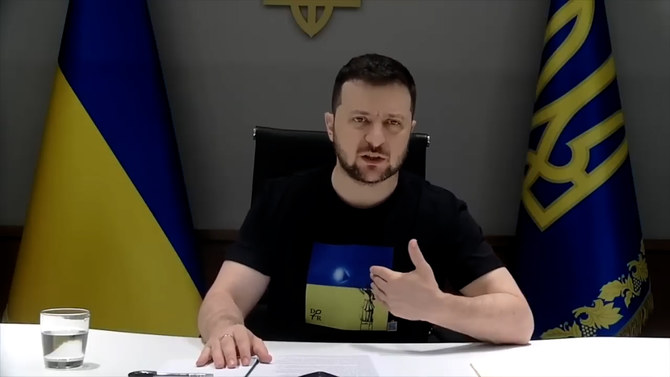
Ukraine President Volodymyr Zelensky wears a T-shirt designed by a teen Singaporean artist as he virtually addresses the Shangri-La Dialogue security forum organized in Singapore on June 11, 2022. (International Institute for Strategic Studies)
Short Url
Updated 27 July 2022
Follow

How Singaporean teen’s NFT design gave Zelensky symbolic weapon in fight for Ukraine

  • Ava Soh, a 16-year-old Singaporean artist and activist created an NFT design for her fundraiser for Ukraine
  • President Volodymyr Zelensky wore the design during an annual security forum hosted by Singapore last month

KUALA LUMPUR: When President Volodymyr Zelensky broke from his usual olive-green attire during a Shangri-La Dialogue address last month, the first thing he spoke about was his outfit: A T-shirt designed by a Singaporean teenager to support Ukraine against Russia’s invasion.

The black shirt featured a drawing of a girl standing on a ladder, spray painting the blue and yellow colors of the Ukrainian flag.

The illustration was designed by Ava Soh, a 16-year-old Singaporean artist and activist who came up with the idea in late March, weeks after Russia launched its multi-pronged attack on Ukrainian territory.

Soh created an NFT (non-fungible token) design which she initially used in her Spray Paint Ukraine fundraiser for Ukrainian women and children.

To promote it, she approached the Ukrainian embassy in Singapore and took the courage of asking Zelensky to wear it.

“She wrote me a letter asking to support her initiative,” Zelensky told the audience in his virtual address on June 11. “This request from this girl, her idea, her confidence that the president of Ukraine will really respond to her initiative and that I will be willing to help is of crucial importance. And I’m wearing this T-shirt today.”

As he pointed to the picture, he said it could be “helpful in explaining why Ukraine has garnered so much support worldwide.”

“Can you imagine, for instance, (the) president of Russia responding to such an initiative? … I think that this is impossible.”

It came as a complete surprise to Soh that Zelensky not only responded to her request but also spoke about it at the annual security forum hosted by Singapore.

“I saw him wearing the T-shirt, I was like ‘oh my God!’ I never thought it would come true,” Soh told Arab News. “He built that speech around the idea that you should support these ideas and projects, and that made me feel very touched. I was crying.”
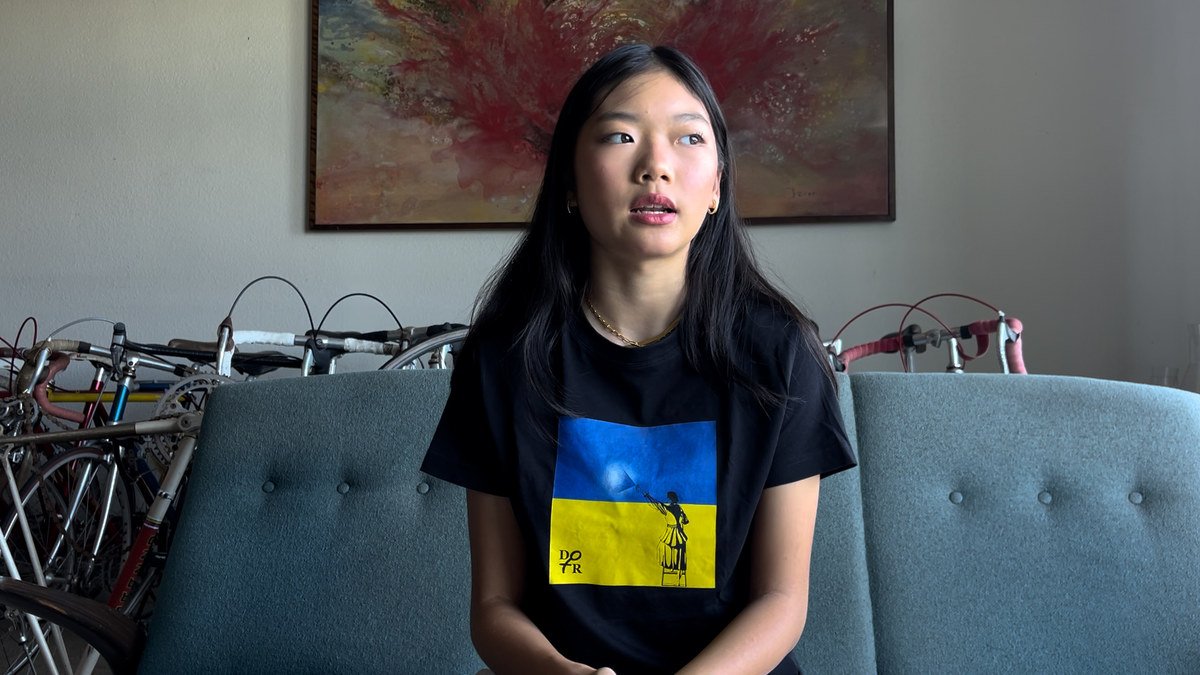


Ava Soh, a 16-year-old Singaporean artist and activist who created an NFT design for her fundraiser for Ukraine speaks to Arab News on July 19, 2022. (AN Photo)

She has been engaged in social causes since the age 13, when she launched her Daughters of The Revolution fashion brand, which “aims to empower the next generation of 21st-century heroines through self-belief.”

“Self-belief is the biggest middle finger to oppression,” Soh said. “I’ve always been interested with gender equality and social problems, my parents brought me up to believe that it is not what job do I want to get, but what problem do I want to solve.”

And one of the problems is for her the ongoing war.

“Maybe it is the child in me, children just think that war doesn’t make sense, we are just like ‘can you all just talk it out with each other? Is it really necessary to kill people?’”

The idea for her illustration was partly inspired by Banksy, one of the world’s favorite street artist-provocateurs, known for his anti-authoritarian work.

“I wanted it to be spray painting because I took some of the inspiration from Banksy, and I like the fact that so much could be said without so many words,” Soh added. “I want it to show female empowerment. It’s because I wanted to shine the spotlight on the women that are involved.”

She hopes her experience will not only help spread the message, but also be a source of support for others.

“More than anything this experience has shown me that you can dream big, you can be ambitious, and things will come true,” she said. “I hope my story can bring some inspiration to others.”


Migrant entries into Spain drop over 40 percent in 2025

Updated 6 sec ago
Follow

Migrant entries into Spain drop over 40 percent in 2025

  • EU border agency Frontex has also cited stricter preventive measures in departure countries, particularly Mauritania, as a key factor in the drop in migrant arrivals in the Canaries

MADRID: Migrant arrivals to Spain fell by over 40 percent in 2025, largely due to a sharp drop in arrivals along the perilous Atlantic route to the Canary Islands, official figures showed Friday.
Spain is one of the main entry points for people seeking a better life in Europe, and the country has faced pressure from European Union partners to curb irregular migration.
The interior ministry said 36,775 migrants entered Spain irregularly last year, the vast majority by sea, declining by 42.6 percent from 64,019 in 2024.
Arrivals to the Canary Islands dropped 62 percent to 17,788 in 2025, while arrivals in the Balearic Islands in the Mediterranean — mainly from Algeria — rose 24.5 percent to 7,321.
Despite the overall decline, migrant deaths remained high.
Spanish NGO Caminando Fronteras said Monday that over 3,000 people died while trying to reach Spain in 2025, including 437 minors.
The group compiles its figures from families of migrants and official statistics of those rescued.
The drop in arrivals to the Canaries follows improved relations between Spain and Morocco, where many of the boats headed for the archipelago originate, since Madrid in 2022 backed Rabat’s autonomy plan for the disputed Western Sahara territory.
Both countries have increased maritime surveillance, intelligence sharing and crackdowns on smuggling networks, with Morocco intensifying coastal patrols.
Spanish Interior Minister Fernando Grande-Marlaska has called for “prevention at the source” to reduce irregular migration.
He has credited Spain’s cooperation with Mauritania and other African countries for the decline in arrivals to the Canaries.
“We can only reduce irregular migration by establishing comprehensive alliances based on trust and mutual benefit,” he said at a November meeting in Malta with EU interior and migration officials.
EU border agency Frontex has also cited stricter preventive measures in departure countries, particularly Mauritania, as a key factor in the drop in migrant arrivals in the Canaries.
In 2024, Mauritania signed a pact with the EU aimed at curbing dangerous maritime crossings in exchange for 210 million euros ($246 million) in funding.
Human rights groups, however, argue that such agreements can encourage abuse.
Human Rights Watch accused Mauritanian authorities in an August report of systematic abuses of migrants, including rape, torture and extortion at the hands of border personnel.
It said the violations worsened after Mauritania signed the migration pact with the EU.
Mauritania has rejected the accusations.