



ISLAMABAD: The lives of Afghan women and girls are being destroyed by a “suffocating” crackdown by the Taliban since they took power nearly a year ago, Amnesty International said in a report released Wednesday.
After they captured the capital, Kabul, in August 2021 and ousted the internationally backed government, the Taliban presented themselves as having moderated since their first time in power, in the 1990s. Initially, Taliban officials spoke of allowing women to continue to work and girls to continue their education.
Instead, they have banned girls from attending school from seventh grade, imposed all-covering dress that leaves only the eyes visible and restricted women’s access to work.
Amnesty said the Taliban have also decimated protections for those suffering domestic violence, detained women and girls for minor violations and contributed to a surge in child marriages. The report also documented torture and abuse of women arrested by the Taliban for protesting against restrictions.
“Taken together, these policies form a system of repression that discriminates against women and girls in almost every aspect of their lives,” the report said. “This suffocating crackdown against Afghanistan’s female population is increasing day by day.”
The group’s researchers visited Afghanistan in March as part of a nine-month-long investigation conducted from September 2021 to June 2022. They interviewed 90 women and 11 girls, between 14 and 74 years-old, across Afghanistan.
Among them were women who were detained for protests and described torture at the hands of their Taliban guards, including beatings and threats to kill them or their families.
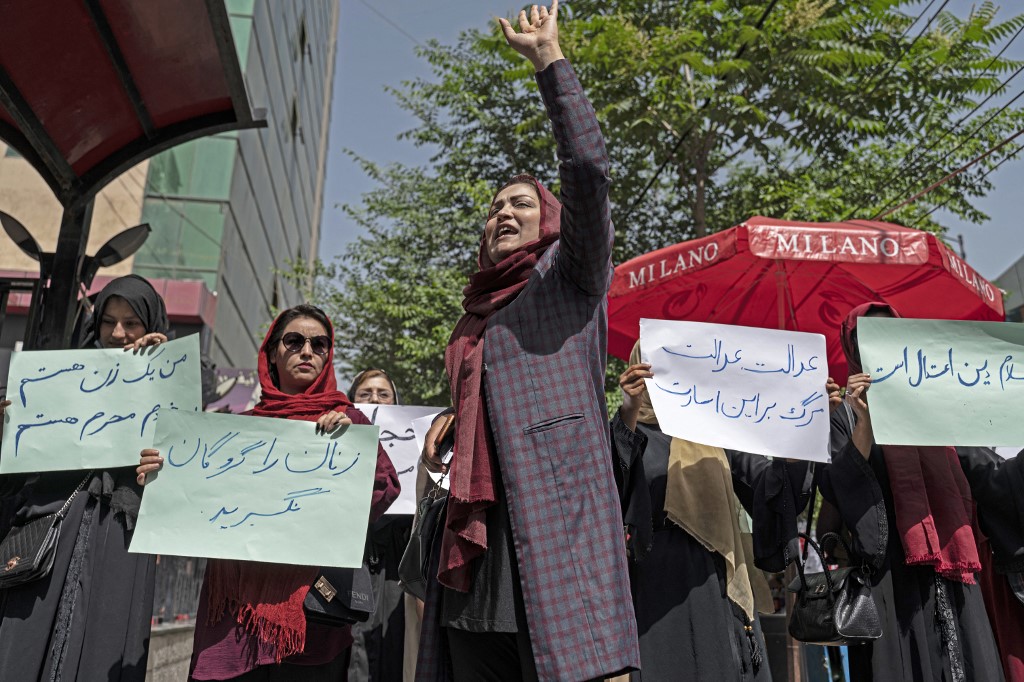
Among them were women who were detained for protests and described torture at the hands of their Taliban guards. (File/AFP)
One university student who was detained said she was electrically shocked on her shoulder, face, neck and elsewhere, while the Taliban shouted insults at her. One held a gun at her and told her, “I will kill you, and no one will be able to find your body.”
Another woman told Amnesty that the guards beat her and other women on the breasts and between the legs, “so that we couldn’t show the world.” She said one told her, “I can kill you right now, and no one would say anything.”
The report said rates of child, early and forced marriage in Afghanistan are surging under Taliban rule.
The increase is fueled by Afghanistan’s economic and humanitarian crisis and the lack of educational and job prospects for women and girls, it said. The report said it also documented cases of forced marriages of women and girls to Taliban members — under pressure by the Taliban member or by the women’s families.
One woman from a central province of Afghanistan told Amnesty that the economic collapse compelled her to marry off her 13-year-old daughter to a 30-year-old neighbor in exchange for 60,000 Afghanis (around $670). She said she felt relieved because her daughter “won’t be hungry anymore.”
She said she was also considering the same for her 10-year-old daughter but was holding off in hopes the girl could get an education and eventually secure a job to support the family. “Of course, if they don’t open the school, I will have to marry her off,” she added.
“You have a patriarchal government, war, poverty, drought, girls out of school. With all of these factors combined … we knew child marriage was going to go through the roof,” said Stephanie Sinclair, director of Too Young to Wed, who was quoted in the report.
The Taliban seized Kabul as US and NATO forces were withdrawing from Afghanistan, ending a nearly 20-year war against the Taliban’s insurgency. The world has refused to recognize the Taliban’s rule, demanding it respect human rights and show tolerance for other groups. The US and its allies have cut off billions in development funds that kept the government afloat, as well as froze billions in Afghan national assets.
This sent the already shattered economy into freefall, increasing poverty dramatically and creating one of the world’s worst humanitarian crises. Millions, struggling to feed their families, are kept alive by a massive UN-led relief effort.
Amnesty called on the international community to take action to protect Afghan women and girls.
“Less than one year after the Taliban’s takeover of Afghanistan, their draconian policies are depriving millions of women and girls of their right to lead safe, free and fulfilling lives,” said Agnès Callamard, Amnesty secretary general.
“If the international community fails to act, it will be abandoning women and girls in Afghanistan, and undermining human rights everywhere,” she said.


